
Euler's Eyes
2026-10-14
The first proposition: the equilateral triangle
On a given finite straight line, to construct an equilateral triangle.
— Euclid, Elements, Proposition I.1
After the definitions, postulates and common notions, the Elements begin with a small and beautiful problem. You have a segment $AB$. You want to construct, with straightedge and compass only, a triangle whose three sides are equal to $AB$. It is the first of the book’s 465 propositions, and it shows in a few lines how all the others will work.
The construction
Euclid uses only the first three postulates:
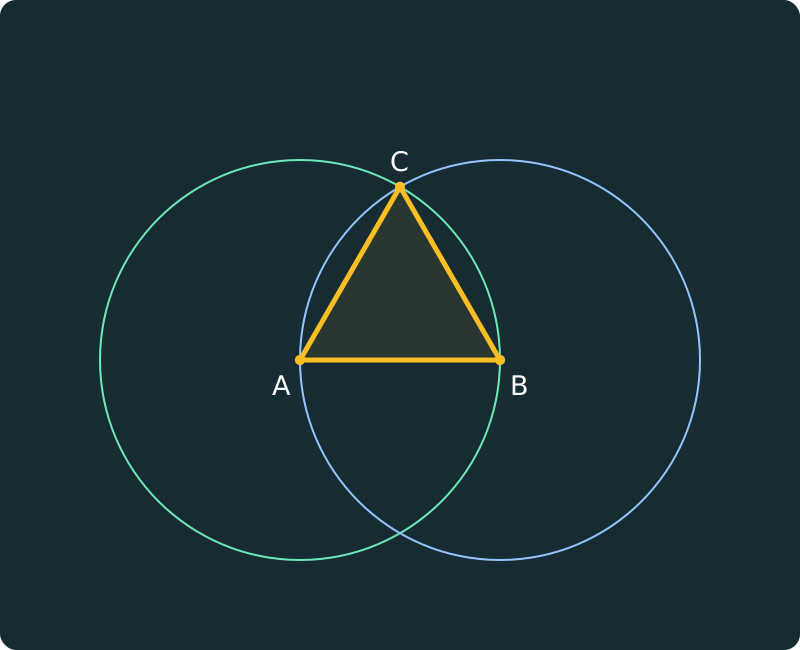
- With centre $A$ and radius $AB$, draw a circle (postulate 3).
- With centre $B$ and the same radius $BA$, draw another circle (postulate 3).
- The circles cross at a point $C$.
- Draw the lines $CA$ and $CB$ (postulate 1).
Triangle $ABC$ is the triangle sought.
The proof
Constructing is not enough: one must prove that the triangle is equilateral. The proof has three steps, and each cites its justification:
- $C$ lies on the circle with centre $A$, so $AC=AB$, by the definition of a circle: all radii are equal.
- $C$ lies on the circle with centre $B$, so $BC=BA$, for the same reason.
- $AC$ and $BC$ are both equal to $AB$, so $AC=BC$, by common notion 1: things equal to the same thing are equal to one another.
Therefore
$$AC=AB=BC,$$and the triangle is equilateral. Euclid ends, as in every proposition, with the phrase the Latin translators rendered as quod erat faciendum, “which was to be done”. In theorems, instead of constructions, the phrase is quod erat demonstrandum, “which was to be proved”: the famous QED.
The calculation with coordinates
Today we can check the construction with algebra. Put $A=(0,0)$ and $B=(s,0)$. The two circles are
$$x^2+y^2=s^2,\qquad(x-s)^2+y^2=s^2.$$Subtracting the first from the second, $-2sx+s^2=0$, that is, $x=\frac s2$. Putting this back into the first,
$$y^2=s^2-\frac{s^2}4=\frac{3s^2}4\quad\Longrightarrow\quad y=\pm\frac{\sqrt3}2s.$$The circles cross at two points, $C=\left(\frac s2,\pm\frac{\sqrt3}2s\right)$, one on each side of $AB$. Either will do. The height of the triangle is $\frac{\sqrt3}2s$ and its area is
$$\boxed{\text{area}=\frac12\cdot s\cdot\frac{\sqrt3}2s=\frac{\sqrt3}4s^2.}$$The hole
The proof has a gap, which commentators noticed already in antiquity: why do the two circles cross? The figure shows that they do, but no postulate guarantees it. In a “plane” containing only the points with rational coordinates, for example, all of Euclid’s postulates would still hold, but the point $C$, with coordinate $\frac{\sqrt3}2s$, would not exist when $s=1$. The circles would pass through each other without touching.
To close the hole one needs an axiom of continuity, saying that a circle with points both inside and outside another circle cuts it. Hilbert and others added axioms of this kind at the end of the nineteenth century. The lesson is the one Euclid wanted to teach, only taken further than he took it himself: the figure suggests, but does not prove.
Exercise: if the side is 6 cm, what are the height and the area of the equilateral triangle?
The height is $\frac{\sqrt3}2\cdot6=3\sqrt3\approx5.20$ cm. The area is $\frac{\sqrt3}4\cdot36=9\sqrt3\approx15.6$ cm².
Exercise: what is the area of the regular hexagon with side s?
The hexagon divides into six equilateral triangles of side $s$, with a common vertex at the centre. The area is $6\cdot\frac{\sqrt3}4s^2=\frac{3\sqrt3}2s^2\approx2.6\,s^2$. That is why honeycombs are hexagonal: among the regular polygons that tile the plane without gaps, the hexagon encloses the most area for the same perimeter.
Sources: Elements, Proposition I.1, D. E. Joyce’s edition · Robin Hartshorne, Geometry: Euclid and Beyond (Springer, 2000), ch. 1.
All topics on Euclid · ← The Elements: definitions, postulates and common notions · Pythagoras’s theorem, Euclid’s way →