
Euler's Eyes
2024-06-27
Regular Polygons
In previous posts we talked about some concepts about polygons in general.
Regular polygons are closed, flat and fascinating geometric figures that have aroused the interest of mathematicians and artists throughout history. Characterized by having all sides and internal angles congruent, these figures are the embodiment of symmetry and harmony.
A flat geometric figure with sides of equal length and internal angles of equal measure. This means that a regular polygon not only looks balanced, but also follows precise mathematical rules that can be expressed through elegant and useful formulas.
For example, the perimeter of a regular polygon can be calculated by multiplying the length of one side by the total number of sides ($P = n \times l$), where $P$ represents the perimeter, $n$ represents the number of sides, and $l$ represents the length of one side. This property makes regular polygons especially interesting for the study of geometry and its practical applications.
In addition to the perimeter, another important aspect of regular polygons is the measurement of their internal angles. The sum of the interior angles of a regular polygon can be found by the formula ($S = (n - 2) ⋅ 180°$), where $n$ is the number of sides. This allows us to calculate the measure of each interior angle by dividing the total sum by the number of sides.
Uses in everyday life
Regular polygons are also known for their aesthetic properties. Since ancient times, they have been used in art and architecture to create patterns and structures that are pleasing to the eye. They are the basis of many mosaics and tile patterns found in historic sites around the world.

However, regular polygons are not just beautiful; they are extremely useful. In engineering and design, they are applied to create shapes and structures that need uniformity and precision. For example, regular hexagons are used to design screws and nuts, ensuring they fit together perfectly.

In nature, regular polygons appear in many contexts, perhaps the most famous is the honeycomb of bees, which consists of perfectly aligned regular hexagons. This pattern not only maximizes storage space, but also minimizes the amount of wax needed for construction, demonstrating the efficiency of these geometric shapes.

History
The concept of regular polygons has been studied by mathematicians throughout history, but there is no single mathematical “first” associated with them. However, I can share some relevant information about regular polygons:
Euclid: The Greek mathematician Euclid, known for his work in geometry, described properties of regular polygons in his work “The Elements”. He established rules for constructing regular polygons inscribed in a circle.

Archimedes: Another Greek mathematician, Archimedes, also studied regular polygons. He developed methods for calculating areas and perimeters of polygons inscribed and circumscribed in circles.

Leonardo Fibonacci: The famous Italian mathematician Fibonacci (also known as Leonardo of Pisa) studied numerical sequences and, indirectly, regular polygons. Its Fibonacci sequence is related to the golden ratio, which is present in many regular polygons.

In summary, several mathematicians have contributed to the study of regular polygons over time. They explored its geometric properties and applied this knowledge in various areas, such as architecture and design.
Regular polygons
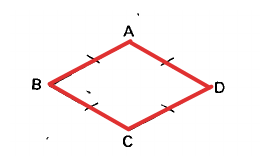
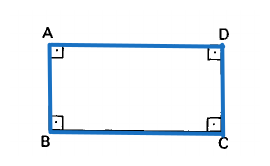
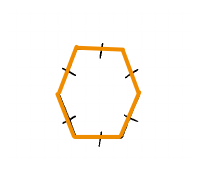
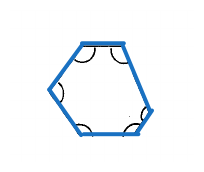
A polygon that has congruent sides is equilateral and if it has congruent angles, it is equiangular.
| equilateral quadrilateral | equiangular quadrilateral |
|---|---|
|
|
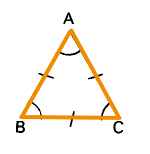
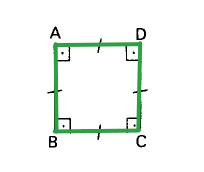
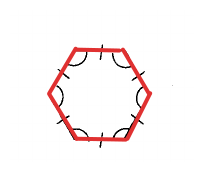
Definition: a convex polygon is regular if, and only if, it has all congruent sides (equilateral) and all congruent angles (equiangular).
| Regular triangle (equilateral) | Regular quadrilateral (square) |
|---|---|
|
|
Now how to identify a regular polygon:
| equilateral hexagon | equiangular hexagon | Regular hexagon |
|---|---|---|
|
|
|
In short, regular polygons are more than just geometric figures. They are examples of how mathematics manifests itself in both natural beauty and human creations. Its study not only enriches our knowledge of geometry, but also helps us better understand the world around us. Here a small contribution was made to regular polygons, wait for the next posts.