
Euler's Eyes
2026-11-04
EJU 2016 (1st session) – Mathematics Course 2 solved
Source: JASSO – Mathematics paper in English, in Japanese and official answer key. Files on the page for the 1st session of 2016.
Course 2 is the advanced mathematics paper of the EJU. Each letter $\boxed{\text{A}}$, $\boxed{\text{B}}$, … is a digit from 0 to 9 or the minus sign. The statements below are summarized from the official English version.
Answer key
| Question | Topic | Answers |
|---|---|---|
| I | Same as Question I of Course 1 | A=4, B=2, CD=−2, E=4, F=1, G=1, H=3, I=1, J=8; KLM=220, N=3, O=8, PQ=12, R=8, STU=200, VW=48 |
| II Q1 | A Riemann sum | AB=−6, C=3, D=2, E=4, F=6, G=3, H=9, IJ=17, K=2 |
| II Q2 | Disk and line in the complex plane | L=1, M=2, N=2, O=5, PQ=10, R=1, ST=10, U=2, V=1, W=2, X=1, Y=2 |
| III | Sum of cubes on an arc | A=2, B=3, C=6, D=6, E=0, F=2, G=6, H=1, I=2, JK=12, L=1, M=2, NO=36, P=3, Q=2, RS=12, T=0, UV=24, W=3 |
| IV | Areas under $a\cos3x$ | A=3, B=3, C=1, D=2, E=2, FG=18, H=2, I=3, J=3, K=9 |
Question I
Question I of Course 2 is identical to that of Course 1 (the vertex of a parabola on a line and the triangles in a grid of 12 points). The full solution is in the Course 1 post.
Answers: A=4, B=2, CD=−2, E=4, F=1, G=1, H=3, I=1, J=8; KLM=220, N=3, O=8, PQ=12, R=8, STU=200, VW=48.
Question II
Q1: dot products that turn into a Riemann sum
Statement. Triangle $ABC$ has $AB = 2$, $BC = 3$ and $CA = 4$.
-
With $\angle ABC = \theta$, $\vec{AB}\cdot\vec{BC} = \boxed{\text{AB}}\cos\theta$. By the law of cosines, $\vec{AB}\cdot\vec{BC} = \dfrac{\boxed{\text{C}}}{\boxed{\text{D}}}$ ①.
-
Divide $BC$ into $n$ equal parts by the points $P_1, \dots, P_{n-1}$ (starting from $B$), with $P_0 = B$ and $P_n = C$. We want $\lim_{n\to\infty}\frac1n\sum_{k=1}^n\vec{AP_{k-1}}\cdot\vec{AP_k}$. Using ①,
$$\vec{AP_{k-1}}\cdot\vec{AP_k} = \boxed{\text{E}} + \frac{\boxed{\text{F}}\,k - \boxed{\text{G}}}{2n} + \frac{\boxed{\text{H}}(k^2 - k)}{n^2},$$and the limit is $\dfrac{\boxed{\text{IJ}}}{\boxed{\text{K}}}$.
Solution.
1. The angle between $\vec{AB}$ and $\vec{BC}$ (placed at a common origin) is $\pi - \theta$, so $\vec{AB}\cdot\vec{BC} = 2\cdot3\cos(\pi - \theta) = -6\cos\theta$. By the law of cosines, $\cos\theta = \frac{4 + 9 - 16}{12} = -\frac14$, and the product is $\frac32$.
2. The product. $\vec{AP_k} = \vec{AB} + \frac kn\vec{BC}$. So
$$\vec{AP_{k-1}}\cdot\vec{AP_k} = |\vec{AB}|^2 + \frac{2k - 1}{n}\,\vec{AB}\cdot\vec{BC} + \frac{k(k - 1)}{n^2}|\vec{BC}|^2 = 4 + \frac{6k - 3}{2n} + \frac{9(k^2 - k)}{n^2}.$$3. The average. Summing from $k = 1$ to $n$ and dividing by $n$:
- the term $4$ gives $4$;
- $\frac1n\sum\frac{6k - 3}{2n} = \frac{3n(n + 1) - 3n}{2n^2} = \frac32$;
- $\frac1n\sum\frac{9(k^2 - k)}{n^2} = \frac{9}{n^3}\cdot\frac{(n - 1)n(n + 1)}{3} \to 3$.
The limit is $4 + \frac32 + 3 = \frac{17}{2}$. (It is the average of $|\vec{AP}|^2$ along $BC$: $\int_0^1|\vec{AB} + s\vec{BC}|^2ds = 4 + \frac32 + 3$.)
Answers: AB=−6, C=3, D=2, E=4, F=6, G=3, H=9, IJ=17, K=2.
Q2: a disk and a line in the complex plane
Statement. Consider the $z$ with $z\bar z - (1 - 2i)z - (1 + 2i)\bar z \le 15$ ①.
- In the complex plane, ① is the disk (interior and circle) with center $\boxed{\text{L}} + \boxed{\text{M}}\,i$ and radius $\boxed{\text{N}}\sqrt{\boxed{\text{O}}}$.
- Among the $z$ on the line $(1 - i)z - (1 + i)\bar z = 2i$ that satisfy ①, let $z_1$ be the one with the largest $|z|$ and $z_2$ the one with the smallest $|z|$. Then $z_1 = \sqrt{\boxed{\text{PQ}}} + \boxed{\text{R}} + \left(\sqrt{\boxed{\text{ST}}} + \boxed{\text{U}}\right)i$ and $z_2 = -\dfrac{\boxed{\text{V}}}{\boxed{\text{W}}} + \dfrac{\boxed{\text{X}}}{\boxed{\text{Y}}}i$.
Solution.
1. The disk. $|z - c|^2 = z\bar z - \bar cz - c\bar z + |c|^2$. With $\bar c = 1 - 2i$, that is, $c = 1 + 2i$, ① is $|z - (1 + 2i)|^2 \le 15 + 5 = 20$: center $1 + 2i$ and radius $2\sqrt5$.
2. The line. With $z = x + yi$: $(1 - i)z - (1 + i)\bar z = 2(y - x)i$, so the line is $y = x + 1$.
3. The segment. On the line, $(x - 1)^2 + (x - 1)^2 \le 20$, or $|x - 1| \le \sqrt{10}$. And $|z|^2 = x^2 + (x + 1)^2 = 2\left(x + \frac12\right)^2 + \frac12$.
- The maximum is at the end farther from $x = -\frac12$: $x = 1 + \sqrt{10}$, and $z_1 = (\sqrt{10} + 1) + (\sqrt{10} + 2)i$.
- The minimum is at $x = -\frac12$, which lies on the segment ($-\frac12 \ge 1 - \sqrt{10}$): $z_2 = -\frac12 + \frac12i$.
Answers: L=1, M=2, N=2, O=5, PQ=10, R=1, ST=10, U=2, V=1, W=2, X=1, Y=2.
Question III: the sum of cubes on an arc
Statement. The real numbers $x, y, t, u$ satisfy $y \ge |x|$ ①, $x + y = t$ ②, $x^2 + y^2 = 12$ ③ and $x^3 + y^3 = u$ ④. We want the possible values of $t$ and $u$.
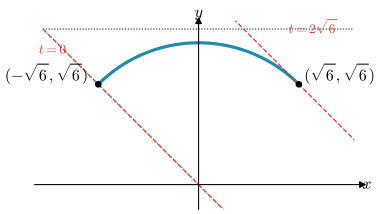
- From ① and ③, $(x, y)$ lies on a quarter circle centered at the origin with radius $\boxed{\text{A}}\sqrt{\boxed{\text{B}}}$, with endpoints $\left(\sqrt{\boxed{\text{C}}}, \sqrt{\boxed{\text{D}}}\right)$ and $\left(-\sqrt{\boxed{\text{C}}}, \sqrt{\boxed{\text{D}}}\right)$. So $\boxed{\text{E}} \le t \le \boxed{\text{F}}\sqrt{\boxed{\text{G}}}$ ⑤.
- From ② and ③, $xy = \dfrac{\boxed{\text{H}}}{\boxed{\text{I}}}\left(t^2 - \boxed{\text{JK}}\right)$, and from ④, $u = \dfrac{\boxed{\text{L}}}{\boxed{\text{M}}}\left(\boxed{\text{NO}}\,t - t^3\right)$. Since $\dfrac{du}{dt} = \dfrac{\boxed{\text{P}}}{\boxed{\text{Q}}}\left(\boxed{\text{RS}} - t^2\right)$, the values of $u$ under ⑤ are $\boxed{\text{T}} \le u \le \boxed{\text{UV}}\sqrt{\boxed{\text{W}}}$.
Solution.
1. The arc. $y \ge |x|$ is the region above the lines $y = \pm x$. The circle of radius $2\sqrt3$ enters it between the angles $\frac\pi4$ and $\frac{3\pi}{4}$, with endpoints $(\pm\sqrt6, \sqrt6)$. With $x = 2\sqrt3\cos\varphi$, $y = 2\sqrt3\sin\varphi$:
$$t = 2\sqrt3(\cos\varphi + \sin\varphi) = 2\sqrt6\sin\left(\varphi + \frac\pi4\right), \qquad \varphi + \frac\pi4 \in \left[\frac\pi2, \pi\right],$$so $0 \le t \le 2\sqrt6$.
2. $xy$ and $u$. $t^2 = 12 + 2xy$, so $xy = \frac12(t^2 - 12)$. And
$$u = (x + y)^3 - 3xy(x + y) = t^3 - \frac32(t^2 - 12)t = \frac12\left(36t - t^3\right).$$3. The range of $u$. $\frac{du}{dt} = \frac32(12 - t^2)$: $u$ increases up to $t = 2\sqrt3$ and decreases afterwards. $u(0) = 0$, $u(2\sqrt3) = \frac12(72\sqrt3 - 24\sqrt3) = 24\sqrt3$ and $u(2\sqrt6) = \frac12(72\sqrt6 - 48\sqrt6) = 12\sqrt6 > 0$. So $0 \le u \le 24\sqrt3$.
Answers: A=2, B=3, C=6, D=6, E=0, F=2, G=6, H=1, I=2, JK=12, L=1, M=2, NO=36, P=3, Q=2, RS=12, T=0, UV=24, W=3.
Question IV: the difference of two areas under a·cos 3x
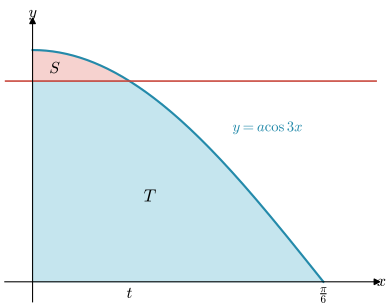
Statement. Let $a > 1$. The region $0 \le x \le \frac\pi6$, $0 \le y \le a\cos3x$ is divided by the line $y = 1$. Let $S$ be the area of the part with $y \ge 1$ and $T$ that of the part with $y \le 1$. We want the $a$ that maximizes $T - S$ and the maximum value.
Let $t$ ($0 \le t \le \frac\pi6$) satisfy $a\cos3t = 1$. Then $S = \dfrac{\sin3t}{\boxed{\text{A}}\cos3t} - t$ and $S + T = \dfrac{1}{\boxed{\text{B}}\cos3t}$. With $f(t) = T - S$,
$$f'(t) = \frac{\left(\boxed{\text{C}} - \boxed{\text{D}}\sin3t\right)\sin3t}{\cos^{\boxed{\text{E}}}3t}.$$$T - S$ is largest at $t = \dfrac{\pi}{\boxed{\text{FG}}}$, that is, at $a = \dfrac{\boxed{\text{H}}\sqrt{\boxed{\text{I}}}}{\boxed{\text{J}}}$, and the maximum is $\dfrac{\pi}{\boxed{\text{K}}}$.
Solution.
1. The areas. With $a = \frac{1}{\cos3t}$:
$$S = \int_0^t(a\cos3x - 1)\,dx = \frac{a\sin3t}{3} - t = \frac{\sin3t}{3\cos3t} - t, \qquad S + T = \int_0^{\pi/6}a\cos3x\,dx = \frac a3 = \frac{1}{3\cos3t}.$$2. The difference. $f = (S + T) - 2S = \frac{1 - 2\sin3t}{3\cos3t} + 2t$. With $s = \sin3t$ and $c = \cos3t$, the derivative of the quotient is $\frac{s - 2}{c^2}$, and
$$f'(t) = \frac{s - 2}{c^2} + 2 = \frac{s - 2 + 2(1 - s^2)}{c^2} = \frac{(1 - 2s)s}{c^2}.$$3. The maximum. For $0 < 3t < \frac\pi2$, $s > 0$, and $f' > 0$ exactly when $s < \frac12$, that is, $3t < \frac\pi6$. So the maximum is at $t = \frac{\pi}{18}$, with $a = \frac{1}{\cos(\pi/6)} = \frac{2\sqrt3}{3}$ and
$$f\left(\frac{\pi}{18}\right) = \frac{1 - 2\cdot\frac12}{3\cos\frac\pi6} + \frac{2\pi}{18} = \frac\pi9.$$Answers: A=3, B=3, C=1, D=2, E=2, FG=18, H=2, I=3, J=3, K=9.