
Euler's Eyes
2026-10-25
The life of Gabriel Cramer
Timeline
- 1704Born on 31 July in Geneva, son of the physician Jean-Isaac Cramer.
- 1722Doctorate at eighteen, with a thesis on the theory of sound.
- 1724Shares the new chair of mathematics at the Academy of Geneva with Jean-Louis Calandrini.
- 1727Sets out on a two-year journey: Basel, London, Leiden and Paris.
- 1728From London, writes to Nicolaus Bernoulli about the St Petersburg paradox.
- 1730His essay on the orbits of the planets takes second place in the Paris Academy prize.
- 1734Becomes sole holder of the chair of mathematics. Joins the Council of Two Hundred.
- 1742Publishes the complete works of Johann Bernoulli, in four volumes.
- 1744Publishes the works of Jakob Bernoulli, in two volumes.
- 1750Publishes the Introduction to the analysis of algebraic curves. Takes the chair of philosophy.
- 1752Dies on 4 January at Bagnols-sur-Cèze, on his way to the south of France, aged 47.
- He is born on 31 July 1704, the son of a physician. A doctor at eighteen, at twenty he shares the Academy’s chair of mathematics with Calandrini.
- He spends five months working with Johann Bernoulli and meets the young Euler, about to leave for St Petersburg.
- He meets Halley, de Moivre and Stirling. In May 1728 he writes Nicolaus Bernoulli the letter on the St Petersburg paradox.
- He visits the physicist Willem ’s Gravesande, one of Newton’s great popularisers on the Continent.
- He spends time with Fontenelle, Maupertuis, Buffon and the young Clairaut. He returns to Paris in 1747 and meets d’Alembert.
- He teaches in French, edits the works of the Bernoullis and writes the Introduction to the analysis of algebraic curves, published in 1750.
- On his way to the south of France, where his doctor had sent him to rest, he dies on 4 January 1752, aged 47.
- 1704–1727 · Geneva
- 1727 · Basel
- 1727–1728 · London
- 1728 · Leiden
- 1728–1729 · Paris
- 1729–1751 · Academy of Geneva
- 1752 · Bagnols-sur-Cèze
A Genevan family
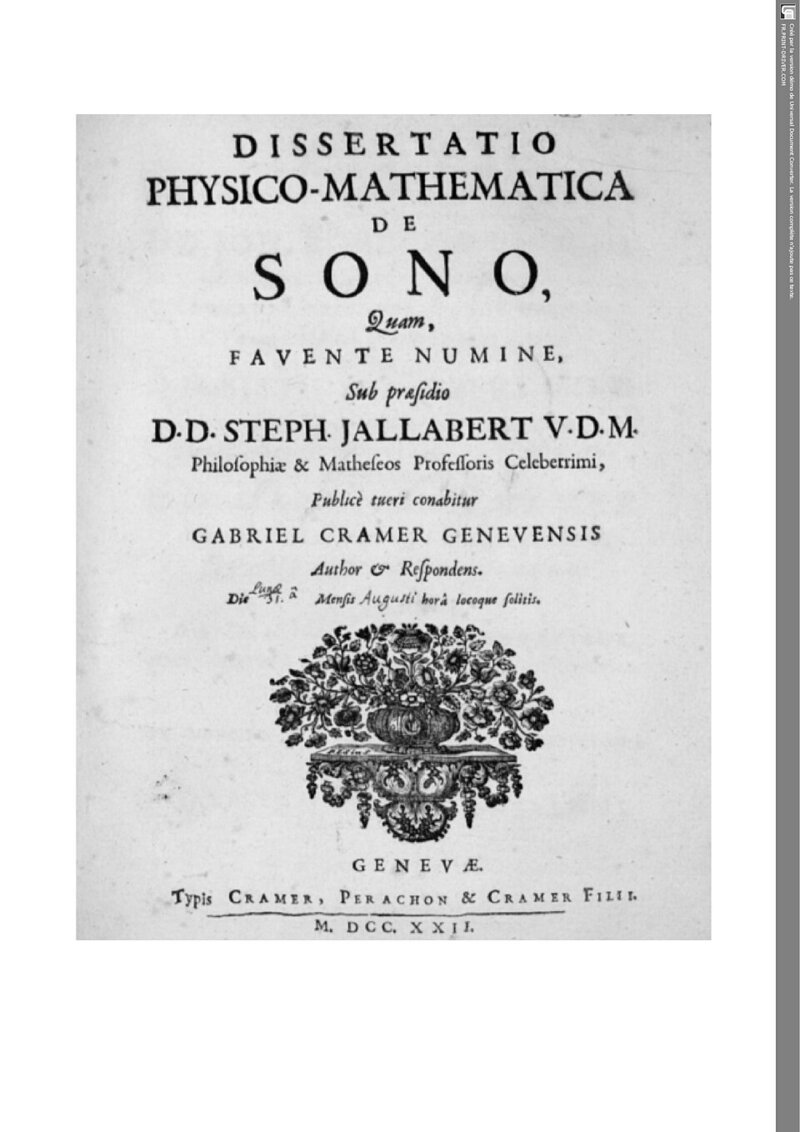
Gabriel Cramer was born on 31 July 1704 in Geneva, which was then an independent republic, Protestant and walled, allied with the Swiss cantons but not part of them. His father, Jean-Isaac Cramer, was a physician; his mother was Anne Mallet. Of the three sons, two followed respectable and predictable careers: Jean-Antoine became a physician like his father, and Jean a professor of law. Gabriel went into mathematics.
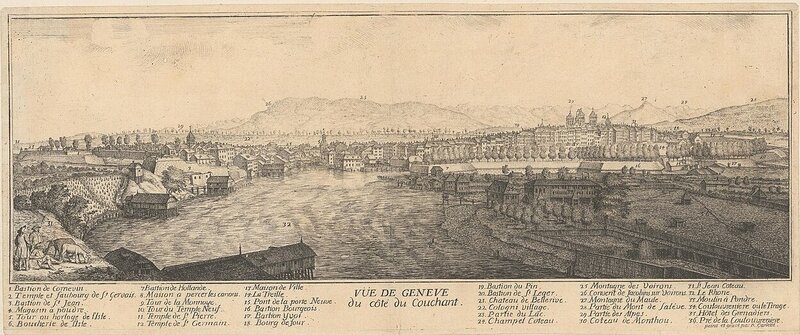
He was precocious. In 1722, at eighteen, he defended at the Academy of Geneva a doctoral thesis in Latin on the theory of sound, the Dissertatio physico-mathematica de sono, presided over by Professor Étienne Jallabert. The title page says it was printed “at the press of Cramer, Perachon and Cramer’s sons”: there were booksellers in the family, and the name Cramer would appear on many Genevan title pages of the 18th century.
Castor and Pollux
In 1724 the chair of philosophy fell vacant at the Academy of Geneva, the school of higher learning founded by Calvin in 1559. Three candidates came forward: the eldest, Amédée de la Rive, and two young men, Jean-Louis Calandrini, aged 21, and Cramer, a year younger. The city magistrates, impressed by the two young men, made an unusual decision. They gave the chair of philosophy to de la Rive and created a new chair of mathematics, which they handed to both of them at once.
Cramer and Calandrini would split the teaching and the salary. Cramer would teach geometry and mechanics; Calandrini, algebra and astronomy. There was one condition: each would spend two or three years travelling around Europe to complete his education, while the other took on all the teaching alone and received the whole salary. Their friends nicknamed them Castor and Pollux, the inseparable twins of mythology.
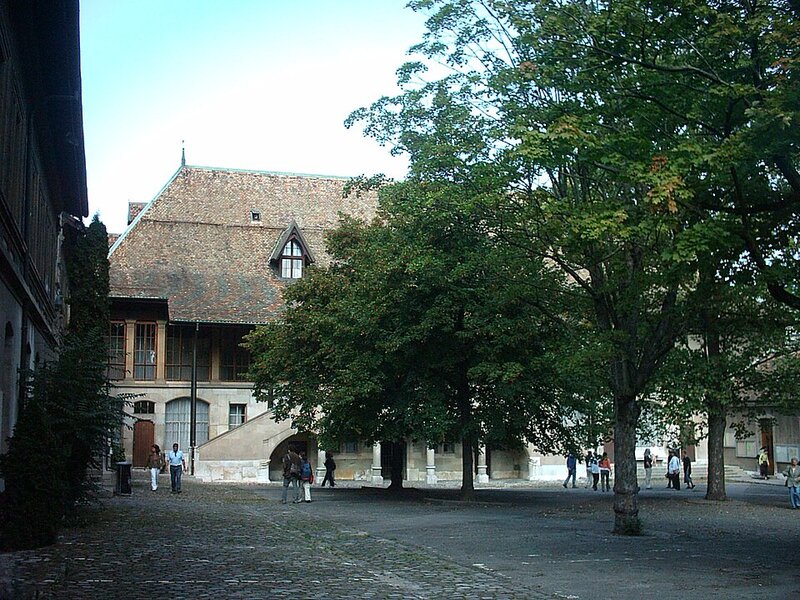
Cramer made a proposal that seems obvious today and was a small revolution at the time: to lecture in French rather than in Latin, the language of every university. He wanted, he said, “persons who had a taste for these sciences but no Latin” to be able to profit. The Academy agreed.
The journey
Cramer’s turn to travel came in 1727. He went first to Basel, where he spent five months working with Johann Bernoulli, then the greatest living mathematician on the Continent. There he also met a young pupil of Bernoulli’s, Leonhard Euler, who was about to leave for St Petersburg. Cramer and Euler would correspond for the rest of their lives.
From Basel he went to England, where he met Edmond Halley, Abraham de Moivre and James Stirling, and from there to Leiden, where he visited the physicist Willem ’s Gravesande. He ended in Paris, among Fontenelle, Maupertuis, Buffon and the young Clairaut. He returned to Geneva in 1729. It was from London, in May 1728, that he wrote the letter to Nicolaus Bernoulli about the St Petersburg paradox.
The following year he entered the prize competition of the Paris Academy of Sciences, which asked for the cause of the elliptical shape of the planets’ orbits. Cramer’s essay came second; the winner was his host from Basel, Johann Bernoulli.
The editor
In 1734 Calandrini moved to the chair of philosophy, and Cramer was left alone with the chair of mathematics. In the same year he joined the Council of Two Hundred, one of the governing bodies of the republic, and later, in 1749, the Council of Seventy. These were not honorary posts: Cramer looked after the city’s artillery and fortifications, the rebuilding of public buildings, excavations and the archives.
The work that took most of his time, though, was editing. Johann Bernoulli, by then an old man, entrusted him with the edition of his complete works and insisted that no other editor should publish them. The four volumes came out in 1742. Two years later Cramer published the works of Jakob Bernoulli, the elder brother, who had died in 1705, with unpublished texts taken from the family papers. In 1745, with Johann Castillon, he published the correspondence between Leibniz and Johann Bernoulli, one of the great sources for the history of the calculus. And he prepared a new edition of the five volumes of the Elements of all mathematics by the German Christian Wolff.
The book of curves
Cramer’s great work appeared in 1750: the Introduction à l’analyse des lignes courbes algébriques, a volume of almost seven hundred pages. Its model was Newton’s short treatise on curves of the third degree, of 1704, and the commentary Stirling had written on it. Cramer explains how to draw a curve from its equation, how to simplify the equation by changing the axes, how to count the points that determine a curve, how to study its branches near a point and at infinity, and how to classify curves. He hardly uses the infinitesimal calculus at all.
In the preface Cramer admits that, had he known earlier of Euler’s Introductio in analysin infinitorum, published in 1748, he would have made use of much of it. The two books partly cover the same subjects and were written at the same time, without either author knowing of the other.
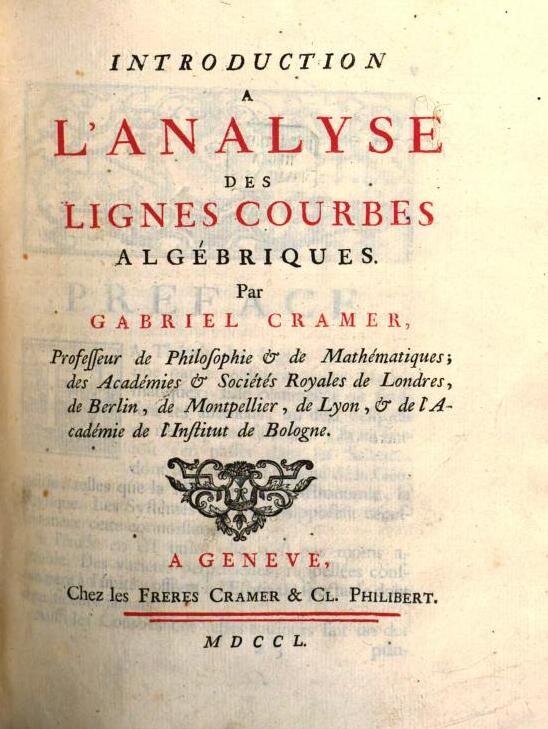
The book was printed by the Frères Cramer, Genevan booksellers of the same surname, who nine years later would print Voltaire’s Candide. In the same year, 1750, Cramer took over the chair of philosophy at the Academy.
The last journey
The years of work on the book and the editions, on top of his lectures and public offices, wore Cramer out. At the end of 1751 a fall from his carriage kept him in bed for two months. His doctor recommended a period of rest in the mild climate of the south of France. Cramer left Geneva on 21 December 1751 and died on the way, on 4 January 1752, at Bagnols-sur-Cèze, in the Rhône valley. He was 47 and had never married.
Exercise: Cramer's ages
Cramer was born on 31 July 1704. How old was he when he defended his thesis, in the summer of 1722, and when he died, on 4 January 1752?
In August 1722, after his July birthday: $1722 - 1704 = 18$ years. In January 1752, before his birthday: $1752 - 1704 - 1 = 47$ years.
Exercise: the journey to Bagnols
Geneva lies at about $46.2°$ north latitude and $6.1°$ east longitude; Bagnols-sur-Cèze at about $44.2°$ N and $4.6°$ E. A degree of latitude measures about $111$ km, and a degree of longitude, at this latitude, about $111 \cos 45° \approx 78$ km. Estimate the straight-line distance and how many kilometres a day, at the least, Cramer covered between 21 December and 4 January.
The difference in latitude is $2.0°$, or $222$ km; in longitude it is $1.5°$, or $117$ km. By Pythagoras’s theorem the distance is $\sqrt{222^2 + 117^2} \approx 251$ km. Over $14$ days that is about $18$ km a day. Along the roads of the Rhône valley, winding round the mountains, the real distance was much greater.
Sources: Phillip S. Jones, “Cramer, Gabriel”, Dictionary of Scientific Biography · Cramer biography, MacTutor · Gabriel Cramer, Introduction à l’analyse des lignes courbes algébriques (1750).