
Euler's Eyes
2022-08-18
Signal rule
See why the operation matters
The chips represent sum: positive 3 and negative 5 leave balance −2. The “like signs are positive” rule refers to multiplication and division of non-zero values, not their sum.
Em telas pequenas, deslize o gráfico na horizontal para ler os detalhes.
If a multiplication factor is zero, the result is zero. Zero divided by a non-zero number is also zero.
Compare sum and product
(−4) + (−2) = −6; (−4) × (−2) = 8. The type of operation determines the strategy.
In this post, we are going to talk about the sign rule, for this, whole numbers are fundamental. For the rule of signs, we will pay homage to Diophanti of Alexandria.
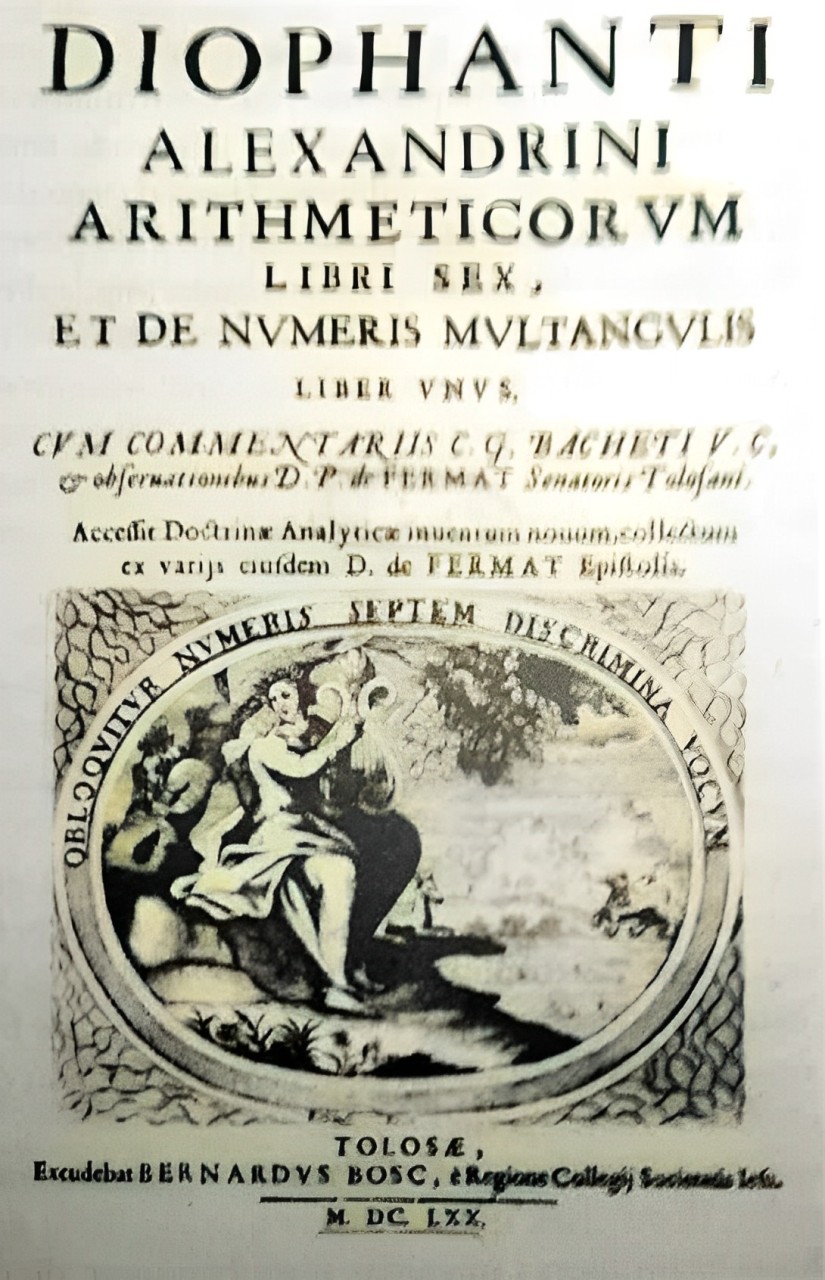
Despite little historical reference, these reports date back to around the 3rd century AD and were written by a Greek mathematician called Diophanti of Alexandria. Diophantus was one of the first mathematicians to write about the rule of signs. Other subjects written by Diophanti were:
- Arithmetic
- Polygonal Numbers
- Prisms.

The sign rule appears in the Arithmetic book, but without a formal justification of the rule. To this end, he used the rule in intermediate calculations and did not accept negative roots in solving quadratic equations.
Rule of signs
That said, we will show how the rule of signs was constructed visually by Diophanti of Alexandria to propose the rule of signs.

Ampliar figura para ler os detalhes
When we add the partial areas we obtain:
| Multiplication of Terms | $$\Rightarrow$$ | Rule of Signs |
|---|---|---|
| $$(+b) \times (+b) \quad = \quad + (bb)$$ | $$\Rightarrow$$ | $$(+)\quad \times \quad (+) \quad = \quad (+) $$ |
| $$(+b) \times (-a) \quad = \quad - (ba)$$ | $$\Rightarrow$$ | $$(+)\quad \times \quad (-) \quad = \quad (-) $$ |
| $$(-a) \times (+b) \quad = \quad - (ab)$$ | $$\Rightarrow$$ | $$(-)\quad \times \quad (+) \quad = \quad (-) $$ |
| $$(-a) \times (-a) \quad = \quad + (aa)$$ | $$\Rightarrow$$ | $$(-)\quad \times \quad (-) \quad = \quad (+) $$ |
Notable squares
As in the previous post we talked about potentiation, we can propose what at school we call notable squares. To do this, we will use the sign rule.
Notable square for a + b

Ampliar figura para ler os detalhes
Example (a+b)
To illustrate the example, let’s see if the notable product property is worth it. Let $a=2$ and $b=3$.

Notable square for a - b
From the sign rule we obtain the notable square for $(a-b)$
Example (a-b)
To illustrate the example, let’s see if the notable product property is worth it. Let $a=5$ and $b=2$.

Signal rule for potentiation
The sign rule works well for potentiation, for example:
| Exponent Type | Power | Rule of Signs | Result |
|---|---|---|---|
| Pair | $(+2)^1 ~.~ (+2)^1 = (\underbrace{+2~.~+2}_{(+)~.~(+) = (+)})^2 = (+4)^2$ | $(+)^{\text{par}} = +$ | $16 $ |
| Pair | $(-2)^1 ~.~ (+2)^1 = (\underbrace{-2~.~+2}_{(-)~.~(+) = (-)})^2 = (-4)^2$ | $(-)^{\text{par}} = +$ | $16 $ |
| Odd | $(+2)^1 ~.~ (+2)^2 = (\underbrace{+2~.~+2}_{(+)~.~(+) = (+)})^3 = (+4)^3$ | $(+)^{\text{ímpar}} = +$ | $64 $ |
| Odd | $(-2)^1 ~.~ (+2)^2 = (\underbrace{-2~.~+2}_{(-)~.~(+) = (-)})^3 = (-4)^3$ | $(-)^{\text{ímpar}} = -$ | $-64$ |
Regulate quatuor
The four rules (regulae quatuor) were proposed in 1577 by Guillaume Gosselin in his book De Arte Magma. The rule of signs was applied of + (more) and - (less), which in his work was denoted by P (Piú) and M (Meno).
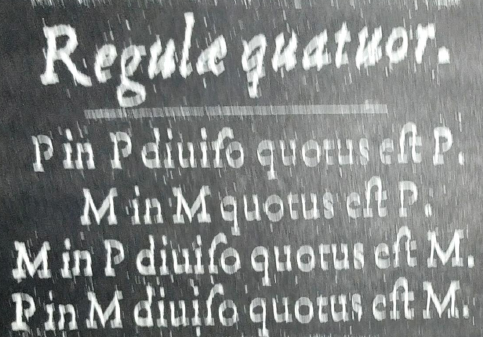
The rule of signs, unlike that presented by the Greeks, was presented for the case of division.
$$\frac{P}{P}=P$$$$\frac{M}{M}=P$$
$$\frac{M}{P}=M$$
$$\frac{P}{M}=M$$
Which we know today as:
$$\frac{(+)}{(+)}=(+)$$$$\frac{(-)}{(-)}=(+)$$
$$\frac{(-)}{(+)}=(-)$$
$$\frac{(+)}{(-)}=(-)$$
That’s it for now. Wait for the next posts.