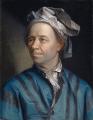
Euler's Eyes
2026-10-18
The D that factorises: the derivative as an operator
Write $D$ for “differentiate with respect to $x$”. Then $D(x^3)=3x^2$, $D(\sin x)=\cos x$, and differentiating twice is $D(D(f))$, abbreviated $D^2f$. So far it is just an abbreviation. Things get interesting when you take the shape of the notation seriously: if $D^2$ looks like a square, why not treat $D$ as a number?
A differential equation becomes a polynomial
Consider the equation
$$y''-3y'+2y=0.$$With $D$, it is written $D^2y-3Dy+2y=0$, or, taking $y$ out as a factor,
$$(D^2-3D+2)\,y=0.$$And now the bold step: factorise the “polynomial” in $D$ as if it were a polynomial in $r$:
$$(D-1)(D-2)\,y=0.$$If $(D-1)y=0$, then $y'=y$, and $y=e^{x}$. If $(D-2)y=0$, then $y'=2y$, and $y=e^{2x}$. The solutions of the equation are the combinations
$$y=C_1e^{x}+C_2e^{2x}.$$What has just happened is that a differential equation was solved with secondary-school algebra. The notation $D$ turned the question “which function satisfies this relation between its derivatives?” into the question “what are the roots of $r^2-3r+2$?”. Textbooks call this polynomial the characteristic equation, and the method works for any linear equation with constant coefficients.
Taylor in an exponential
The trick goes further. The Taylor series says that
$$\begin{aligned} f(x+h)&=f(x)+h\,f'(x)\\ &\quad+\frac{h^2}{2!}f''(x)+\frac{h^3}{3!}f'''(x)+\cdots \end{aligned}$$With $D$, this becomes
$$\begin{aligned} f(x+h)&=\Bigl(1+hD+\frac{(hD)^2}{2!}\\ &\qquad+\frac{(hD)^3}{3!}+\cdots\Bigr)f(x). \end{aligned}$$And the series in brackets is the exponential series, with $hD$ in place of the number. So
$$f(x+h)=e^{hD}f(x).$$Shifting a function by $h$ is applying to it the exponential of the derivative. A sentence like that makes no sense at all read literally, and makes perfect sense read as a rule of manipulation that gives correct results.
Boole and Heaviside
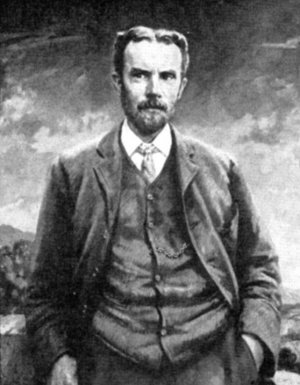
In 1844 George Boole, the same Boole of the algebra of logic, published a prize-winning paper on this “calculus of operators”. But the one who took the idea to the extreme was the Englishman Oliver Heaviside, a self-taught telegraphist. In the 1880s and 1890s he solved the equations of submarine cables by treating $D$ as a number, taking square roots of $D$ and dividing by it, without worrying about justification.
The Cambridge mathematicians complained about the lack of rigour. Heaviside replied with a line that became famous:
Shall I refuse my dinner because I do not fully understand the process of digestion?
— attributed to Oliver Heaviside
The results were right. The justification came decades later, with the Laplace transform, which turns differentiation into multiplication by a number and makes rigorous what Heaviside did by eye. It is a rare and beautiful case in which the notation arrived before the theory: the writing suggested calculations, the calculations worked, and only afterwards was it understood why.
Exercise: check the solution
Check that $y=e^{2x}$ satisfies $y''-3y'+2y=0$.
$y'=2e^{2x}$ and $y''=4e^{2x}$. Then $4e^{2x}-3\cdot2e^{2x}+2e^{2x}=(4-6+2)e^{2x}=0$. The factor $4-6+2$ is the polynomial $r^2-3r+2$ evaluated at $r=2$.
Exercise: e^{hD} applied to x²
Calculate $e^{hD}x^2$ by adding up the series.
$Dx^2=2x$, $D^2x^2=2$ and $D^3x^2=0$, so the series stops at the third term: $x^2+h\cdot2x+\frac{h^2}{2}\cdot2=x^2+2hx+h^2=(x+h)^2$. The exponential of the derivative did indeed shift the function.
Chapter index · ← Is dy/dx a fraction? · The integral read sign by sign →