Life is good for only two things: doing mathematics and teaching it.
— Siméon Denis Poisson, according to François Arago (1850)
Siméon Denis Poisson (1781–1840) was born in a small town south of Paris, was sent at fifteen to learn the trade of surgeon and proved clumsy with the lancet. He went back home, came across mathematics by chance and, at seventeen, entered the École Polytechnique in first place. Lagrange and Laplace took him on as a disciple, and he spent the rest of his life doing exactly what the sentence above says.
Poisson was the great translator of physics into equations in France in the early nineteenth century. He wrote the equation that describes gravity and electricity inside matter, and studied the stability of the Solar System, heat, elasticity and capillarity. He published more than three hundred works. And, ironically, he became most famous for two things he regarded as secondary: an objection to a theory of light, which ended up proving the opposite of what he intended, and a formula written in passing in a book about juries, the Poisson distribution, now used wherever rare events are counted.
In this series we tell Poisson’s life and work through seven of his ideas, with the calculations in plain view.
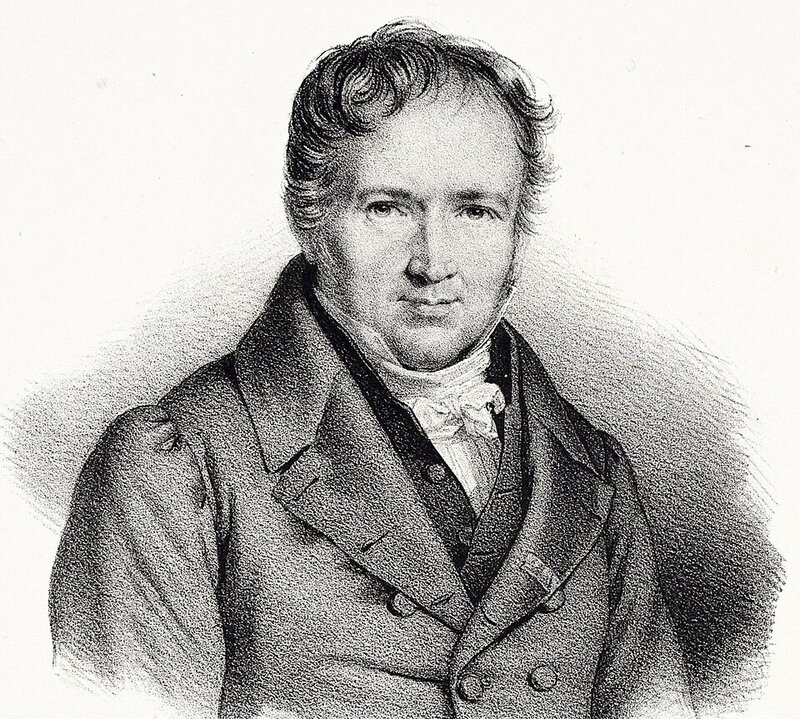
Who he was
Siméon Denis Poisson
- Nascimento
- 21 June 1781, Pithiviers, France
- Morte
- 25 April 1840, Sceaux, France
- Origem
- France
- Áreas
- Celestial mechanics, mathematical physics, elasticity, analysis, probability
Reading guide
Biography
Discoveries and proofs
- Poisson brackets
- Poisson’s equation
- Poisson’s spot
- The Poisson summation formula
- Poisson’s ratio
- Juries and the law of large numbers
- The Poisson distribution