
Euler's Eyes
2026-10-14
Euclid of Alexandria: the author without a face
Timeline
- c. 530 BCPythagoras and his followers study numbers and figures in southern Italy.
- c. 387 BCPlato founds the Academy in Athens. Over the door, according to tradition: “Let no one ignorant of geometry enter”.
- 331 BCAlexander the Great founds Alexandria, in the Nile delta.
- c. 300 BCEuclid teaches in Alexandria, in the time of King Ptolemy I, and writes the Elements.
- c. 250 BCArchimedes, in Syracuse, cites the Elements.
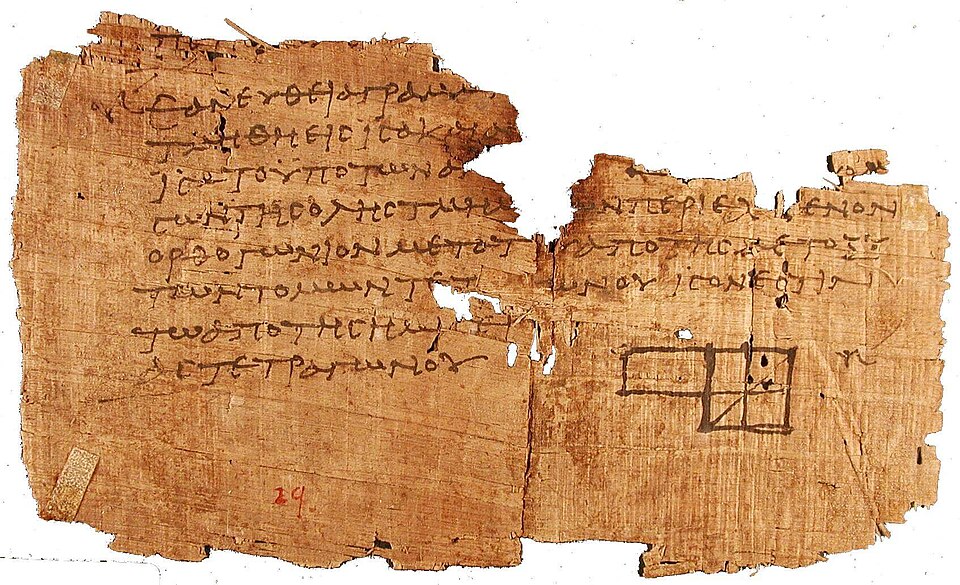
- c. AD 100A papyrus found at Oxyrhynchus, in Egypt, preserves a passage from Book II.
- c. 370Theon of Alexandria prepares the edition that will be copied over the following centuries.
- c. 450Proclus writes his commentary on Book I, with the little news we have of Euclid.
- c. 800The Elements are translated into Arabic in Baghdad.
- c. 1120Adelard of Bath translates the Arabic text into Latin.
- 1482First printed edition, in Venice, by Erhard Ratdolt.
- Plato founds the Academy. The geometry Euclid will organise grows up in the Greek schools.
- Euclid teaches in the time of Ptolemy I and writes the thirteen books of the Elements.
- Archimedes already cites the Elements in his works.
- A papyrus found in the town’s rubbish heaps preserves a passage from Book II, with a figure.
- Theon of Alexandria prepares the edition that will be copied for a thousand years.
- Proclus writes his commentary on Book I, with the little news we have about Euclid.
- In the House of Wisdom the Elements are translated into Arabic.
- Adelard of Bath translates the Arabic text into Latin, and the book returns to Europe.
- Erhard Ratdolt prints the first edition, with the figures in the margins. More than a thousand editions followed.
- c. 387 a.C. · Athens
- c. 300 a.C. · Alexandria
- c. 250 a.C. · Syracuse
- c. 100 · Oxyrhynchus
- c. 370 · Alexandria
- c. 450 · Athens
- c. 800 · Baghdad
- c. 1120 · Bath
- 1482 · Venice
A new city
In 331 BC Alexander the Great conquered Egypt and founded, in the Nile delta, a city bearing his name. When he died eight years later, his general Ptolemy took Egypt, made himself king and turned Alexandria into the cultural capital of the Greek world. The Ptolemies built the Museum, a temple of the Muses that worked as a research institute, with scholars paid by the king, and the famous Library, which came to hold hundreds of thousands of papyrus rolls.
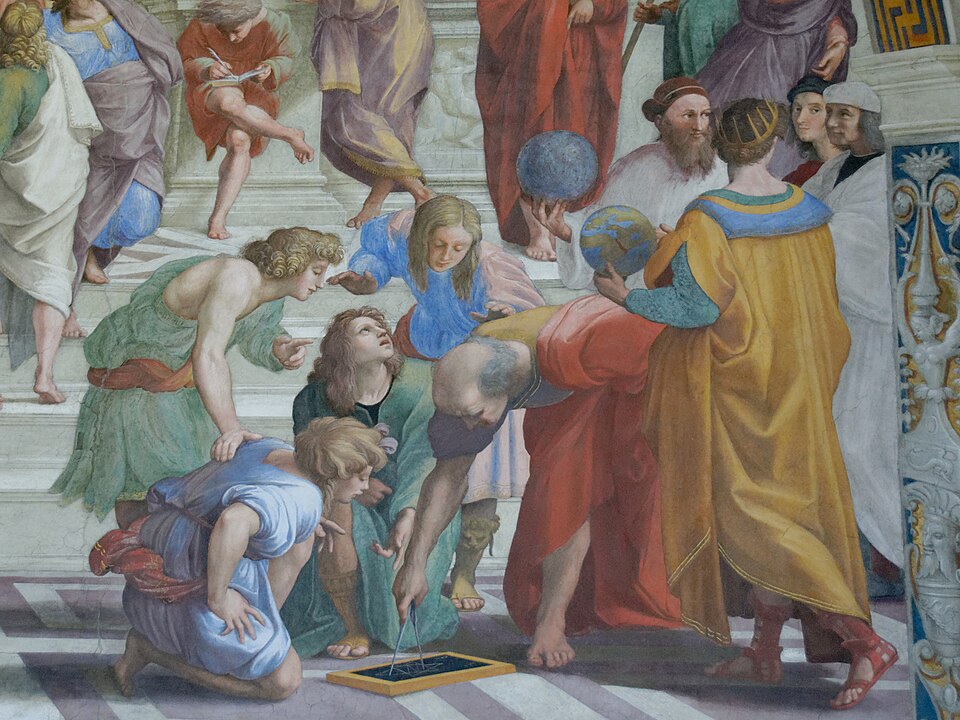
It was in this setting that Euclid taught, around 300 BC. That is almost all we know about him. There is no portrait, no date of birth or death, no record of where he was born. He says nothing about himself in his books. The little information we have comes from authors who lived centuries later, above all the philosopher Proclus, who around AD 450 wrote a commentary on the first book of the Elements. According to Proclus, Euclid was younger than Plato’s pupils and older than Archimedes, who cites him.
Two anecdotes
Two stories about Euclid have come down through the centuries. Perhaps they are true, perhaps not; but they show how the ancients imagined him.
The first is in Proclus. King Ptolemy, finding the Elements too long, asked Euclid whether there was a shorter way to learn geometry. Euclid is said to have replied: “There is no royal road to geometry.” The royal roads of Persia let the king cross his empire quickly; in mathematics there is no shortcut, not even for a king.
The second is in a fifth-century anthology by John Stobaeus. A pupil, having learned the first theorem, asked Euclid what he would gain by studying these things. Euclid called a slave and said: “Give him three coins, since he must make a profit from what he learns.”
What he wrote
The Elements have thirteen books and 465 propositions. Euclid did not discover everything in them himself. Much of it came from the Pythagoreans, from Hippocrates of Chios, from Theaetetus and from Eudoxus. What he did was to organise: choose a small number of starting points and deduce from them, in order, an enormous number of results, so that each rests only on the previous ones. The work was so successful that the older geometry books it replaced disappeared.
Euclid also wrote other books: the Data, on what can be determined from given information; the Optics, on perspective; the Phenomena, on the astronomy of the celestial sphere; and lost works on conics and on the so-called porisms.
Which Euclid?
During the Middle Ages and the Renaissance, many authors confused the mathematician with Euclid of Megara, a philosopher and pupil of Socrates who lived a century earlier. Several printed editions of the Elements had “Euclid of Megara” on the title page. The confusion was only cleared up in the sixteenth century.
How the book reached us
We have no manuscript by Euclid himself. The text we read passed through many hands. Around AD 370, Theon of Alexandria, father of the mathematician Hypatia, prepared an edition with small corrections, and almost all medieval copies descend from it. In the ninth century the Elements were translated into Arabic in Baghdad, and the mathematicians of the Islamic world studied, commented on and extended them. Around 1120 the Englishman Adelard of Bath translated the Arabic text into Latin, and the Elements returned to Europe.
In 1808 the Frenchman François Peyrard found in the Vatican library a tenth-century Greek manuscript that did not descend from Theon’s edition. It is the basis of modern editions.
Sources: Euclid, MacTutor · Proclus, A Commentary on the First Book of Euclid’s Elements, trans. Glenn R. Morrow (Princeton, 1970) · Thomas L. Heath, The Thirteen Books of Euclid’s Elements, vol. 1 (Dover, 1956), introduction.
All topics on Euclid · The Elements: definitions, postulates and common notions →