
Euler's Eyes
2026-10-14
The legacy of Euclid
He studied and nearly mastered the six books of Euclid, since he was a member of Congress.
— Abraham Lincoln, autobiographical note (1860)
After the Bible, the Elements are one of the most copied, translated and printed books in history. Since the first printed edition, in Venice in 1482, there have been more than a thousand editions. For more than two thousand years, “studying geometry” meant “studying Euclid”.
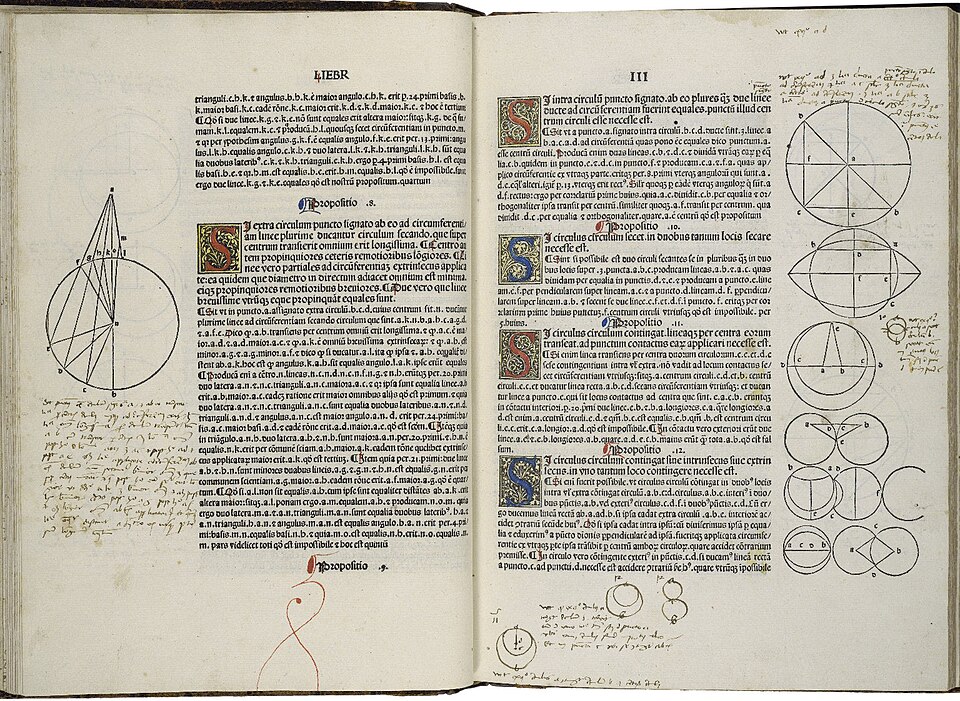
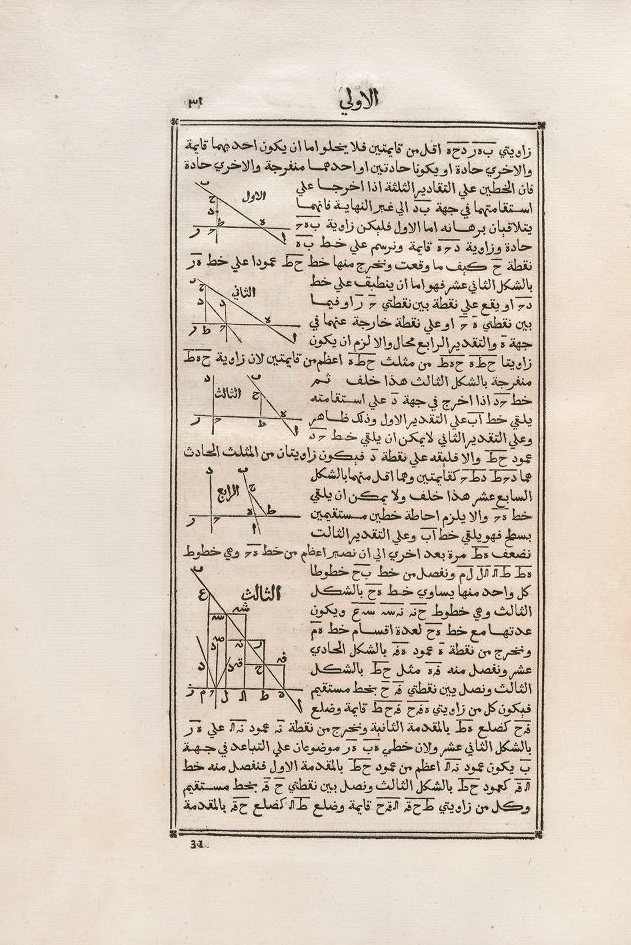
The many faces of a book
This site’s old trigonometry course gathered some editions that changed the way Euclid was presented:
| Year | Author | Edition |
|---|---|---|
| c. 1120 | Adelard of Bath | Translation from Arabic into Latin |
| 1482 | Erhard Ratdolt | First printed edition, in Venice |
| 1570 | Henry Billingsley | First English translation, with paper figures that fold up into three dimensions |
| 1607 | Matteo Ricci and Xu Guangqi | Chinese translation of the first six books, in Beijing |
| 1698 | Samuel Reyher | Euclides… mit algebraischen Zeichen, Euclid with algebraic signs |
| 1847 | Oliver Byrne | The First Six Books of the Elements of Euclid, in which letters are replaced by colours |
Byrne’s edition is one of the most beautiful ever printed. Instead of “triangle $ABC$”, he draws the triangle in yellow, red and blue, and the proofs become sequences of small coloured figures. At the time it was a commercial failure; today it is a museum piece and an inspiration for designers.
The method
More important than the theorems was the method. Isaac Newton wrote the Principia (1687) in imitation of the Elements: definitions, axioms, which he called the laws of motion, and propositions proved one by one. Spinoza wrote his Ethics (1677) “in geometrical order”, with definitions, axioms and propositions about God and the soul. The United States Declaration of Independence begins with truths held to be self-evident, like axioms, and deduces from them the right to independence.
Abraham Lincoln, a lawyer in rural Illinois, realised that he did not know what it meant to demonstrate. To find out, the story goes, he carried the Elements on his travels around the courts; he studied the first six books, as he himself records in the quotation above.
Hilbert and modern mathematics
In 1899 the German David Hilbert published the Foundations of Geometry, redoing Euclid’s work with modern rigour: twenty axioms, with no gaps and no appeal to the figure. The terms “point”, “line” and “plane” no longer had a meaning of their own; all that mattered was what the axioms said about them. This way of doing mathematics, starting from explicit axioms, became the standard in every field in the twentieth century. It is, at bottom, Euclid’s method taken to its ultimate consequences.
What remained
- Geometry. Triangles, circles, similarity, areas and volumes, Pythagoras’s theorem and the five regular polyhedra.
- Arithmetic. Euclid’s algorithm, the infinity of the primes and the construction of the even perfect numbers, $2^{p-1}(2^p-1)$.
- Algebra. The identities of Book II, which al-Khwarizmi used to solve quadratic equations.
- Logic. The idea of starting from explicit definitions and postulates and proving everything else.
- New geometries. The fifth postulate, which led to hyperbolic geometry and, through it, to the geometry of spacetime.
To remember
- Euclid lived in Alexandria around 300 BC. Almost nothing is known of his life; everything is known of his work.
- The Elements have thirteen books and 465 propositions, all deduced from definitions, five postulates and five common notions.
- With straightedge and compass, two circles of radius $AB$ construct the equilateral triangle; its area is $\frac{\sqrt3}4s^2$.
- In right triangles, $a^2=b^2+c^2$: the two rectangles under the hypotenuse have the areas of the two squares on the legs.
- $(x+5)^2=64$ solves $x^2+10x=39$: completing the square is algebra done with areas.
- $\gcd(a,b)=\gcd(b,r)$: Euclid’s algorithm divides until the remainder is zero.
- $p_1p_2\cdots p_n+1$ has a prime factor outside the list: the primes never run out.
- Without the fifth postulate there are geometries in which the angles of a triangle do not add up to $180°$.
Sources: Thomas L. Heath, The Thirteen Books of Euclid’s Elements (Dover, 1956), vol. 1 · Benno Artmann, Euclid: The Creation of Mathematics (Springer, 1999) · Euclid, MacTutor.
All topics on Euclid · ← The fifth postulate and the other geometries · Image credits →