
Euler's Eyes
2026-11-01
MEXT 2024 – Mathematics (A) solved
Source: MEXT / Study in Japan – Mathematics (A) exam and official answer key. Files on the past-exam page.
Mathematics (A) is the exam for undergraduate applicants in the humanities and social sciences. It lasts 60 minutes and has three fill-in-the-blank questions: each box $\boxed{\text{1-1}}$, $\boxed{\text{1-2}}$, … takes a number. The statements below follow the original English.
Answer key
| Question | Topic | Answers |
|---|---|---|
| 1 | Nine short items | see the table in the question |
| 2 | Minimum of $\lvert x\rvert\,(x^2 - \dots)$ | $\frac32,\ -\frac12,\ \frac13;\ 0;\ 3;\ -\frac12,\ \frac32;\ \frac{27}{4}$ |
| 3 | Quadrilateral with $\angle D = 60^\circ$ | $120;\ 5;\ \frac13,\ 21;\ 5,\ 3$ |
Question 1: nine short items
| Item | Boxes | Answer |
|---|---|---|
| (1) | 1-1 | $\frac14$ |
| (2) | 1-2, 1-3 | $1$, $0$ |
| (3) | 1-4, 1-5 | $4$, $-9$ |
| (4) | 1-6 to 1-10 | $-4$, $3$; $1$, $5$, $4$ |
| (5) | 1-11, 1-12 | $4$, $3$ |
| (6) | 1-13 | $6, 54$ |
| (7) | 1-14 to 1-16 | $3$, $-6$, $12$ |
| (8) | 1-17 | $\frac{5}{108}$ |
| (9) | 1-18 to 1-20 | $3$, $2$, $-27$ |
Item (1)
Statement. Let $0 < a < 1$. If $\sqrt{a + 1 + 2\sqrt a} - \sqrt{a + 1 - 2\sqrt a} = 1$, then $a = \boxed{\text{1-1}}$.
Solution. The radicands are perfect squares: $a + 1 \pm 2\sqrt a = (\sqrt a \pm 1)^2$. So
$$\sqrt{(\sqrt a + 1)^2} - \sqrt{(\sqrt a - 1)^2} = (\sqrt a + 1) - |\sqrt a - 1|.$$Since $0 < a < 1$, $|\sqrt a - 1| = 1 - \sqrt a$, and the expression equals $2\sqrt a$. From $2\sqrt a = 1$ we get $a = \frac14$.
Answer: $\frac14$.
Item (2)
Statement. Let $x \ge 0$ and $y \ge 0$ be integers with $2x^2 + 7xy + 3y^2 - 2 = 0$. Then $x = \boxed{\text{1-2}}$ and $y = \boxed{\text{1-3}}$.
Solution. The left-hand side factors: $2x^2 + 7xy + 3y^2 = (2x + y)(x + 3y) = 2$. Both factors are non-negative integers, so they are $1$ and $2$ in some order.
- $2x + y = 1$ and $x + 3y = 2$: gives $x = \frac15$, which does not work.
- $2x + y = 2$ and $x + 3y = 1$: gives $x = 1$, $y = 0$.
Answer: $x = 1$ and $y = 0$.
Item (3)
Statement. The line $\ell$ is tangent to the graph of $y = x^2 - 4x + 7$ and passes through the point $(4, 7)$. Then $\ell: y = \boxed{\text{1-4}}\,x + \boxed{\text{1-5}}$.
Solution. The point $(4, 7)$ lies on the parabola itself: $16 - 16 + 7 = 7$. The tangent at $x = t$ is $y = (2t - 4)(x - t) + t^2 - 4t + 7$; requiring it to pass through $(4, 7)$,
$$0 = (2t - 4)(4 - t) + t^2 - 4t = -(t - 4)^2,$$so $t = 4$ gives the only tangent. The slope is $2\cdot 4 - 4 = 4$, and $y = 4(x - 4) + 7 = 4x - 9$.
Answer: $4$ and $-9$.
Item (4)
Statement. Let $0^\circ < \theta < 90^\circ$ with $5\theta = 180^\circ$. Then $\sin 2\theta = \boxed{\text{1-6}}\sin^3\theta + \boxed{\text{1-7}}\sin\theta$ and
$$\cos 36^\circ = \frac{\boxed{\text{1-8}} + \sqrt{\boxed{\text{1-9}}}}{\boxed{\text{1-10}}}.$$Solution.
1. $\theta = 36^\circ$ and $2\theta = 180^\circ - 3\theta$, so $\sin 2\theta = \sin 3\theta = 3\sin\theta - 4\sin^3\theta$.
2. Writing $\sin 2\theta = 2\sin\theta\cos\theta$ and dividing by $\sin\theta \ne 0$:
$$2\cos\theta = 3 - 4\sin^2\theta = 4\cos^2\theta - 1 \iff 4\cos^2\theta - 2\cos\theta - 1 = 0.$$3. The positive root is
$$\cos 36^\circ = \frac{2 + \sqrt{4 + 16}}{8} = \frac{1 + \sqrt5}{4}.$$It is half the golden ratio, as in the regular pentagon.
Answer: $-4$, $3$; $1$, $5$, $4$.
Item (5)
Statement. If the natural number $x$ satisfies
$$5^8 - 1 = (5^7 + 5^6 + 5^5 + 5^4 + 5^3 + 5^2 + 5 + 1)\,x,$$then $x = \boxed{\text{1-11}}$. When the septenary (base 7) number $6532452$ is divided by $6$, the remainder is $\boxed{\text{1-12}}$.
Solution.
1. $5^8 - 1 = (5 - 1)(5^7 + 5^6 + \dots + 1)$, so $x = 4$.
2. The same fact holds in any base: $7^k - 1$ is a multiple of $7 - 1 = 6$, that is, $7^k \equiv 1 \pmod 6$. So a base-7 number leaves the same remainder as the sum of its digits:
$$6 + 5 + 3 + 2 + 4 + 5 + 2 = 27 \equiv 3 \pmod 6.$$It is “casting out nines” from base 10 turned into “casting out sixes” in base 7.
Answer: $4$ and $3$.
Item (6)
Statement. Consider the natural numbers whose least common multiple with $18$ is three times their greatest common divisor with $18$. Write these numbers in ascending order, separated by commas: $\boxed{\text{1-13}}$.
Solution. Let $g = \gcd(n, 18)$. Since $\operatorname{lcm}(n, 18)\cdot\gcd(n, 18) = 18n$, the condition $\operatorname{lcm} = 3g$ gives
$$3g^2 = 18n \iff n = \frac{g^2}{6}.$$$g$ divides $18$, so $g \in \{1, 2, 3, 6, 9, 18\}$, and $\frac{g^2}{6}$ is an integer only for $g = 6$ ($n = 6$) and $g = 18$ ($n = 54$). Check: $\gcd(6, 18) = 6$ and $\operatorname{lcm}(6, 18) = 18 = 3\cdot 6$; $\gcd(54, 18) = 18$ and $\operatorname{lcm}(54, 18) = 54 = 3\cdot 18$.
Answer: $6, 54$.
Item (7)
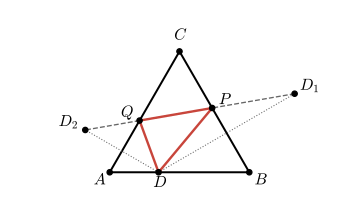
Statement. In the equilateral triangle $ABC$ with side $2$, let $D$ be a point on the side $AB$ with $AD = x$ ($0 < x < 2$). Consider the shortest path that starts at $D$, passes through a point of side $BC$ and a point of side $CA$, and returns to $D$. Writing its length as $\sqrt{ax^2 + bx + c}$, we have $a = \boxed{\text{1-14}}$, $b = \boxed{\text{1-15}}$ and $c = \boxed{\text{1-16}}$.
Solution.
1. Reflections. Let $D_1$ be the reflection of $D$ in the line $BC$ and $D_2$ its reflection in $CA$. For points $P \in BC$ and $Q \in CA$,
$$DP + PQ + QD = D_1P + PQ + QD_2 \ge D_1D_2,$$with equality when $P$ and $Q$ lie on the segment $D_1D_2$.
2. The triangle $D_1CD_2$. Reflections preserve the distance to $C$: $CD_1 = CD_2 = CD$. The angle $\angle D_1CD_2$ is twice $\angle ACB$, that is, $120^\circ$. In an isosceles triangle with a $120^\circ$ angle between sides equal to $CD$, the base is $D_1D_2 = \sqrt3\,CD$.
3. $CD$. In triangle $ACD$, with $\angle A = 60^\circ$: $CD^2 = 4 + x^2 - 2\cdot 2x\cos 60^\circ = x^2 - 2x + 4$.
4. The shortest length is $\sqrt{3(x^2 - 2x + 4)} = \sqrt{3x^2 - 6x + 12}$.
Answer: $a = 3$, $b = -6$, $c = 12$.
Item (8)
Statement. A box contains six cards with the numbers $1, 2, 3, 5, 6$ and $12$, one number on each. We draw a card, note it and return it to the box, three times. The probability that the sum of the three numbers is $15$ is $\boxed{\text{1-17}}$.
Solution. The outcomes are the $6^3 = 216$ equally likely ordered triples. Sums equal to $15$ come from three multisets:
- $\{1, 2, 12\}$: $3! = 6$ orders;
- $\{3, 6, 6\}$: $3$ orders;
- $\{5, 5, 5\}$: $1$ order.
(Without the $12$, a sum of $15$ from $\{1, 2, 3, 5, 6\}$ only arises in those two ways; with the $12$, the other two must add up to $3 = 1 + 2$.) That makes $10$ triples, and $\frac{10}{216} = \frac{5}{108}$.
Answer: $\frac{5}{108}$.
Item (9)
Statement. In the $xy$-plane, consider the line symmetric to $3x + 2y + 3 = 0$ with respect to the line $y = 3$. If $ax + by + c = 0$ is symmetric to that new line with respect to the line $x = 2$, then $a = \boxed{\text{1-18}}$, $b = \boxed{\text{1-19}}$ and $c = \boxed{\text{1-20}}$, where $a$ is a non-negative integer, $b$ and $c$ are integers, and $a, b, c$ are relatively prime.
Solution. The symmetry in $y = 3$ replaces $y$ by $6 - y$: $3x + 2(6 - y) + 3 = 0$, or $3x - 2y + 15 = 0$. The symmetry in $x = 2$ replaces $x$ by $4 - x$: $3(4 - x) - 2y + 15 = 0$, or $-3x - 2y + 27 = 0$. With $a \ge 0$: $3x + 2y - 27 = 0$.
Answer: $a = 3$, $b = 2$, $c = -27$.
Question 2: the minimum of a function with an absolute value
Statement
Let $a > 0$ and consider the function $f(x) = |x|\left(x^2 - \frac32(a + 1)x + 3a\right)$. Fractions are reduced.
-
The minimum value of $f(x)$ is
$$\begin{cases} \boxed{\text{2-1}}\,a + \boxed{\text{2-2}}, & 0 < a < \boxed{\text{2-3}}, \\ \boxed{\text{2-4}}, & \boxed{\text{2-3}} \le a \le \boxed{\text{2-5}}, \\ \boxed{\text{2-6}}\,a^3 + \boxed{\text{2-7}}\,a^2, & a > \boxed{\text{2-5}}. \end{cases}$$ -
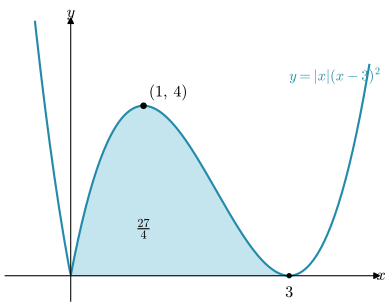
When $a = \boxed{\text{2-5}}$, the area of the region enclosed by the graph of $y = f(x)$ and the $x$-axis is $\boxed{\text{2-8}}$.
Solution
1. The side $x < 0$. For $x < 0$, every term of $x^2 - \frac32(a + 1)x + 3a$ is positive, and $|x| > 0$. So $f(x) > 0$ there, and the minimum lies at $x \ge 0$.
2. The side $x \ge 0$. There $f(x) = x^3 - \frac32(a + 1)x^2 + 3ax$ and
$$f'(x) = 3x^2 - 3(a + 1)x + 3a = 3(x - 1)(x - a).$$The minimum on $[0, \infty)$ is the smaller of $f(0) = 0$ and the value at the local minimum, which is at the larger of the roots $1$ and $a$.
3. Case $a < 1$. The local minimum is at $x = 1$: $f(1) = 1 - \frac32(a + 1) + 3a = \frac32a - \frac12$. It is negative for $a < \frac13$.
4. Case $a > 1$. The local minimum is at $x = a$: $f(a) = a^3 - \frac32(a + 1)a^2 + 3a^2 = -\frac12a^3 + \frac32a^2 = \frac{a^2(3 - a)}{2}$. It is negative for $a > 3$. (With $a = 1$, $f' = 3(x - 1)^2 \ge 0$ and the minimum is $f(0) = 0$.)
Putting it together:
$$\min f = \begin{cases} \frac32a - \frac12, & 0 < a < \frac13, \\ 0, & \frac13 \le a \le 3, \\ -\frac12a^3 + \frac32a^2, & a > 3. \end{cases}$$5. The area with $a = 3$. $x^2 - 6x + 9 = (x - 3)^2$, so $f(x) = |x|(x - 3)^2 \ge 0$, which touches the $x$-axis at $x = 0$ and $x = 3$. The enclosed region lies between these points:
$$S = \int_0^3 x(x - 3)^2\,dx = \int_0^3 (x^3 - 6x^2 + 9x)\,dx = \frac{81}{4} - 54 + \frac{81}{2} = \frac{27}{4}.$$Answer
$\boxed{\text{2-1}} = \frac32$, $\boxed{\text{2-2}} = -\frac12$, $\boxed{\text{2-3}} = \frac13$, $\boxed{\text{2-4}} = 0$, $\boxed{\text{2-5}} = 3$, $\boxed{\text{2-6}} = -\frac12$, $\boxed{\text{2-7}} = \frac32$, $\boxed{\text{2-8}} = \frac{27}{4}$.
Question 3: a quadrilateral that turns out to be cyclic
Statement
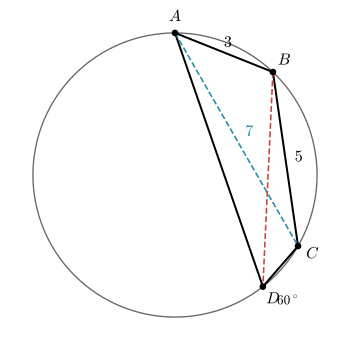
In the quadrilateral $ABCD$, the side $AB$, the side $BC$ and the diagonal $CA$ measure $3$, $5$ and $7$. The angle $\angle CDA$ is $60^\circ$. The area of triangle $BAD$ is three times the area of triangle $BCD$. Let $a = DA$ and $b = DC$. Fractions are reduced, with positive denominators; the numbers under square roots are also positive integers.
- $\angle ABC = \boxed{\text{3-1}}^\circ$.
- $a = \boxed{\text{3-2}}\,b$.
- $b = \boxed{\text{3-3}}\sqrt{\boxed{\text{3-4}}}$.
- The area of triangle $BAD$ is $\boxed{\text{3-5}}\sqrt{\boxed{\text{3-6}}}$.
Solution
1. The angle at $B$. Law of cosines in triangle $ABC$:
$$49 = 9 + 25 - 2\cdot 3\cdot 5\cos B \implies \cos B = -\frac12 \implies \angle ABC = 120^\circ.$$2. The quadrilateral is cyclic. $\angle B + \angle D = 120^\circ + 60^\circ = 180^\circ$, so $ABCD$ is inscribed in a circle, and $\angle A + \angle C = 180^\circ$, that is, $\sin A = \sin C$. Hence
$$\frac{[BAD]}{[BCD]} = \frac{\frac12\cdot AB\cdot AD\sin A}{\frac12\cdot CB\cdot CD\sin C} = \frac{3a}{5b} = 3 \implies a = 5b.$$3. $b$. Law of cosines in triangle $ACD$, with the $60^\circ$ angle at $D$:
$$49 = a^2 + b^2 - ab = 25b^2 + b^2 - 5b^2 = 21b^2 \implies b = \sqrt{\frac{7}{3}} = \frac13\sqrt{21}.$$4. The area. The area of the quadrilateral is the sum of $[ABC]$ and $[ACD]$:
$$[ABC] = \frac12\cdot 3\cdot 5\sin 120^\circ = \frac{15\sqrt3}{4}, \qquad [ACD] = \frac12\,ab\sin 60^\circ = \frac{5b^2\sqrt3}{4} = \frac{35\sqrt3}{12}.$$The total is $\frac{45\sqrt3 + 35\sqrt3}{12} = \frac{20\sqrt3}{3}$. Since $[BAD] = 3[BCD]$, triangle $BAD$ gets $\frac34$ of the total: $[BAD] = 5\sqrt3$.
Answer
$\angle ABC = 120^\circ$; $a = 5b$; $b = \frac13\sqrt{21}$; area $5\sqrt3$.