
Euler's Eyes
2026-10-13
Boole, Frege and Peano: writing down reasoning
Until the nineteenth century, mathematical notation was used to write quantities and the operations between them. There was no script for something else that mathematicians did all the time without writing it down: reasoning. “If this, then that”; “for every number”; “there is a number such that”. All of this was still said in Latin, French or German, between one formula and the next. This text tells how reasoning itself got its signs.
The algebra of thought
In the nineteenth century mathematics began to look inwards: what is a number? what is a proof? To answer, it needed a script not only for quantities but for statements and for the steps between them.
In 1854 the Englishman George Boole published The Laws of Thought, in which he treated reasoning as algebra. If $x$ stands for “the things that are white”, then $x\cdot x$ (the white things that are white) is just $x$. Hence the strange law of Boole’s algebra:
$$x^2=x,\qquad\text{that is,}\qquad x(1-x)=0,$$which Boole read as “nothing can at the same time have and not have a property”. A century later this same algebra, with only two values, $0$ and $1$, would be the basis of computer circuits.
In 1879 the German Gottlob Frege went further. In the book Begriffsschrift (Concept-script) he created a complete language for logic, capable of expressing any mathematical proof step by step. It was an extraordinary achievement, but the script was two-dimensional: statements hung from horizontal and vertical strokes, like the branches of a tree lying on its side. A simple formula took up half a page. His contemporaries found it unreadable, and almost nobody read the book.
∈, ∃ and ∀
Peano is responsible for many of the logical signs we use. In 1889, to say that an element belongs to a set, he used a letter epsilon, the initial of the Greek estí, “is”: $3\in\mathbb{N}$ reads “$3$ is a natural number”. In 1897, to say that there exists an element with a certain property, he used a turned E: $\exists$. The $\forall$, “for all”, is the youngest: the German Gerhard Gentzen created it in 1935 by turning an A, for alle, by symmetry with $\exists$.
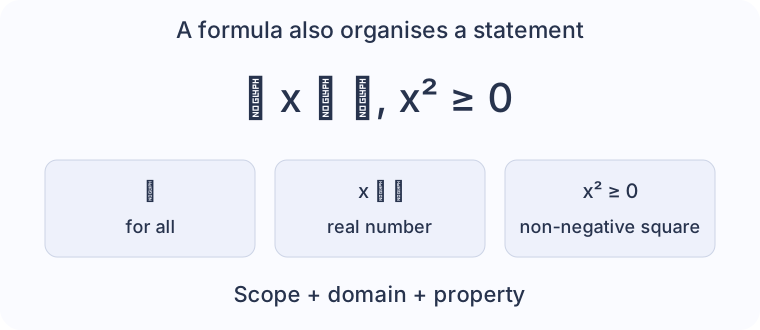
With these signs, the sentence “every real number has a square greater than or equal to zero” becomes
$$\forall x\in\mathbb{R},\quad x^2\ge 0.$$It looks like just an abbreviation, but the script makes visible something ordinary language hides: the order of the quantifiers. Compare:
$$\forall x\ \exists y:\ y>x \qquad\text{and}\qquad \exists y\ \forall x:\ y>x.$$The first says that for each number there is another one larger than it, which is true. The second says that there is a number larger than all numbers, which is false. In English, both fit into the ambiguous sentence “there is always a bigger number”. In logical script, the difference lies in the position of the signs and leaps to the eye.
What the chapter has shown
From the Indian zero to Gentzen’s quantifiers, every important change in mathematical writing opened a new path. Place value turned calculation into a task on paper; Viète’s letters turned the recipe into an object; Napier’s logarithm swapped multiplications for additions; Leibniz’s $d$ made the chain rule write itself; Euler’s $f(x)$ gave functions a name; Galois’s and Cayley’s table turned moves into symbols, and matrices treated a system as a single thing; Gibbs’s and Heaviside’s vectors reduced Maxwell’s equations to four lines; quantifiers brought the structure of a statement into view.
Not every new script took hold. Roman numerals for sums, Newton’s dots outside physics, Byrne’s colours and Frege’s tree are scripts that recorded well but did not invite anyone to go further. The history of notation is also the history of these choices: a community tests signs, keeps the ones that work and forgets the rest. In the next chapter we will look at a single sign and ask what, exactly, makes it a sign.
Exercise: negate the statement
Consider $\forall x\in\mathbb{R},\ x^2>0$. Negation swaps $\forall$ for $\exists$ and negates the property: $\exists x\in\mathbb{R},\ x^2\le 0$. The negation is true, because $x=0$ satisfies $0^2=0\le0$. So the original statement is false: the square of a real number is always greater than or equal to zero, not strictly greater.
Exercise: swap the order
Read the two statements about the natural numbers:
$$\text{(a)}\ \forall n\ \exists m:\ m>n \qquad\qquad \text{(b)}\ \exists m\ \forall n:\ m\ge n.$$(a) says every natural number has a larger one: true, just take $m=n+1$. (b) says there is a natural number greater than or equal to all of them, a “last number”: false, because $m+1$ would be greater than it. The same signs, in another order, say opposite things.
Chapter index · ← Differential equations: the law in an anagram, ∂ and ∇ · Chapter 1: references and credits →