
Euler's Eyes
2026-10-14
The life of James Bernoulli
Timeline
- 1655Born on 6 January in Basel, into a family of spice merchants.
- 1671Receives his master’s degree in philosophy. Goes on studying theology, as his father wishes.
- 1676Finishes theology and sets off on his travels. In Geneva he teaches mathematics to a blind girl.
- 1681Visits England, where he meets Robert Boyle and Robert Hooke. Writes about the great comet of 1680.
- 1683Back in Basel, lectures on experimental physics and studies the problem of compound interest.
- 1684Marries Judith Stupanus. Begins reading Leibniz’s papers on the calculus.
- 1687Becomes professor of mathematics at the University of Basel, a post he holds until his death.
- 1689Publishes the first of his dissertations on infinite series, with the harmonic series.
- 1690Solves the isochrone problem and uses the word integral for the first time.
- 1694Describes the lemniscate.
- 1697Breaks publicly with his brother Johann over the brachistochrone.
- 1705Dies on 16 August in Basel, leaving the Ars conjectandi unfinished.
- 1713The Ars conjectandi is published by his nephew Nicolaus.
- He is born into a family of spice merchants. At his father’s wish he studies theology; on his own, mathematics.
- He tutors Elisabeth von Waldkirch, a blind girl, teaching her to read, write and a little mathematics.
- He studies the philosophy of Descartes and Malebranche.
- He meets the scientists of the new experimental philosophy.
- He meets Robert Boyle and Robert Hooke and writes about the great comet of 1680.
- He returns home, teaches himself Leibniz’s calculus and is a professor at the university until his death in 1705.
- 1655–1676 · Basel
- 1676 · Geneva
- 1677–1680 · France
- 1681 · Holland
- 1681 · England
- 1683–1705 · Basel
A family of merchants
The Bernoullis were Protestants from Antwerp who fled the Spanish persecutions at the end of the sixteenth century and ended up in Basel, in Switzerland, where they prospered selling spices. Nicolaus Bernoulli, Jakob’s father, was a merchant and a member of the town council. He had clear plans for his sons: the eldest would be a pastor, the youngest, Johann, a merchant.
Jakob obeyed. He graduated in philosophy in 1671, at 16, and in theology in 1676. But all the while he was studying mathematics and astronomy on his own, against his father’s will. He chose as his motto a Latin phrase that is almost a confession: Invito patre sidera verso, “against my father’s will, I study the stars”. The emblem that went with it showed Phaethon, the son of the Sun who secretly took his father’s chariot.
Travels: the blind girl and the comets
With theology behind him, Jakob spent years travelling, as young men of good family used to do. In Geneva, in 1676, he was tutor to a blind girl, Elisabeth von Waldkirch. He taught her to read, to write and some mathematics, a daring thing for the time.
In France he studied the philosophy of Descartes and Malebranche. In Holland and England, in 1681, he met the scientists of the new experimental philosophy, among them Robert Boyle and Robert Hooke. That year he wrote a little book on the great comet of 1680, proposing that comets were bodies that came back periodically, like planets, and not omens. The theory was wrong in its details, but the spirit was right: a little over twenty years later, Halley would compute the orbit of the comet that bears his name.
Professor in Basel
Back in Basel in 1682, Jakob lectured on experimental physics and, in 1684, married Judith Stupanus, the daughter of a wealthy pharmacist. They had a son and a daughter, and neither of them took up mathematics, a rare thing in that family.
In 1687 he became professor of mathematics at the University of Basel, a post he held for the rest of his life. Shortly before, he had discovered Leibniz’s papers in the Acta Eruditorum, the scientific journal of Leipzig. Leibniz wrote so tersely that almost nobody understood him. Jakob did, and wrote to Leibniz asking for clarification. The letter took three years to be answered, because Leibniz was travelling. When the reply arrived, Jakob no longer needed it: he had rebuilt the calculus by himself.
The two brothers
His brother Johann, twelve years younger, did not want to be a merchant either. He went to study medicine and, at the same time, learned mathematics from Jakob, who taught him to use Leibniz’s calculus. Within a few years the two were the best experts in the new method outside Leibniz’s own circle.
In 1690, in the Acta Eruditorum, Jakob solved the problem of the isochrone, proposed by Leibniz: the curve along which a body descends with constant vertical speed. In the same paper the word integral appears for the first time in print, and Jakob proposed a new challenge: what is the shape of a chain hanging by its ends? He could not solve his own problem. Johann could, and never let his brother forget it.
My brother’s efforts were without success. As for me, I was more fortunate, for I found the skill to solve it in full. I spent an entire night without sleep.
— Johann Bernoulli, recalling the catenary, in a letter of 1718
Collaboration turned into competition, and competition turned into war. Jakob referred to Johann as his pupil; Johann considered himself his equal or better. In 1696 Johann issued the challenge of the brachistochrone. Jakob solved it and replied with a harder problem, about curves of fixed length, which Johann solved wrongly. Years of attacks in journals followed, in elegant Latin and with inelegant insults. When Johann won a chair in Groningen, in Holland, the two practically stopped speaking.
The unfinished work
In his last years, Jakob devoted himself to a book on the calculus of probabilities, which he called Ars conjectandi, “The art of conjecturing”. He worked on it for almost twenty years. The final part contained the result he was proudest of, the first version of the law of large numbers, which he called the golden theorem.
Jakob died in Basel on 16 August 1705, aged 50, before finishing the book. His widow and son did not trust Johann to look after the manuscript, which lay idle until his nephew Nicolaus, son of another brother, published it in 1713. The Basel chair went to Johann.
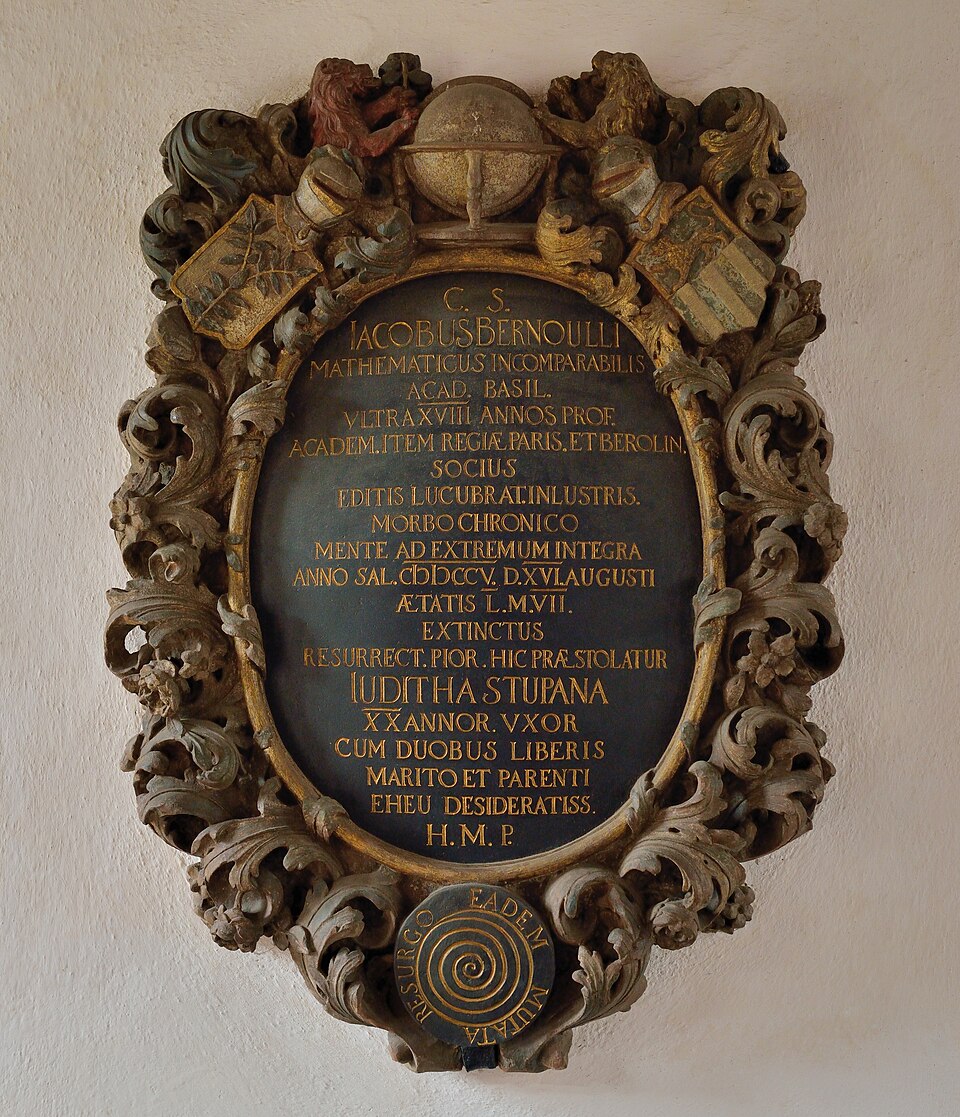
The wrong spiral
Jakob had a favourite curve: the logarithmic spiral, which he called spira mirabilis, the marvellous spiral. He asked for it to be engraved on his tomb, with the phrase Eadem mutata resurgo, “though changed, I rise again the same”: the spiral, enlarged, remains the same as itself, like the soul after the resurrection.
The request was only half granted. The phrase is there, in the cloister of Basel Minster. But the stonemason, who did not know the difference, carved an Archimedean spiral, the one whose turns are evenly spaced, like the grooves of a vinyl record. In the logarithmic spiral, each turn is much wider than the one before. Visitors to Basel can still see the mistake.
Sources: biography of Jacob Bernoulli, MacTutor · Edith Dudley Sylla, introduction to The Art of Conjecturing (Johns Hopkins, 2006) · Otto Spiess, Die Mathematikerfamilie Bernoulli (1955).
All topics on James Bernoulli · Interest that never ends and the number e →