
Euler's Eyes
2026-09-26
ENEM 2025 – Solved mathematics: questions 136 to 150
Source: INEP – proof and template of the 2nd day, Notebook 5 – Yellow.
The ENEM Mathematics and Technologies test 2025 was administered on the 2nd day and will from question 136 to 180. This post addresses questions 136 to 150. The numbering used here is that of the Notebook 5 – Yellow; us In other notebooks the same questions appear in a different order.
Template
| Question | Subject | Template |
|---|---|---|
| 136 | Circumference length | C |
| 137 | Percentage: solution concentration | E |
| 138 | Reasoning problem: discarded volume | C |
| 139 | Statistics: median | C |
| 140 | Multiplication and comparison | A |
| 141 | Spatial geometry: faces of a polyhedron | D |
| 142 | Graph reading | D |
| 143 | Operations with decimals | B |
| 144 | Spatial geometry: orthogonal projections | E |
| 145 | Probability | B |
| 146 | Reason and consumption | C |
| 147 | Analytical geometry: perpendicular bisector | A |
| 148 | Bar and line graph reading | C |
| 149 | Percentage and graphs | E |
| 150 | Scale | C |
Question 136: Police on the bike path (length of circumference)
Statement
Around a circular lagoon, whose radius measures 1 km, there is a cycle path. Due to frequent bicycle thefts, the city hall plans to allocate police officers in strategic positions to patrol this cycle path, in order to make it fully protected. A point on the cycle path is considered protected if there is at least one police officer at most 200 m away from that point, positioned over the cycle path. The figure illustrates a point $P$ on the cycle path, that will be protected if there is at least one police officer positioned over the dark gray region.
Ignore the width of the cycle lane and use 3 as an approximation for $\pi$.
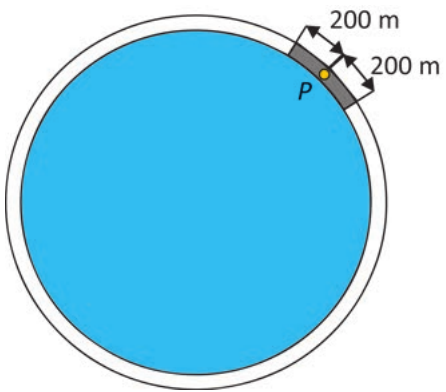
Under these conditions, the minimum necessary number of police officers to be allocated along this cycle path to make it protected is
- A) 4.
- B) 8.
- C) 15.
- D) 30.
- E) 60.
Resolution
1. Length of the cycle path. The cycle path is a circle of radius $r = 1 \text{ km} = 1000 \text{ m}$:
$$C = 2\pi r = 2 \cdot 3 \cdot 1000 = 6000 \text{ m}$$2. Section protected by a police officer. A police officer protects all points up to 200 m from it, on one side and the other of the track. Every cop covers, So, a snippet of
$$200 + 200 = 400 \text{ m}$$3. Minimum number of police officers. By placing police officers every 400 m, the covered sections fit without excess:
$$\frac{6000}{400} = 15 \text{ policiais}$$Answer: alternative C (15).
Beware of the catch: alternative D (30) appears when considering that each police officer only covers 200 m, forgetting that he protects both sides.
To review, see Circumferences.
Question 137: Removing a substance from a solution (percentage)
Statement
In a laboratory, a container contains 10 liters of a compound solution only for substances S1 e S2. From this solution, 99,95% is from S1. A quantity of S1 will be removed from this solution, maintaining the initial amount of S2, so that 99,90% of the new solution is S1.
What is the amount of S1, in liters, that will be removed?
- A) 0,0050
- B) 0,0100
- C) 0,5000
- D) 4,9775
- E) 5,0000
Resolution
The key is to look for the substance that does not change: S2.
1. Amount of S2. If 99,95% is S1, then 0,05% is S2:
$$0{,}0005 \cdot 10 = 0{,}005 \text{ L de } S_2$$2. Volume of the new solution. In the new solution, S1 is 99,90%, so S2 becomes 0,10% of the total $V$. How S2 continues to be valid 0,005 L:
$$0{,}001 \cdot V = 0{,}005 \quad\Rightarrow\quad V = 5 \text{ L}$$3. Quantity withdrawn. The volume fell from 10 L to 5 L, and only S came out1:
$$10 - 5 = 5{,}0000 \text{ L}$$(Checking: S1 went from 9,995 L to 4,995 L, and $4{,}995 / 5 = 99{,}90\%$.)
Answer: alternative E (5,0000).
Beware of the catch: the percentage of S1 only change 0,05 point percentage, and this leads us to think about a tiny withdrawal (alternatives A and B). But the fraction of S2 doubles (from 0,05% to 0,10%), then the volume total needs to fall by half.
To review, see Percentage Basics.
Question 138: Fuel discarded during transportation
Statement
A fuel distributor has tank trucks with capacity to 30 000 liters each. In any transport carried out by these trucks, a The same volume of fuel is discarded, as it contains many impurities. This Discarded volume does not depend on the quantity transported.
A gas station ordered 10 000 liters of gasoline from this distributor, which sent 10 200 liters, considering the volume discarded in the transport. Even so, the amount of gasoline delivered to the station was 9 900 liters.
In a new order, this station requested that exactly twice as much be delivered of the volume of gasoline ordered in the previous order.
Using the same truck as the previous delivery, what is the minimum volume of gasoline, in liters, that the distributor must send to guarantee delivery of the quantity ordered in this new order?
- A) 20 100
- B) 20 200
- C) 20 300
- D) 20 400
- E) 20 600
Resolution
1. Volume discarded in each transport. 10 200 L were sent and arrived 9 900 L:
$$10\thinspace 200 - 9\thinspace 900 = 300 \text{ L}$$This disposal is always the same, whatever the load.
2. New order. The previous order was for 10 000 L, so the new order is $2 \cdot 10\thinspace 000 = 20\thinspace 000$ L.
3. Volume to be sent. To reach 20 000 L, you must send the 20 000 L plus the 300 L that will be discarded:
$$20\thinspace 000 + 300 = 20\thinspace 300 \text{ L}$$This volume fits in the 30 000 L truck.
Answer: alternative C (20 300).
Be careful with the catch: alternative D (20 400) doubles the volume sent before ($2 \cdot 10\thinspace 200$), as if the discard also doubled. But the The statement says that disposal does not depend on the quantity transported.
Question 139: Median connection speeds
Statement
A technology company will standardize internet connection speeds which it offers to its customers in ten cities. The company’s management decides that its new reference speed standard will be the median of the values of the reference connection speeds in these ten cities. These values, in megabyte per second (MB/s), are shown in the table.
| Cities | Reference speed (MB/s) |
|---|---|
| C1 | 390 |
| C2 | 380 |
| C3 | 320 |
| C4 | 390 |
| C5 | 340 |
| C6 | 380 |
| C7 | 390 |
| C8 | 400 |
| C9 | 350 |
| C10 | 360 |
The reference speed, in megabytes per second, to be adopted by this company is
- A) 360.
- B) 370.
- C) 380.
- D) 390.
- E) 400.
Resolution
1. Sort the data.
$$320, \quad 340, \quad 350, \quad 360, \quad 380, \quad 380, \quad 390, \quad 390, \quad 390, \quad 400$$2. Central terms. These are 10 values (even quantity), so the median is the average of the 5th and 6th terms, which are worth 380 and 380:
$$\text{Mediana} = \frac{380 + 380}{2} = 380$$Answer: alternative C (380).
Be careful with the catch: without ordering, the terms in the middle of the table would be 340 (C5) and 380 (C6), and the “median” would give 360 (alternative A). And fashion, 390, is alternative D.
To review the concept, see Position Measurements.
Question 140: Lower amount of sodium per package
Statement
In a school canteen, there are five foods sold in packages with different portion quantities.
The nutritional information contained on the labels of these products is indicated in the images.
| Product | Package | Sodium |
|---|---|---|
| Potato chips | Package with 3 portions of 50 g | 170 mg sodium per serving |
| Savory sticks | Package with 4 portions of 20 g | 501 mg sodium per serving |
| Multigrain biscuit | Package with 8 portions of 25 g | 264 mg sodium per serving |
| Starch biscuits | Package with 6 portions of 15 g | 175 mg sodium per serving |
| Salt biscuit | Package with 5 portions of 40 g | 166 mg sodium per serving |
A student always chooses the food with the lowest total amount of sodium per package.
Which of these products should the student choose?
- A) Potato chips.
- B) Salty sticks.
- C) Multigrain biscuit.
- D) Tapioca starch biscuit.
- E) Salt and water biscuit.
Resolution
The total sodium in the package is (number of servings) × (sodium per serving). The mass of portion doesn’t matter here.
| Product | Total sodium per package |
|---|---|
| Potato chips | $3 \cdot 170 = 510$mg |
| Savory sticks | $4 \cdot 501 = 2004$mg |
| Multigrain biscuit | $8 \cdot 264 = 2112$mg |
| Tapioca biscuit | $6 \cdot 175 = 1050$mg |
| Salt and water biscuit | $5 \cdot 166 = 830$mg |
The lowest total is for potato chips, 510 mg.
Answer: alternative A (Potato chips).
Be careful with the catch: salt and water biscuits have the lowest sodium for portion (166 mg), which leads to alternative E. But his package has 5 portions, against 3 of potato chips.
Question 141: Colors to paint a polyhedron (prism + pyramid frustum)
Statement
A factory used a 3D printer to produce a prototype of a part. O prototype has the shape of a convex polyhedron, obtained by the juxtaposition of two distinct solids, one shaped like a straight regular hexagonal prism and the other shaped like a straight hexagonal pyramid frustum. The largest base of the trunk pyramid coincides with one of the bases of the prism.
After printing the prototype, it was sent to the customization sector to paint its surface. The criteria defined for carrying out the painting considers that faces that are congruent with each other must be painted with the same color, and non-congruent faces must have different colors.
How many colors were used to paint the prototype?
- A) 9
- B) 8
- C) 6
- D) 4
- E) 3
Resolution
1. Faces of the prism that are exposed. A straight regular hexagonal prism has 6 rectangular side faces, all congruent, and two hexagonal bases regular. One of the bases is glued to the trunk, so is not the face of the prototype. What remains:
- 6 congruent rectangles → 1 color;
- 1 regular hexagon (the other base of the prism) → 1 color.
2. Faces of the trunk that are exposed. The straight hexagonal pyramid trunk has 6 congruent trapezoidal side faces and two bases. The largest base is which coincides with the base of the prism (glued, does not appear). What remains:
- 6 congruent trapezoids → 1 color;
- 1 smaller regular hexagon (the smaller base of the torso) → 1 color, different from of the prism hexagon, because the two hexagons have different sizes and, therefore, they are not congruent.
3. Total. Rectangles, trapezoids, large hexagon and small hexagon:
$$1 + 1 + 1 + 1 = 4 \text{ cores}$$Answer: alternative D (4).
Be careful with the trick: who counts the faces of two separate solids (including the bases that were glued together) or do you think that the two hexagonal bases visible are equal reaches other values. The glued faces disappear, and the Visible hexagons have different sizes.
Question 142: Respiratory rate in meditation (chart reading)
Statement
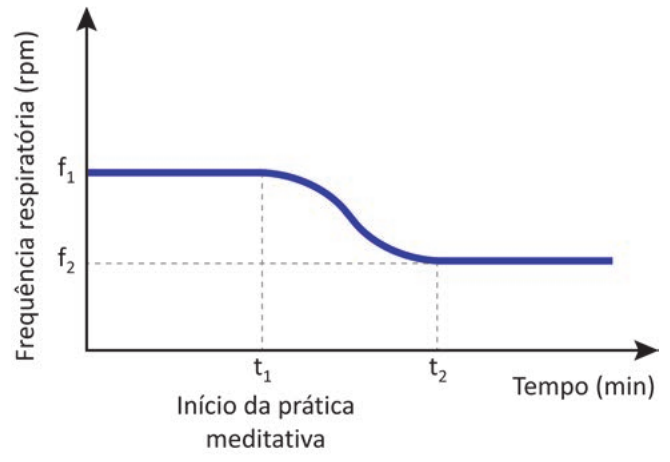
Research in the area of neurobiology confirms that meditative practice is responsible for considerably decreasing the respiratory rate to advanced practitioners, who, after starting meditation, have their frequencies reduced respiratory rates until they stabilize at a lower level. The graph presents the relationship of respiratory frequency, in breaths per breath minute (rpm), in relation to the time, in minutes, of an advanced practitioner, in which (f1) represents the frequency at time t1, which begins meditative practice; and (f2), the frequency at time t2, the from which it stabilizes during meditation.
Available at: www.redepsi.com.br. Accessed on: 3 Dec. 2018 (adapted).
From the moment t1, in which meditative practice begins, the respiratory rate behavior, in relation to time,
- A) remains constant.
- B) is directly proportional to time.
- C) is inversely proportional to time.
- D) decreases until time t2, from which it becomes constant.
- E) decreases proportionally to time, both between t1 e t2 how much after t2.
Resolution
Just read the graph from t1:
1. Between you1 e t2: the curve drops from f1 until f2, that is, the frequency decreases. The descent is curved, not a straight; so it is not “proportional to time”.
2. After you2: the curve becomes horizontal at height f2, that is, the frequency remains constant.
Answer: alternative D (decreases until t2 and then becomes constant).
Be careful with the catch: alternative A describes the excerpt before t1, and not what happens from it. And alternative E fails because, after2, the frequency no longer decreases.
Question 143: Usain Bolt’s record (subtraction of decimals)
Statement
In athletics, a great challenge of the 100 meter sprint is its completion in a time below the 10,00 seconds reference mark. Several athletes have already achieved this feat. In 2009, Jamaican Usain Bolt set the record men’s world championship in this event, with a time of 9,58 seconds.
What is the difference, second, between the reference brand and the brand established by Usain Bolt in 2009?
- A) 0,02
- B) 0,42
- C) 0,52
- D) 1,02
- E) 1,42
Resolution
Aligning the commas and subtracting:
$$10{,}00 - 9{,}58 = 0{,}42 \text{ s}$$Checking: $9{,}58 + 0{,}42 = 10{,}00$.
Answer: alternative B (0,42).
To review, see Operations with Rational Numbers.
Question 144: Orthogonal projections of a moving cube
Statement
In a computer game, a cube is initially positioned as indicated in the figure.
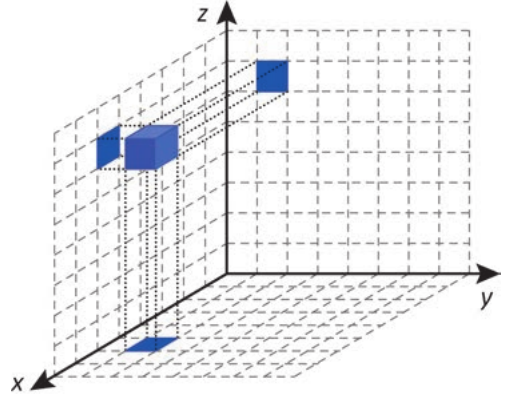
Each displacement made by this cube always takes place in one of the directions defined by the three coordinate axes. When moving from the position initial, this cube approached 3 units from the plane yz, moved away 5 units of the plane xz and approached 4 units of the plane xy.
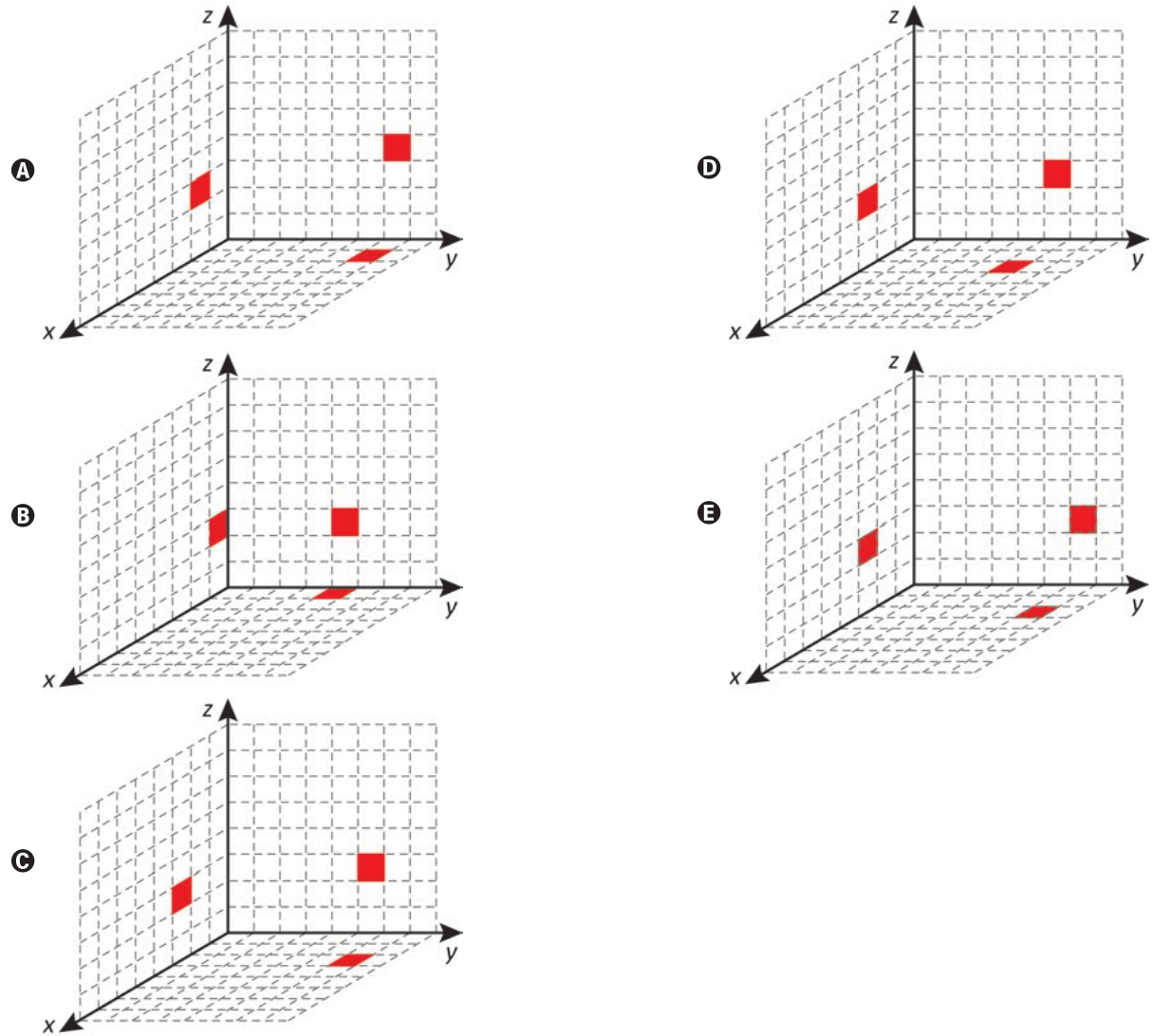
The figure that presents the orthogonal projections of this cube onto the three planes coordinated, after carrying out the movements described, it is
Resolution
1. What each movement changes. The distance to the yz plane is the coordinate $x$; to the plane xz, the coordinate $y$; to the xy plane, the coordinate $z$. Then:
- approached 3 the plane yz → $x$ decreases 3;
- 5 moved away from the plane xz → $y$ increases 5;
- approached 4 the plane xy → $z$ decreases 4.
2. Initial position, read in projection onto the yz plane (the square on the wall bottom right). Counting the squares of the mesh, it occupies $1 \le y \le 2$ and $6 \le z \le 7$.
3. New projection onto the plane yz. With $y$ increasing 5 and $z$ decreasing 4:
$$6 \le y \le 7 \qquad\text{e}\qquad 2 \le z \le 3$$That is, the red square on the wall yz must be in the 7th column (counting the starting from axis $z$) and in the 3rd row (counting from axis $y$).
4. Comparing with the alternatives. Only alternative E has the projection on plane yz in that position. In A, the square is in the right column, but a row above ($3 \le z \le 4$, as if $z$ had only decreased 3); in B, C and D, the square is in leftmost columns (the $y$ has not increased 5). The other two projections of alternative E (in the xz plane, on the left, and in the xy plane, on the ground) also appear closer to the yz plane and, on the ground, displaced in the direction of $y$, according to the movements.
Answer: alternative E.
Be careful with the catch: “getting closer to the yz” plane changes the coordinate $x$, not $y$ nor $z$. Whoever associates each plane with the wrong axis chooses a figure with the displacements swapped.
Question 145: Men who access social networks (probability)
Statement
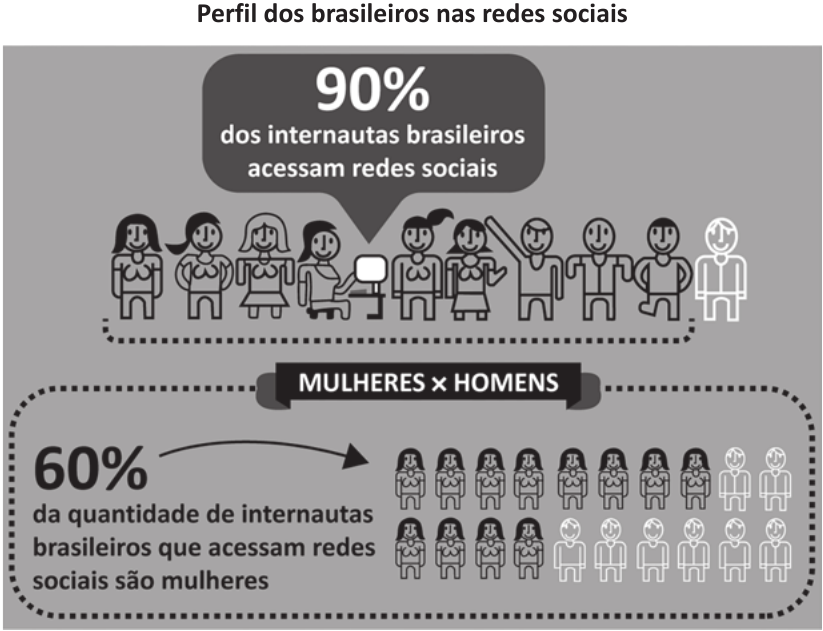
A magazine report addressed the use of social networks by internet users Brazilians. Some of the data collected by the report are presented in infographic.
Available at: http://revistagalileu.globo.com. Accessed at: 22 Oct. 2015 (adapted).
According to the data in the infographic, when randomly choosing an internet user Brazilian during the period to which the report refers, the probability of him being a man who accesses a social network is
- A) $\dfrac{30}{90}$
- B) $\dfrac{36}{100}$
- C) $\dfrac{40}{100}$
- D) $\dfrac{40}{90}$
- E) $\dfrac{46}{90}$
Resolution
1. Who accesses social networks. 90% of Internet users access social networks: $P(\text{acessa}) = \frac{90}{100}$.
2. Men among those who access. 60% of those who access are women, so 40% are men: $P(\text{homem} \mid \text{acessa}) = \frac{40}{100}$.
3. Probability requested. We want an internet user who accesses and is a man:
$$P = \frac{90}{100} \cdot \frac{40}{100} = \frac{3600}{10\thinspace 000} = \frac{36}{100}$$Answer: alternative B ($\frac{36}{100}$).
Be careful with the catch: alternative C ($\frac{40}{100}$) is the percentage of men among those who access, not among all Internet users. How the draw is among all internet users, you need to multiply by 90%.
To review the concept, see Introduction to Probability.
Question 146: CNG cylinder for one week
Statement
A person intends to install a vehicle natural gas (CNG) kit in their car. In the store you chose to purchase and install this kit, there were five cylinder models for gas storage, whose capacities, in meters cubic, were, respectively: 10, 14, 17, 21 and 25. The cylinder price is proportional to its capacity. This car will run 30 km daily, 7 days a week, and CNG consumption is 1 m³ for every 13 km driven. The person will choose the cylinder model with the lowest price and which only guarantees a weekly supply.
Under these conditions, what will be the capacity, in cubic meters, of the chosen cylinder? for this person?
- A) 10
- B) 14
- C) 17
- D) 21
- E) 25
Resolution
1. Distance per week.
$$30 \cdot 7 = 210 \text{ km}$$2. Gas used per week. With 1 m³ every 13 km:
$$\frac{210}{13} \approx 16{,}15 \text{ m}^3$$3. Cylinder selection. With just one fill per week, the cylinder must be at least 16,15 m³. As the price is proportional to the capacity, the person chooses the smallest cylinder that meets this: the 14 m³ one is not enough, and that of 17 m³ is enough.
Answer: alternative C (17).
Be careful with the catch: round 16,15 down and choose 14 m³ (Alternative B) would run the car out of gas before the end of the week.
To review, see Fees.
Question 147: Equidistant trajectory of the villains (analytical geometry)
Statement
In a digital game, there are three characters: a hero and two villains. The programming is made in such a way that the hero will always be attacked by the villain who is most close to him. One of the ways to “confuse” the villains is to move the hero around trajectories that keep him equidistant from the villains, generating uncertainty between them and, therefore, not being attacked.
To program one of the stages of this game, the programmer considered, in Cartesian plane, the square STUV as the region of motion of the characters, where V and T represent the fixed positions of the villains, and S, the initial position of the hero, as shown in the figure.
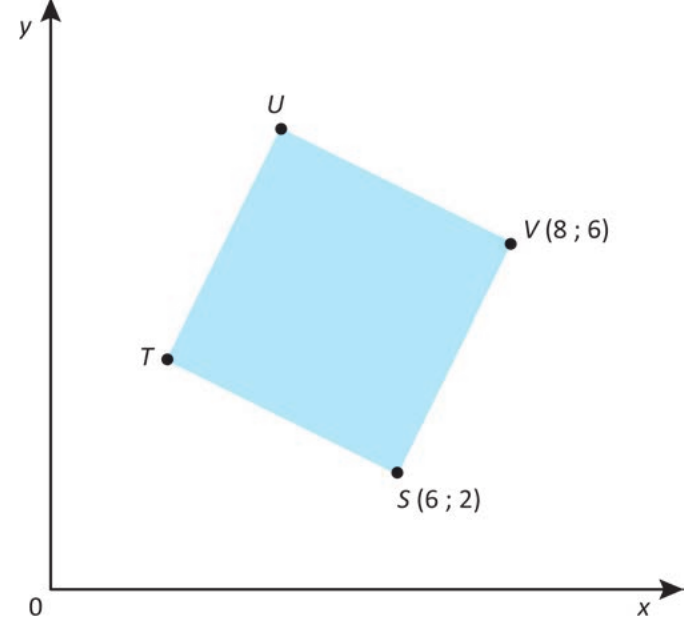
What is the trajectory equation in which the hero can move without being attacked?
- A) $y = -3x + 20$
- B) $y = -3x + 16$
- C) $y = -3x - 20$
- D) $y = 3x + 16$
- E) $y = 3x - 16$
Resolution
The equidistant points of $T$ and $V$ form the perpendicular bisector of the segment $TV$. In a square, this perpendicular bisector is the straight line of the diagonal $SU$ (the diagonals of a square are perpendicular and cut in half).
1. Coordinates of T. The $\overrightarrow{SV}$ side goes from $S(6, 2)$ to $V(8, 6)$: $\overrightarrow{SV} = (2, 4)$. The $\overrightarrow{ST}$ side has the same size and is perpendicular to it, pointing left and up (as in the figure): $\overrightarrow{ST} = (-4, 2)$. Then,
$$T = (6 - 4,\ 2 + 2) = (2, 4)$$2. perpendicular bisector of TV. The midpoint of $TV$ is $M = \left(\frac{2 + 8}{2}, \frac{4 + 6}{2}\right) = (5, 5)$. The slope of $TV$ is $\frac{6 - 4}{8 - 2} = \frac{1}{3}$, then perpendicular bisector has slope $-3$:
$$y - 5 = -3(x - 5) \quad\Rightarrow\quad y = -3x + 20$$3. Conference. The straight line passes through $S(6, 2)$: $-3 \cdot 6 + 20 = 2$. Right, the hero already starts on the safe trajectory.
Answer: alternative A ($y = -3x + 20$).
Tip: as the hero starts at $S(6, 2)$, equidistant from the villains, the straight line has to go through $S$. This eliminates B, C and D. Between A and E, which pass through $S$, the right straight line has slope $-3$ (perpendicular to $TV$); $y = 3x - 16$ has slope $+3$ and it does not work.
Question 148: Stock and demand for books
Statement
A bookstore sells books in the following literary genres: fiction scientific, self-help, romance and biography. The graph shows the stock of books that this bookstore has, by literary genre and author’s nationality, as well as the demand for literary genre, obtained through a survey carried out with your regular customers.
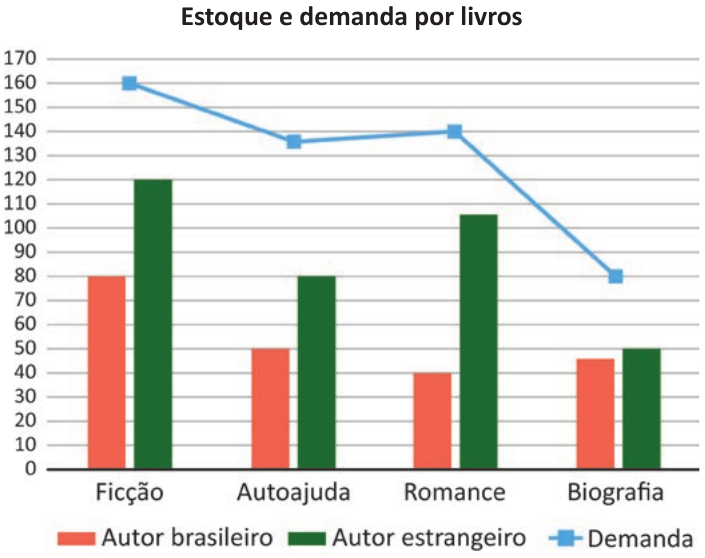
The bookstore manager will order new copies only of the genre whose quantity in stock is insufficient to meet the demand determined by the poll.
The genre of book that the manager should order more copies of is
- A) fiction, as it is what is in greatest demand.
- B) biography, as it is the genre that has the least demand.
- C) self-help, as the quantity in stock is lower than demand.
- D) biography, as it is the genre that has the smallest number of books in stock.
- E) romance, as it has the smallest stock of books by Brazilian authors.
Resolution
The stock of each genre is the sum of the two bars (Brazilian author + author foreign). Comparing with demand (blue line), with values read on the graph:
| Gender | Stock | Demand | Is there enough stock? |
|---|---|---|---|
| Fiction | $80 + 120 = 200$ | 160 | Yes |
| Self-help | $50 + 80 = 130$ | about 135 | no |
| Romance | about $40 + 105 = 145$ | 140 | Yes |
| Biography | about $46 + 50 = 96$ | 80 | Yes |
Only in self-help is the stock (130) lower than the demand.
Answer: alternative C (self-help).
Be careful with the catch: looking at just one bar per genre, it seems that everyone stocks are below demand. It is necessary to add the books of authors Brazilians and foreigners.
Question 149: Enrollment in the French course
Statement
A language school offers courses in English, Spanish, French and German. The graphs show the percentage distribution of enrollments, by language, in 2023, and the distribution of the number of enrollments, by language, in 2024.
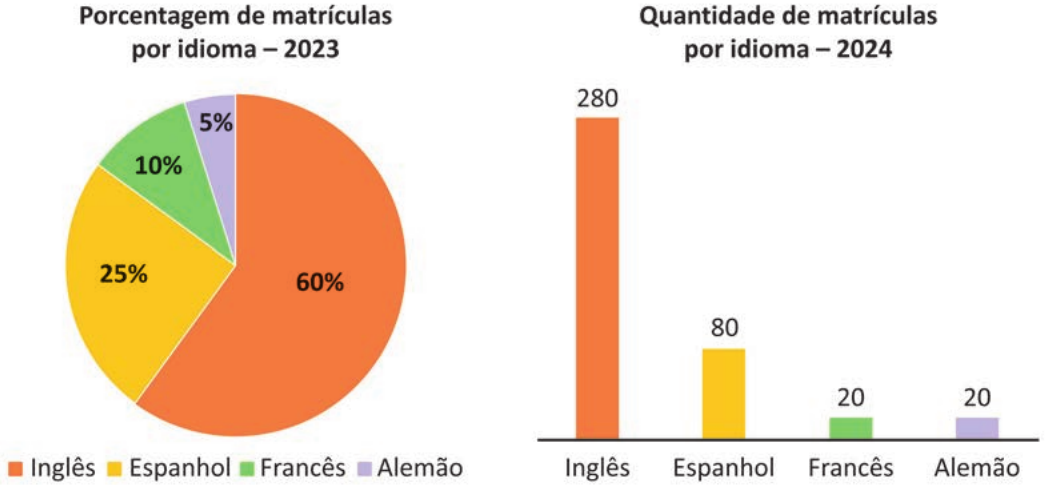
To plan the activities of 2025, the school manager estimated that the total enrollments will be the same as 2024, and the percentage distribution of enrollments, by language, will be the same as that registered in 2023.
According to this estimate, the number of enrollments in the French course for the year of 2025 will be
- A) 2.
- B) 12.
- C) 20.
- D) 22.
- E) 40.
Resolution
1. Total enrollment in 2024 (which will be the total of 2025):
$$280 + 80 + 20 + 20 = 400$$2. Percentage of French in 2023: 10%.
3. Estimate for 2025:
$$10\% \text{ de } 400 = 0{,}10 \cdot 400 = 40$$Answer: alternative E (40).
Be careful with the catch: alternative C (20) is the number of enrollments in French from 2024. The statement asks to apply the percentage of 2023 to the total 2024.
To review, see Percentage Basics.
Question 150: Remote control cart displacements (scale)
Statement
The remote control of a toy car is equipped with a screen that automatically adjusts the scale used to display each displacement. A screen presents the image of the displacement, the scale used in generating this image and the length of this displacement, in centimeters, in accordance with the scale used. The figures represent the remote control screen displaying the data from five movements carried out by this cart.

The option that indicates the longest displacement made by the cart toy is
- A) I.
- B) II.
- C) III.
- D) IV.
- E) V.
Resolution
On a $1 : k$ scale, each 1 cm of the screen is worth $k$ cm in reality. So the actual length is (on-screen measurement) × $k$:
| Screen | Measure | Scale | Actual length |
|---|---|---|---|
| I | 9 cm | 1 : 100 | $9 \cdot 100 = 900$ cm |
| II | 5 cm | 1 : 300 | $5 \cdot 300 = 1\thinspace 500$ cm |
| III | 5 cm | 1 : 600 | $5 \cdot 600 = 3\thinspace 000$ cm |
| IV | 3 cm | 1 : 700 | $3 \cdot 700 = 2\thinspace 100$ cm |
| V | 2 cm | 1 : 1 000 | $2 \cdot 1000 = 2\thinspace 000$ cm |
The largest displacement is III, with 3 000 cm = 30 m.
Answer: alternative C (III).
Be careful with the catch: segment I is the largest on the screen (9 cm), and the V scale is the largest (1 : 1 000). Neither alone decides: it is the product that matters.
To review, see Proportions and Geometry.