
Euler's Eyes
2026-10-14
Pythagoras's theorem, Euclid's way
In right-angled triangles the square on the side subtending the right angle is equal to the squares on the sides containing the right angle.
— Euclid, Elements, Proposition I.47
Long before the Greeks, the surveyors of Egypt, who re-marked the fields after each Nile flood, were called rope-stretchers. The story goes that they used a rope with 12 equally spaced knots: stretched into a triangle with sides 3, 4 and 5, it gave a right angle. The Babylonians knew much more: a clay tablet from around 1800 BC, Plimpton 322, lists right triangles with whole-number sides, some of them huge, such as 3,367, 3,456 and 4,825.
This site’s old geometry course began with the simplest examples:
$$3^2+4^2=9+16=25=5^2,\qquad 6^2+8^2=36+64=100=10^2.$$What Egyptians and Babylonians lacked was the proof that the relation holds for every right triangle. Tradition attributes it to Pythagoras, in the sixth century BC, but no proof of his survives. The oldest one we have is Euclid’s, the second-to-last proposition of Book I.
The windmill proof
Let $ABC$ be a triangle with a right angle at $A$, legs $AB=c$ and $AC=b$ and hypotenuse $BC=a$. Build a square on each side. The resulting figure looks like a windmill, which is how the proof got that nickname; Arab mathematicians called it the “bride’s chair”.
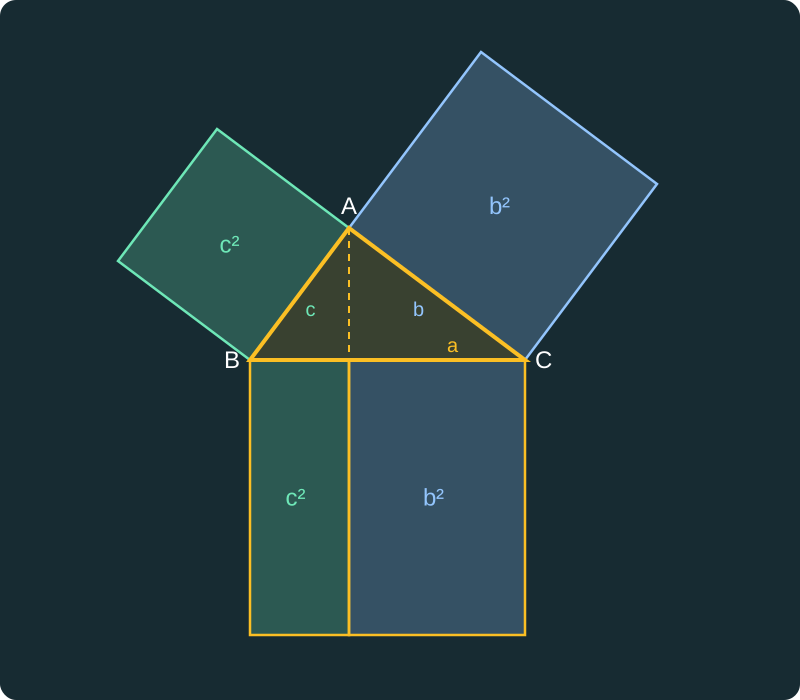
Euclid’s idea is to divide the large square, on $BC$, into two rectangles by drawing through $A$ the perpendicular to $BC$, and then to show that each rectangle has the same area as one of the small squares. The proof uses only two facts already proved:
- I.4: two triangles with two sides equal and the angle between them equal are equal, and have the same area.
- I.41: a triangle with the same base and height as a parallelogram has half the area of the parallelogram.
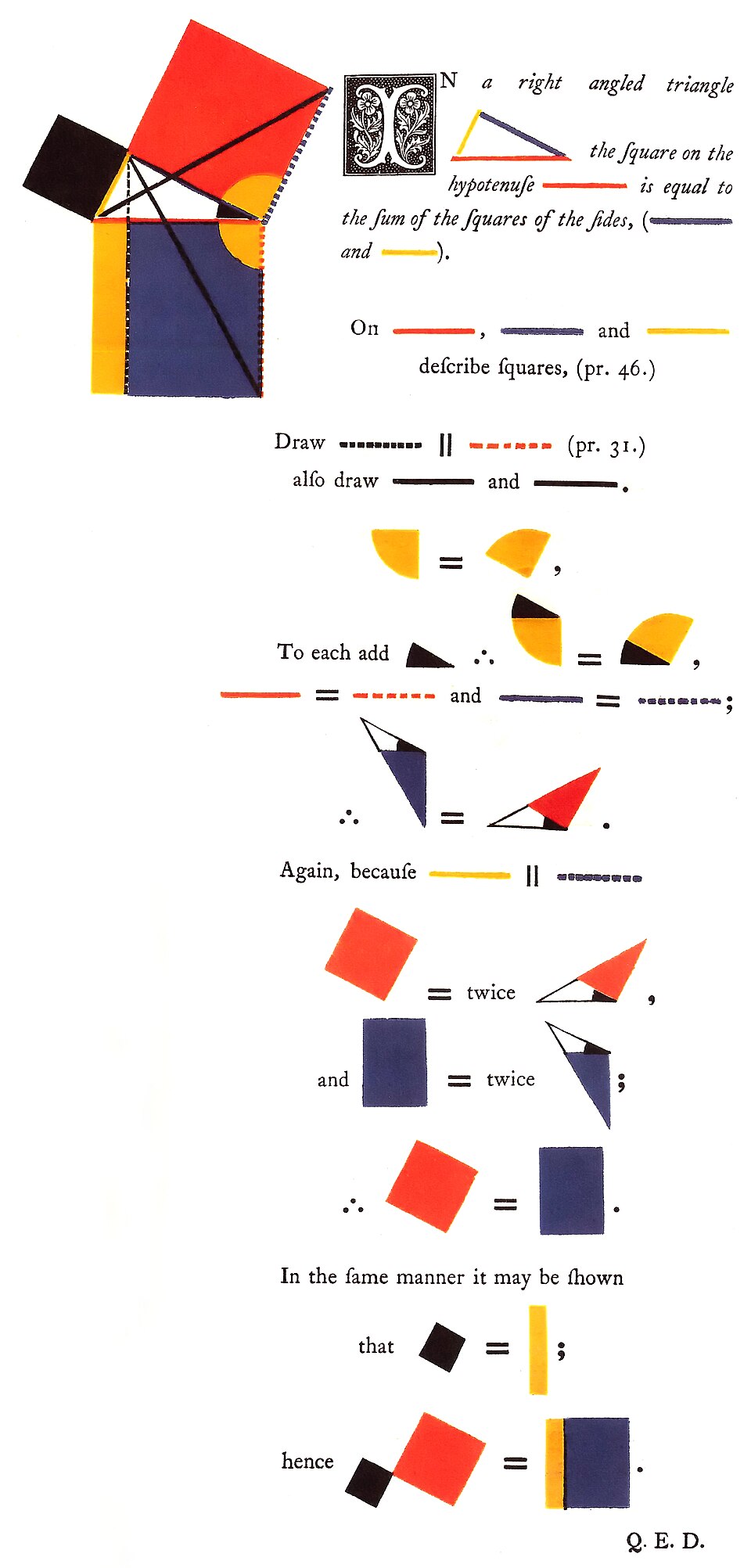
For the left rectangle, Euclid looks at two triangles with a vertex at $B$. The first is formed by $B$, by $A$ and by the vertex of the bottom square that lies below $B$; the second by $B$, by $C$ and by the vertex of the square on $AB$ that is next to $B$ and different from $A$. These two triangles have two sides equal, one side of the square on $AB$ and one side of the square on $BC$, and the angle between them equal: an angle of the triangle plus a right angle. By I.4 they have the same area.
Now, by I.41, the first triangle has half the area of the left rectangle, because it has the same base and the same height. And the second has half the area of the square on $AB$, for the same reason. So
$$\text{left rectangle}=\text{square on }AB=c^2.$$The same argument on the other side gives $\text{right rectangle}=b^2$. Adding:
$$\boxed{a^2=b^2+c^2.}$$A shorter proof, with similarity
In Book VI, after the theory of proportions, Euclid gives a second proof. The altitude $AH$ divides triangle $ABC$ into two smaller triangles, similar to the large one. Calling $BH=m$ and $HC=n$, with $m+n=a$, similarity gives
$$\frac{c}{a}=\frac{m}{c}\quad\Longrightarrow\quad c^2=am,\qquad\frac{b}{a}=\frac{n}{b}\quad\Longrightarrow\quad b^2=an.$$Adding, $b^2+c^2=a(m+n)=a^2$. These are exactly the two rectangles of the figure: $am$ and $an$.
The converse
The last proposition of Book I, I.48, proves the converse: if in a triangle the square on one side equals the sum of the squares on the other two, then the opposite angle is right. This is what justifies the rope-stretchers’ rope: since $3^2+4^2=5^2$, the 3, 4, 5 triangle must be right-angled.
Exercise: a 5 m ladder leans against a wall, with its foot 1.4 m from the wall. At what height does it touch the wall?
The ladder is the hypotenuse: $h^2+1.4^2=5^2$, so $h^2=25-1.96=23.04$ and $h=4.8$ m. The numbers are those of a 7, 24, 25 triangle divided by 5: $1.4=\frac75$, $4.8=\frac{24}5$ and $5=\frac{25}5$.
Exercise: show that, for any integers m > n > 0, the numbers m² − n², 2mn and m² + n² form a right triangle.
With $m=2$, $n=1$: the 3, 4, 5 triangle. With $m=3$, $n=2$: 5, 12, 13. With $m=4$, $n=1$: 15, 8, 17. Euclid proves this rule in Book X (lemma to Proposition X.29), and it gives all primitive Pythagorean triples.
Sources: Elements, Propositions I.47 and I.48, D. E. Joyce’s edition · Eli Maor, The Pythagorean Theorem: A 4,000-Year History (Princeton, 2007) · Elisha S. Loomis, The Pythagorean Proposition (2nd ed., 1940).
All topics on Euclid · ← The first proposition: the equilateral triangle · Algebra done with squares and rectangles →