
Euler's Eyes
2026-10-12
Exercises from chapter 15 — Any triangles
Law of sines
Knowing that $\operatorname{sen}(180^{\circ} - x) = \operatorname{sen}x$ and $\cos(180^{\circ} - x) = -\cos x$, determine: a) $\operatorname{sen}120^{\circ}$; b) $\cos 150^{\circ}$; c) $\cos 135^{\circ}$; d) $\operatorname{sen}150^{\circ}$; e) $\operatorname{sen}135^{\circ}$; f) $\cos 120^{\circ}$.
Ver resposta
a) $\dfrac{\sqrt{3}}{2}$ · b) $-\dfrac{\sqrt{3}}{2}$ · c) $-\dfrac{\sqrt{2}}{2}$ · d) $\dfrac{1}{2}$ · e) $\dfrac{\sqrt{2}}{2}$ · f) $-\dfrac{1}{2}$
Determine the value of $x$ in the following cases:
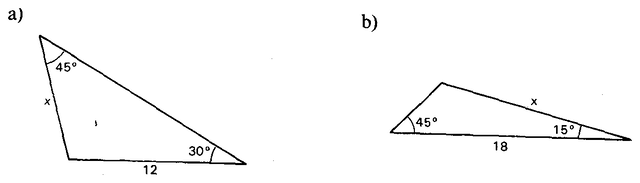
Ver resposta
a) $6\sqrt{2}$ · b) $6\sqrt{6}$
Determine the radius of the circle circumscribed by the triangle in the following cases:
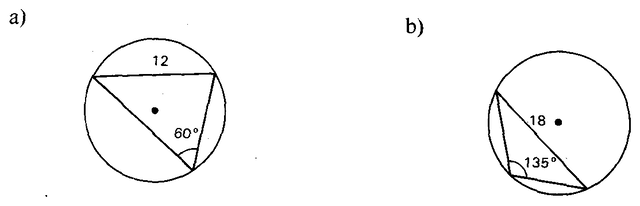
Ver resposta
a) $4\sqrt{3}$ · b) $9\sqrt{2}$
Obtain the value of $x$ in the cases: a) $ABCD$ is a parallelogram; b) $ABCD$ is an isosceles trapezoid.
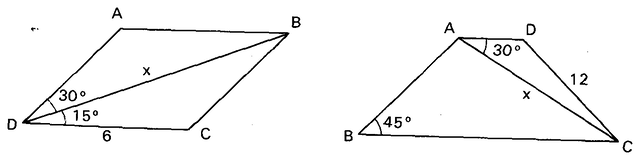
Ver resposta
a) $6\sqrt{2}$ · b) $12\sqrt{2}$
Determine the angle $x$ in the cases:
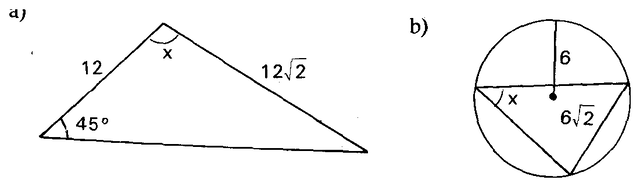
Ver resposta
a) 105° · b) 45° or 135°
In a triangle $ABC$ $\hat A = 60^{\circ}$, $\hat B = 45^{\circ}$ and $BC = 4$ cm are given. Determine the measurement of $\overline{AC}$.
Ver resposta
$\dfrac{4\sqrt{6}}{3}$ cm
In an obtuse angled and isosceles triangle, the base angles measure 30° each. Determine the base of the triangle, knowing that the congruent sides measure 10 cm each.
Ver resposta
$10\sqrt{3}$ cm
The triangle $ABC$ is obtuse with $\hat A = 120^{\circ}$, $BC = 2\sqrt{3}$ dm and $AC = 2$ dm. Determine the measure of the vertex angle $B$ of this triangle.
Ver resposta
30°
If the sides of a triangle $ABC$ measure $a$, $b$ and $c$, prove that
$$\frac{a + b}{b} = \frac{\operatorname{sen}A + \operatorname{sen}B}{\operatorname{sen}B},$$where $A$ and $B$ are the angles of the vertices $A$ and $B$ of the triangle and $a$, $b$ and $c$ the sides respectively opposite the vertices $A$, $B$ and $C$.
Ver resposta
Use the law of sines and the property of proportions.
In the same previous exercise, prove that $\dfrac{a - b}{b} = \dfrac{\operatorname{sen}A - \operatorname{sen}B}{\operatorname{sen}B}$.
Ver resposta
Use the law of sines and the property of proportions.
Let $a$, $b$ and $c$ be the sides opposite the vertices $A$, $B$ and $C$ of a triangle $ABC$. Prove that $\dfrac{\operatorname{sen}A + \operatorname{sen}B}{\operatorname{sen}C} = \dfrac{a + b}{c}$.
Ver resposta
Use the law of sines and the property of proportions.
Metric relations and law of cosines
Determine the value of $x$ in the following cases:
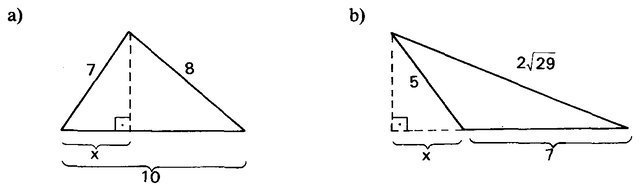
Ver resposta
a) $\dfrac{17}{4}$ · b) 3
Determine $x$ and $y$ in the following cases:
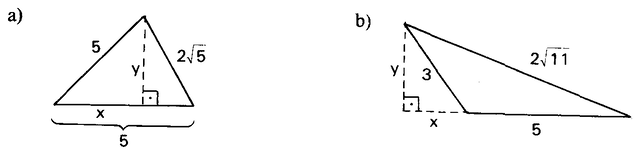
Ver resposta
a) $x = 3$; $y = 4$ · b) $x = 1$; $y = 2\sqrt{2}$
Calculate the height $h$, relative to the side $\overline{BC}$, in the following cases:
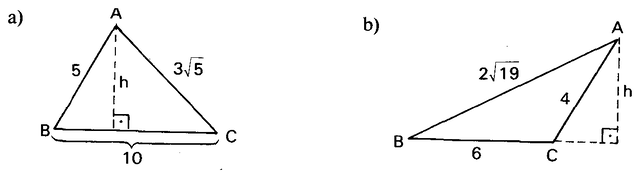
Ver resposta
a) 3 · b) $2\sqrt{3}$
Determine the value of $x$ in the following cases:
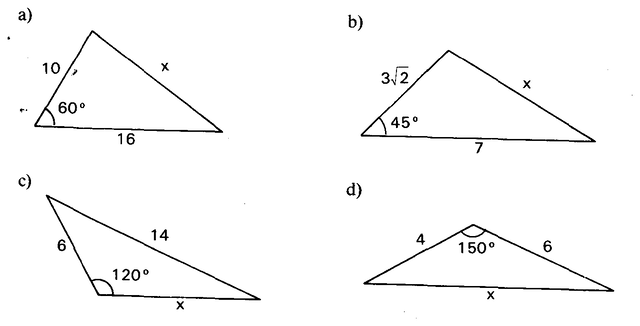
Ver resposta
a) 14 · b) 5 · c) 10 · d) $2\sqrt{6\sqrt{3} + 13}$
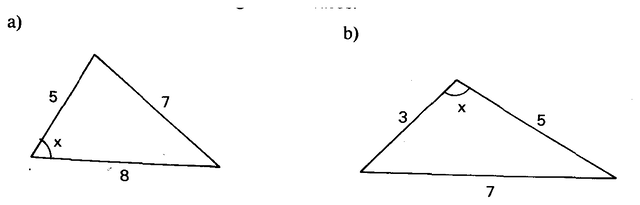
Determine the measure $x$ of the angle in the following cases:
Ver resposta
a) 60° · b) 120°
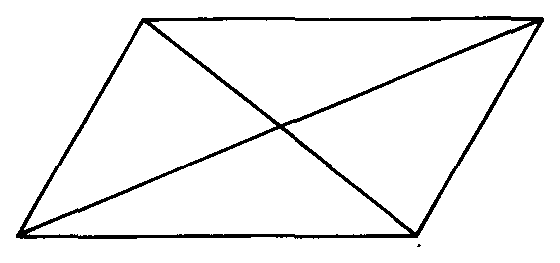
If the diagonals of the parallelogram in the figure measure 20 cm and 32 cm and form an angle of 60°, determine the sides of the parallelogram.
Ver resposta
14 cm and $2\sqrt{129}$ cm
Recognize the nature of a triangle: a) whose sides measure 6, 12 and 13; b) whose sides measure 6, 10 and 12; c) whose sides measure 5, 12 and 13; d) whose sides are in the ratio 3 : 4 : 4,5; e) whose sides are inversely proportional to 3, 4 and 6.
Ver resposta
a) acutangle · b) obtuse · c) rectangle · d) acutangle · e) obtuse
Recognize the nature of a triangle whose sides are inversely proportional to the numbers 3, 4 and 5.
Ver resposta
obtuse angle
The sides of a triangle measure 15 m, 20 m and 25 m. Determine the height relative to the longest side.
Ver resposta
12 m
The sides of a triangle measure 12 m, 20 m and 28 m. Determine the projection of the smallest onto the straight line on the side of 20 m.
Ver resposta
6 m
The sides of a triangle measure 7 m, 24 m and 25 m. Determine the height relative to the short side.
Ver resposta
24 m
Determine the side $\overline{BC}$ of an acute triangle $ABC$, where $AC = 7$ cm, $AB = 5$ cm and the projection of $\overline{AC}$ on $\overline{AB}$ measures 1 cm.
Ver resposta
8 cm
Determine the measurement of the side $\overline{AB}$ of a triangle $ABC$, obtuse angled at $A$, with $BC = 8$ cm, $AC = 5$ cm and the projection of the side $\overline{AB}$ on $\overline{AC}$ equal to 3 mm.
Ver resposta
6 cm
Determine the measurement of the side $\overline{BC}$ of a triangle $ABC$, where $AC = 10$ cm, $AB = 6$ cm and the projection of the side $\overline{BC}$ on $\overline{AC}$ is worth 10,4 cm.
Ver resposta
12 cm
The base of a triangle measures 10 cm and the other two sides, 14 cm and 8 cm, respectively. Determine the projections of these two sides onto the base of the triangle.
Ver resposta
$\dfrac{8}{5}$ cm and $\dfrac{58}{5}$ cm
Determine the projection of side $\overline{BC}$ onto side $\overline{AC}$ of a triangle $ABC$, where $BC = 12$ cm, $AC = 16$ cm and $AB = 18$ cm.
Ver resposta
$\dfrac{19}{8}$ cm
In a triangle $ABC$ is it possible to have $a^2 = b^2 + c^2 + 2bm$ and $c^2 = b^2 + a^2 + 2bn$ simultaneously, with $m$ being the projection of $c$ onto $b$ and $n$ being the projection of $a$ onto $b$? Justify.
Ver resposta
No, because the triangle would have two obtuse angles.
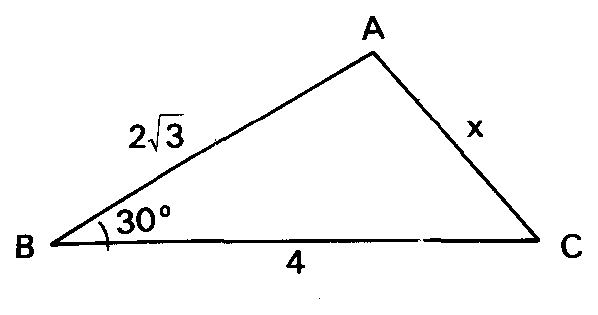
In the figure, calculate the value of $x$.
Ver resposta
2
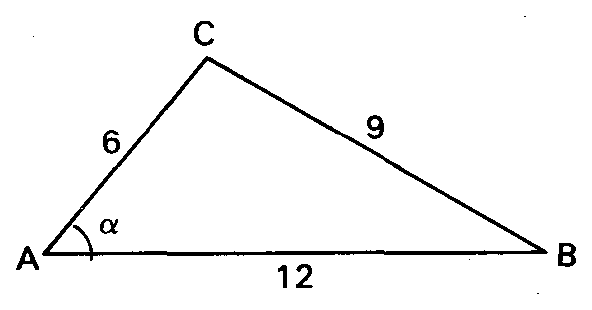
In the triangle $ABC$ in the figure, the side $\overline{AB}$ measures 12 cm, the side $\overline{BC}$ measures 9 cm and the side $\overline{AC}$ measures 6 cm. Calculate the cosine of the angle $\alpha$.
Ver resposta
$\dfrac{11}{16}$
Calculate the perimeter of the triangle in the figure.
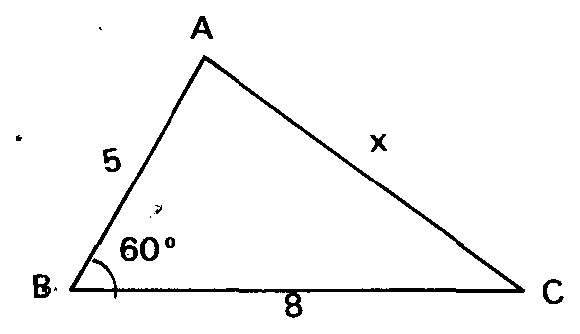
Ver resposta
20
Calculate the perimeter of the triangle $ABC$ in the figure.
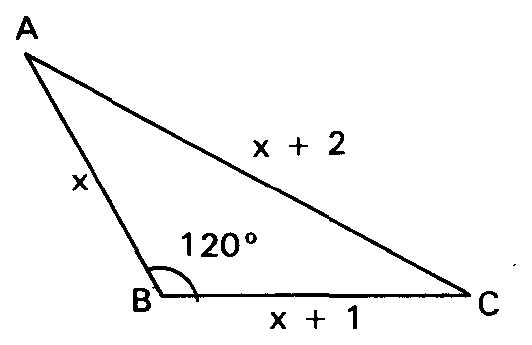
Ver resposta
$\dfrac{15}{2}$
Determine the value of $x$, knowing that $x + 5$, $3 - x$ and $x + 7$ are the measurements of the sides $\overline{AB}$, $\overline{BC}$ and $\overline{AC}$ of a triangle $ABC$ whose angle $\hat B$ is equal to 120°.
Ver resposta
zero
A chord $\overline{AB}$ of measurement $\ell$ determines an arc of 120° on a circle. Determine the distance from point $B$ to diameter $\overline{AC}$ of this circle.
Ver resposta
$\dfrac{\ell}{2}$
In the figure, $\overline{AB}$ is equal to the radius of the center circle $O$, $BC = 26$ and $\overline{BH}$ is perpendicular to $\overline{AC}$. Calculate $HC$.
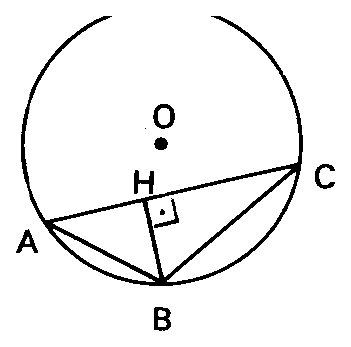
Ver resposta
$13\sqrt{3}$
Determine the longest diagonal of a parallelogram, in which two of its consecutive sides form an angle of 45° and measure, respectively, $5\sqrt{2}$ cm and 10 cm.
Ver resposta
$5\sqrt{10}$ cm
Knowing that the consecutive sides of a parallelogram measure 4 cm and 5 cm and one of the diagonals measures 6 cm, determine the measurement of the other diagonal.
Ver resposta
$\sqrt{46}$ cm
Two consecutive sides of a parallelogram measure 8 m and 12 m and form an angle of 60°. Calculate the diagonals.
Ver resposta
$4\sqrt{7}$ m e $4\sqrt{19}$ m
The median $\overline{AM}$ of a triangle $ABC$ measures 6 cm, divides the opposite side into two segments equal to 12 cm and forms two angles with this side that differ by 60°. Determine the lengths of the sides of this triangle.
Ver resposta
$6\sqrt{7}$ cm, $6\sqrt{3}$ cm and 24 cm
Is there a triangle $ABC$ such that $BC = 10$ cm, $AC = 1$ cm and $\beta = 30^{\circ}$, where $\beta$ is the angle opposite the side $\overline{AC}$?
Ver resposta
No. Use the law of cosines.
Two consecutive sides of a parallelogram have measurements $a$ and $b$ and one of the diagonals has dimensions $c$. Determine the length of the other diagonal.
Ver resposta
$\sqrt{2a^2 + 2b^2 - c^2}$
Prove that: “In any triangle, the square on the side opposite an acute angle is equal to the sum of the squares on the other two sides, minus twice the product of one of these sides and the projection of the other onto it.”
Ver resposta
See theory.
Prove that: “In an obtuse triangle, the square on the side opposite the obtuse angle is equal to the sum of the squares of the other two, plus twice the product of one of these sides and the projection of the other onto it.”
Ver resposta
See theory.
If, in a triangle, the square of one side is equal to the sum of the squares of the other two sides minus the product of these two sides, calculate the internal angle that the same two sides form.
Ver resposta
60°
On the sides of a triangle $ABC$ rectangle with sides 6 cm, $6\sqrt{3}$ cm and 12 cm we construct three external squares. Calculate the length of the sides of the triangle determined by the centers of these squares.
Ver resposta
$3(\sqrt{2} + \sqrt{6})$ cm, $3\sqrt{4\sqrt{3} + 10}$ cm and $3\sqrt{4\sqrt{3} + 14}$ cm
The measurements of the sides of the quadrilateral $ABCD$ are $AB = BC = 10$ m, $CD = 16$ m and $AD = 6$ m. Determine $BD$.
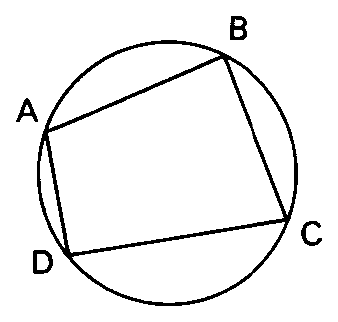
Ver resposta
$BD = 14$ m. Note that $\hat A$ and $\hat C$ are supplementary and apply the law of cosines in the triangles $ABD$ and $CBD$.
An internal point of equilateral triangle is 5 cm, 7 cm and 8 cm away from the vertices of the triangle. Determine the side of this triangle.
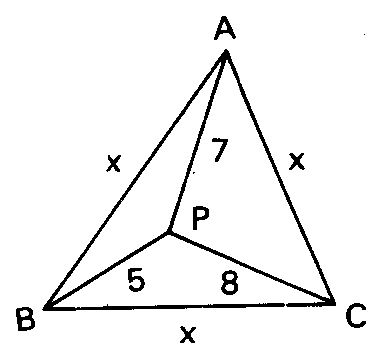
See the resolution of the book
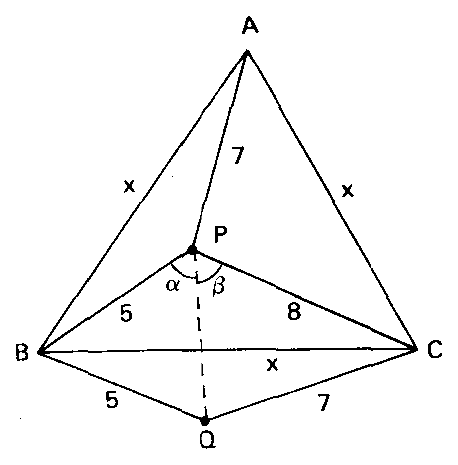
- Consider a point $Q$ external to the triangle with $BQ = 5$ and $CQ = 7$. Note that $\triangle PBA \equiv \triangle QBC$ (LLL), which gives $P\hat BQ = 60^{\circ}$. So $\triangle PBQ$ is equilateral and $B\hat PQ = 60^{\circ}$ ($\alpha = 60^{\circ}$).
- Apply the law of cosines to $\triangle PQC$ (sides 5, 7 and 8): we obtain $\beta = 60^{\circ}$.
- With $\alpha = 60^{\circ}$ and $\beta = 60^{\circ}$, $B\hat PC = 120^{\circ}$. Applying the law of cosines to $\triangle BPC$: $x^2 = 5^2 + 8^2 - 2 \cdot 5 \cdot 8 \cos 120^{\circ} = 129$, that is, $x = \sqrt{129}$ cm.
Ver resposta
$x = \sqrt{129}$ cm
Notable lines
Determine the measurement of the median $\overline{AM}$ of the triangle $ABC$, applying the median formula, and then calculate using the Stewart relationship.
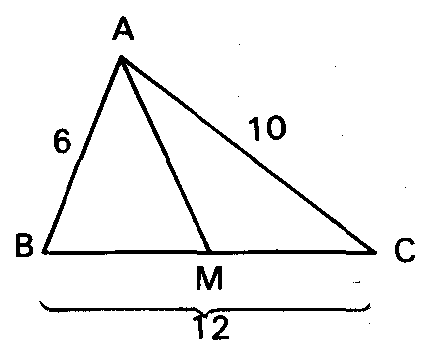
Ver resposta
$4\sqrt{2}$
Determine the measure of angle bisector $\overline{AS}$, applying the internal angle bisector formula, and then calculate using the angle bisector theorem and the Stewart relation.
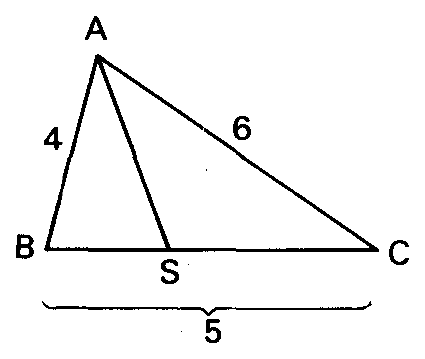
Ver resposta
$3\sqrt{2}$
Determine the measurement of angle bisector outside $\overline{AP}$ of $\triangle ABC$, applying the angle bisector formula, and then calculate using the angle bisector theorem and Stewart’s relation.
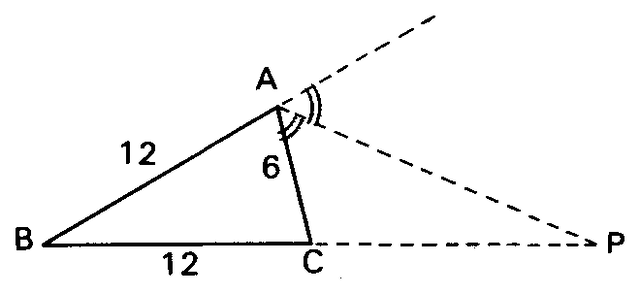
Ver resposta
$6\sqrt{6}$
Determine the value of $x$ in the following cases:
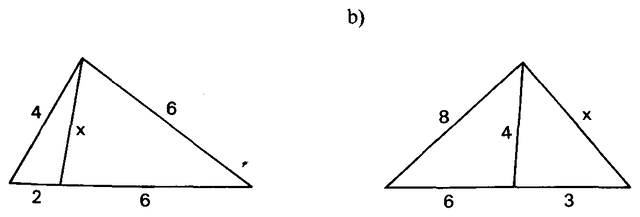
Ver resposta
a) 3 · b) $\sqrt{19}$
Determine the ratio between the sum of the squares of the medians of a triangle and the sum of the squares of the sides of that triangle.
Ver resposta
$\dfrac{3}{4}$
Calculate the heights of a triangle whose sides measure 6 m, 10 m and 12 m.
Ver resposta
$\dfrac{8\sqrt{14}}{3}$ m, $\dfrac{8\sqrt{14}}{5}$ m e $\dfrac{4\sqrt{14}}{3}$ m
The sides $\overline{AB}$, $\overline{AC}$ and $\overline{BC}$ of a triangle $ABC$ measure, respectively, 5 cm, 6 cm and 7 cm. Determine the height and the internal angle bisector relative to the $\overline{AC}$ side and the external angle bisector relative to the $\overline{AB}$ side.
Ver resposta
Height $2\sqrt{6}$ cm; angle bisector internal $\dfrac{\sqrt{105}}{2}$ cm; angle bisector external $12\sqrt{7}$ cm
Given the sides $a$, $b$ and $c$ of a triangle $ABC$, calculate the distance from the vertex $A$ to the point $M$ that divides the base $\overline{BC}$ into segments equal to $m$ and $n$.
Ver resposta
$\dfrac{\sqrt{m^2c^2 + n^2b^2 + mn(b^2 + c^2 - a^2)}}{m + n}$
If $\overline{AS}$ is angle bisector inside the triangle $ABC$, determine $x$ and $y$.
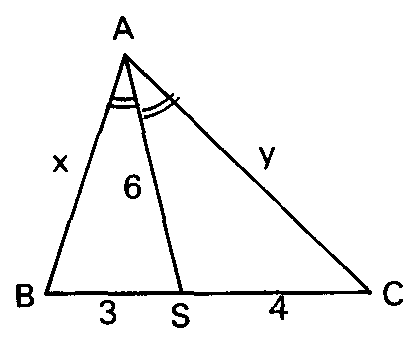
Ver resposta
$x = 6$; $y = 8$
If $\overline{AP}$ is angle bisector external to the triangle $ABC$, determine $x$ and $y$.
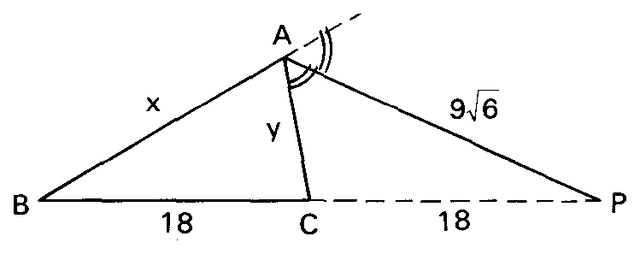
Ver resposta
$x = 18$; $y = 9$
Derive the formulas that give the three medians $m_a$, $m_b$ and $m_c$ of a triangle, depending on the sides $a$, $b$ and $c$.
Ver resposta
See theory (calculation of medians).
Derive the formulas that give the three heights $h_a$, $h_b$ and $h_c$ of a triangle as a function of the sides $a$, $b$ and $c$.
Ver resposta
See theory (calculation of heights).
Derive the expressions that provide the internal angle bisectors $s_a$, $s_b$ and $s_c$ of a triangle in function of the sides $a$, $b$ and $c$.
Ver resposta
See the theory (calculation of internal angle bisectors).
Given the three sides $a$, $b$, and $c$ of a triangle, obtain $s^{\prime}_a$, $s^{\prime}_b$, and $s^{\prime}_c$ by deducing the formulas that give the outer angle bisectors.
Ver resposta
See the theory (calculation of external angle bisectors).