
Euler's Eyes
2026-10-11
Exercises from chapter 6 — Perpendicularity
Exercises and resolutions
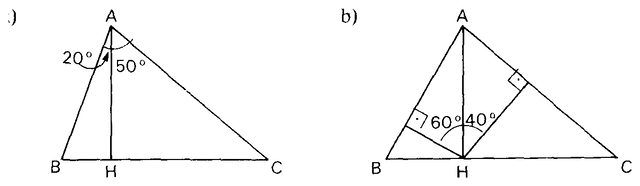
If $\overline{AH}$ is height relative to the $\overline{BC}$ side of $\triangle ABC$, determine $\hat{B}$ and $\hat{C}$ in the cases:
Ver resposta
a) $\hat{B} = 70^{\circ}$ e $\hat{C} = 40^{\circ}$ · b) $\hat{B} = 60^{\circ}$ e $\hat{C} = 40^{\circ}$
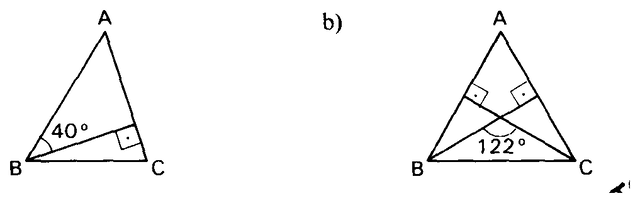
In each case below we have a base isosceles triangle $\overline{BC}$. Determine the angle of the base.
Ver resposta
a) $65^{\circ}$ · b) $61^{\circ}$
In the triangle $ABC$ in the figure, if $\overline{AH}$ is height and $\overline{BS}$ is angle bisector, determine $B\hat{S}C$, given $B\hat{A}H = 30^{\circ}$ and $A\hat{C}B = 40^{\circ}$.
Ver resposta
$B\hat{S}C = 110^{\circ}$
From the figure, we know that $\overline{AH}$ is height and $\overline{AS}$ is angle bisector relative to $\overline{BC}$ of the triangle $ABC$. If $\hat{B} = 70^{\circ}$ and $H\hat{A}S = 15^{\circ}$, determine $\hat{C}$.
Ver resposta
$\hat{C} = 40^{\circ}$
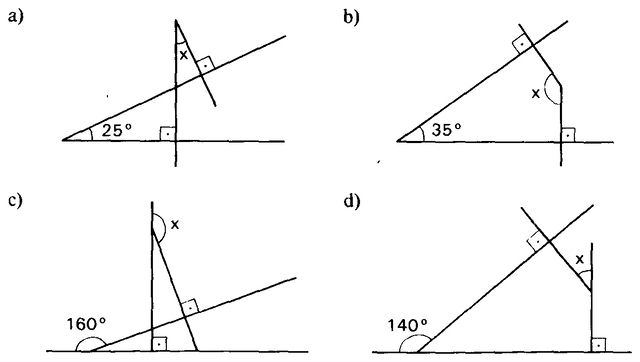
Determine the value of $x$ in the following cases:
Ver resposta
a) $25^{\circ}$ · b) $145^{\circ}$ · c) $160^{\circ}$ · d) $40^{\circ}$
Demonstrate: two angles with respectively perpendicular sides are congruent or supplementary.
See the resolution of the book
Let the angles be $a\hat{O}b$ and $c\hat{V}d$ with $Oa \perp Vc$ and $Ob \perp Vd$, with measurements $\alpha$ and $\beta$, with $\alpha^{\prime}$ and $\beta^{\prime}$ being the measurements of the supplementary adjacent ones. Through $O$ we lead $Oc^{\prime} \parallel Vc$ and $Od^{\prime} \parallel Vd$, resulting in the angle $c^{\prime}\hat{O}d^{\prime}$ measuring $\gamma$ and its adjacent supplementary $\gamma^{\prime}$.
By angles of parallel sides: $\gamma = \beta$, $\gamma^{\prime} = \beta^{\prime}$. Since $a\hat{O}c^{\prime}$ and $b\hat{O}d^{\prime}$ are straight:
$$a\hat{O}d^{\prime} = 90^{\circ} - \alpha \quad\text{e}\quad a\hat{O}d^{\prime} = 90^{\circ} - \gamma = 90^{\circ} - \beta \ \Longrightarrow\ \alpha = \beta.$$Then $\alpha = \beta$, $\alpha^{\prime} = \beta^{\prime}$, $\alpha + \beta^{\prime} = 180^{\circ}$ and $\alpha^{\prime} + \beta = 180^{\circ}$.
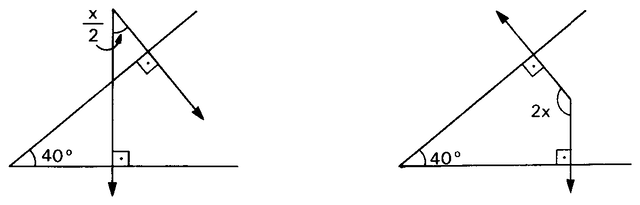
In the figure (on the left), calculate the value of $x$.
Ver resposta
$x = 80^{\circ}$
In the figure above (right), calculate the value of $x$.
Ver resposta
$x = 70^{\circ}$
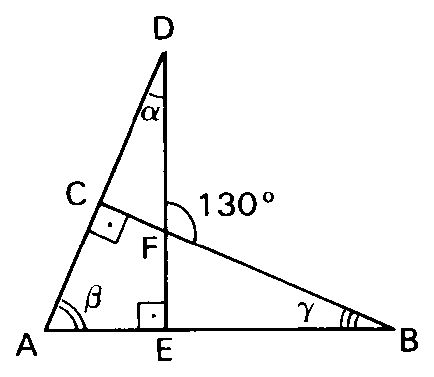
In the figure, determine the measurement of $\alpha$, $\beta$ and $\gamma$.
Ver resposta
$\alpha = 40^{\circ}$, $\beta = 50^{\circ}$ e $\gamma = 40^{\circ}$
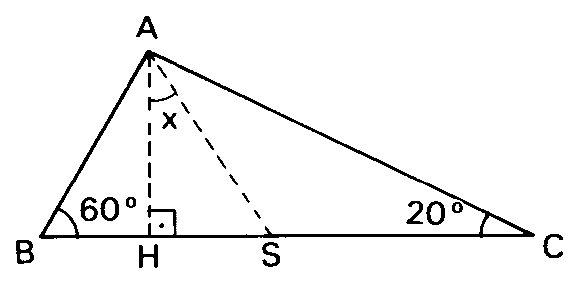
In the triangle $ABC$ in the figure, $\hat{B} = 60^{\circ}$ and $\hat{C} = 20^{\circ}$. What is the value of the angle $H\hat{A}S$ formed by the height $\overline{AH}$ and angle bisector $\overline{AS}$?
Ver resposta
$H\hat{A}S = 20^{\circ}$
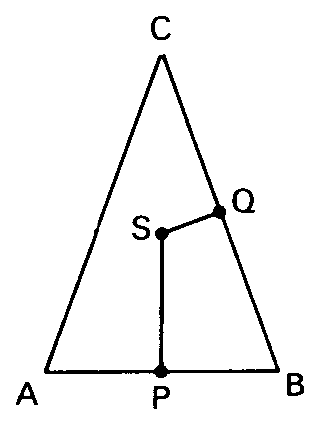
In a isosceles triangle $ABC$ with base $\overline{AB}$, the angle $\hat{B}$ is equal to $\dfrac{2}{3}$ of the angle $\hat{S}$, formed by perpendicular bisectors $\overline{QS}$ and $\overline{PS}$. Calculate the angles of this triangle.
Ver resposta
$36^{\circ}$, $72^{\circ}$ e $72^{\circ}$
Show: the median relative to the hypotenuse of a right-angled triangle measures half the hypotenuse.
Ver resposta
It is the median relative to the hypotenuse theorem, demonstrated above.
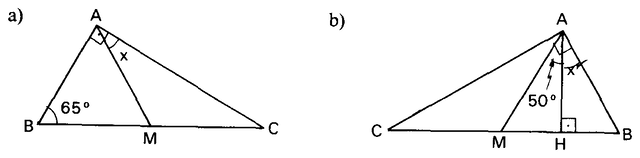
If the triangle $ABC$ is a rectangle with hypotenuse $\overline{BC}$ and $\overline{AM}$ is the median, determine $x$:
Ver resposta
a) $25^{\circ}$ · b) $20^{\circ}$
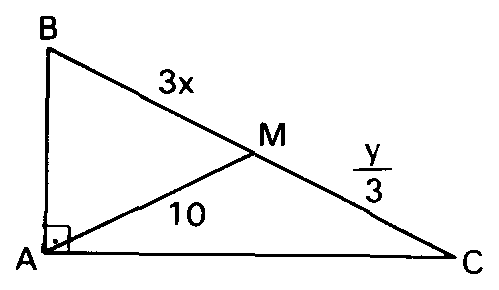
In the figure, calculate $x$ and $y$. $M$ is the midpoint of $\overline{BC}$.
Ver resposta
$x = \dfrac{10}{3}$ e $y = 30$
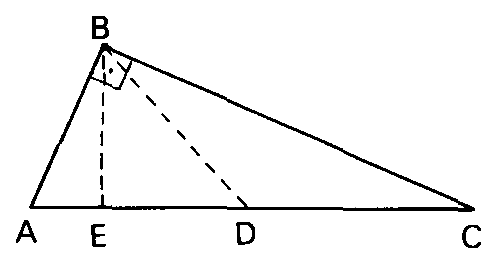
In the figure, $\overline{BD}$ is the median of the right triangle $ABC$ ($\hat{B} = 90^{\circ}$) and $\overline{BE} \perp \overline{AC}$. If $\hat{A} = 70^{\circ}$, calculate the measurement of $E\hat{B}D$.
Ver resposta
$E\hat{B}D = 50^{\circ}$
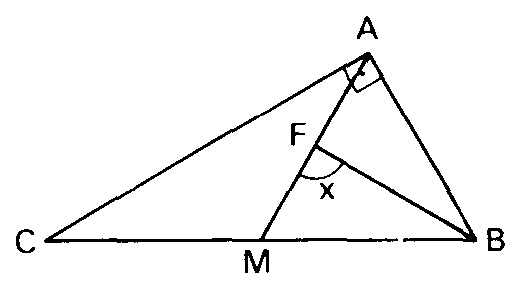
In the right-angled triangle $ABC$ in the figure, the median $\overline{AM}$ forms the adjacent angles $B\hat{F}A$ and $B\hat{F}M$ with angle bisector $\overline{BF}$. Express $B\hat{F}M$ in terms of $\hat{B}$.
Ver resposta
$B\hat{F}M = \dfrac{3\hat{B}}{2}$
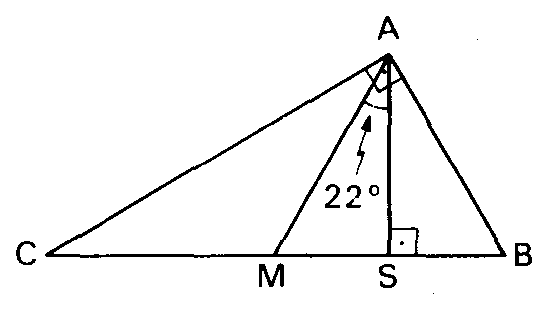
In a right triangle $ABC$, the height $\overline{AS}$ forms an angle of $22^{\circ}$ with the median $\overline{AM}$. Calculate $\hat{B}$ and $\hat{C}$.
Ver resposta
$\hat{B} = 56^{\circ}$ e $\hat{C} = 34^{\circ}$
Determine the acute angles of a right triangle, knowing that the median and angle bisector relative to the hypotenuse form an angle of $35^{\circ}$.
Ver resposta
$80^{\circ}$ e $10^{\circ}$
The internal angle bisectors of the angles $\hat{B}$ and $\hat{C}$ of a triangle $ABC$ form an angle of $116^{\circ}$. Determine the measure of the smallest angle formed by the heights relative to the sides $\overline{AB}$ and $\overline{AC}$ of this triangle.
Ver resposta
$52^{\circ}$
In any right-angled triangle, the angle formed by the height and median relative to the hypotenuse is equal to the modulus of the difference between the angles adjacent to the hypotenuse.
Ver resposta
Consider that the median relative to the hypotenuse determines two isosceles triangles (see the median figure).
Show that if a median relative to a side of a triangle measures half of that side, then the triangle is right-angled.
Ver resposta
The triangles $AMB$ and $AMC$ are isosceles; with $\alpha$ and $\beta$ being their base angles, $2\alpha + 2\beta = 180^{\circ}$, therefore $\alpha + \beta = 90^{\circ} = \hat{A}$.
Since $ABC$ is a isosceles triangle base $\overline{BC}$ and $M$ is a base point, prove that: 1st) if $\overline{AM}$ is median, then it is angle bisector and height; 2nd) if $\overline{AM}$ is angle bisector, then it is median and height; 3rd) if $\overline{AM}$ is height, then it is median and angle bisector.
See the resolution of the book
In a isosceles triangle the base angles are congruent. In each case, $\triangle ABM \equiv \triangle ACM$ is proved:
- $\overline{AM}$ median: for the LLL (or LAL) case. Hence $\overline{AM}$ is angle bisector and height.
- $\overline{AM}$ angle bisector: for the LAL (or ALA) case. Hence $\overline{AM}$ is median and height.
- $\overline{AM}$ height: for the special case of right-angled triangles (or LAAₒ). Hence $\overline{AM}$ is median and angle bisector.
Show that in every isosceles triangle we always have two congruent heights.
Ver resposta
Use LAAₒ.
Show that if an altitude and a median of a triangle coincide, then that triangle is isosceles.
Ver resposta
Use LAL.
Show that if an altitude and an angle bisector of a triangle coincide, then that triangle is isosceles.
Ver resposta
Use ALA.
Prove that the angle bisectors of the acute angles of a right-angled triangle form angles that are independent of the values of those acute angles.
Ver resposta
In fact, they always form angles of $45^{\circ}$ and $135^{\circ}$, because $\dfrac{\hat{B}}{2} + \dfrac{\hat{C}}{2} = 45^{\circ}$.
Show that if two heights of a triangle are congruent, then that triangle is isosceles.
Ver resposta
Use the special case of congruence of right triangles.
Every straight line that passes through the midpoint of a segment is equidistant from the ends of the segment.
See the resolution of the book
Hypothesis: $AM = MB$, $M \in r$. Thesis: $d_{A,r} = d_{B,r}$.
- If $r \supset \overline{AB}$, both distances are null.
- If $r$ does not contain $\overline{AB}$ and is not perpendicular to it, we draw $\overline{AA^{\prime}}$ and $\overline{BB^{\prime}}$ perpendicular to $r$. In triangles $AA^{\prime}M$ and $BB^{\prime}M$: $\hat{A}^{\prime} \equiv \hat{B}^{\prime}$ (straight), $A\hat{M}A^{\prime} \equiv B\hat{M}B^{\prime}$ (o.p.v.) and $AM = BM$. By LAAₒ, they are congruent, and $AA^{\prime} = BB^{\prime}$.
- If $r \perp \overline{AB}$ by $M$ ($r$ is to perpendicular bisector), $A^{\prime} = B^{\prime} = M$ and $AA^{\prime} = BB^{\prime}$.
Note: the straight line is equidistant from the extremes, but its points, in general, are not. Only in perpendicular bisector is each point equidistant from the extremes.
Does every straight line equidistant from the ends of a segment pass through its midpoint?
Ver resposta
No: it can be parallel to the segment.
Given two distinct points $A$ and $B$ and a point $P$ outside the straight line $AB$, how do we obtain, in the plane of the points $A$, $B$ and $P$, two equidistant straight lines from $A$ and $B$ passing through $P$?
Ver resposta
Since $M$ is the midpoint of $\overline{AB}$, the lines are parallel to the line $AB$ through $P$ and the line $PM$.
Prove that the height relative to any side of a triangle is less than the arithmetic mean of the adjacent sides.
Ver resposta
Cathetus < hypotenuse: $h_a < b$ and $h_a < c$; adding, $h_a < \dfrac{b + c}{2}$.
Show that the sum of the three heights of an acute triangle is less than the perimeter and greater than the semiperimeter of that triangle.
Ver resposta
1st part: use the previous one for the three pitches. 2nd part: check that $2h_a > b + c - a$ (and similar) and disappear.
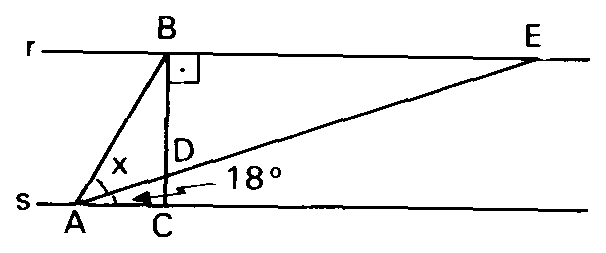
Since $r$ and $s$ are parallel lines and $DE = 2AB$, determine $x$.
Ver resolução
Let $M$ be the midpoint of $\overline{DE}$ and $AB = \ell$. Then $DM = EM = \ell$ and, by the median relative to the hypotenuse in the right triangle $DBE$, also $BM = \ell$. Thus, the triangles $ABM$ and $BME$ are isosceles. Indicating the angles of the bases, we obtain $x = 2 \cdot 18^{\circ} = 36^{\circ}$.
Ver resposta
$x = 36^{\circ}$
In a right triangle $ABC$ with hypotenuse $\overline{BC}$, draw angle bisector $\overline{BS}$, with $S$ in $\overline{AC}$. Show that $AS < SC$.
Ver resposta
Through the point $S$, draw $\overline{SR}$ perpendicular to $\overline{BC}$, with $R$ in $\overline{BC}$. The triangles $BAS$ and $BRS$ are congruent, hence $AS = RS$ (1). In the right triangle $SRC$, $RS < SC$ (side < hypotenuse) (2). From (1) and (2), $AS < SC$.
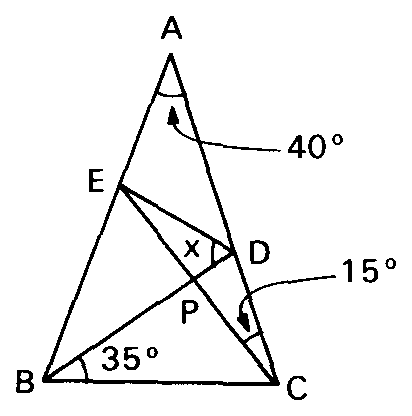
The triangle $ABC$ below is isosceles with base $\overline{BC}$. Determine $x$.
Ver resolução
- $\hat{B} = \hat{C} = 70^{\circ}$, so $\overline{BP}$ is angle bisector of $\hat{B}$ ($35^{\circ} + 35^{\circ}$).
- At $\triangle BPC$: $\hat{B} = 35^{\circ}$, $\hat{C} = 55^{\circ}$, then $\hat{P} = 90^{\circ}$.
- In $\triangle CBE$, $\overline{BP}$ is angle bisector and height, so the triangle is isosceles base $\overline{CE}$, and $P$ is midpoint of $\overline{EC}$.
- In $\triangle DEC$, $\overline{DP}$ is median and height, so it is also isosceles of base $\overline{EC}$. Then $\hat{E} = 15^{\circ}$ and $x = 75^{\circ}$.
Ver resposta
$x = 75^{\circ}$