
Euler's Eyes
2020-06-19
OBMEP 2021 - Second Phase
OBMEP 2021: Second Phase - Level 1
Exercise 1
Mariana has a set of 15 pins, with 5 black, 5 white and 5 gray. Pins of the same color are worth the same number of points. The score obtained in a play is the sum of the points of the pins corresponding to the knocked down pins. In one play, Mariana scored 10 points by knocking down two black pegs. In another play, she scored 12 points by knocking down a black and a white peg. In a third move, Mariana scored 55 points by knocking down three black, one white and three gray pins.

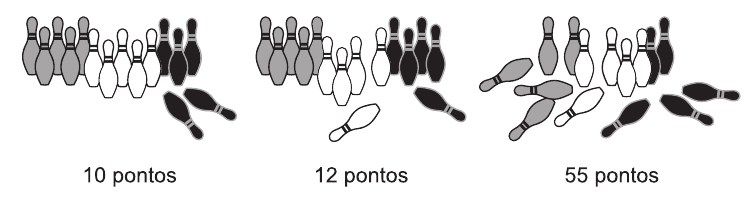
A) How much is each black peg worth?
Response: 5
Since 2 pins are worth 10 points, each black pin is worth:
$$\text{Pino}_{\text{preto} }=10/2=5$$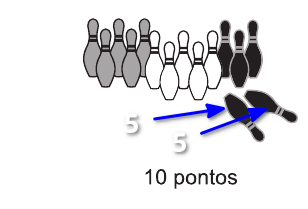
B) How much is each gray pin worth?
Response: 11
-
Step 1: white pin
$$\text{Pino}_{\text{branco} }=12-5=7$$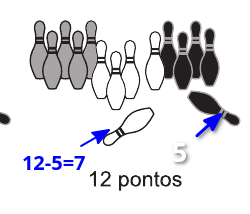
-
Step 2: gray pin
$$3\text{Pino}_{\text{cinza} }=55-15-7=33$$
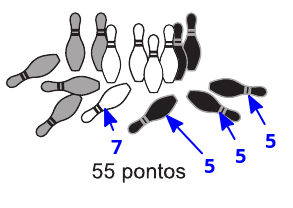 $$\text{Pino}_{\text{cinza} }=\frac{33}{3}=11 ~\text{pinos cinzas}$$
C) Mariana scored 42 points in one play by knocking down at least one pin of each color. How many pegs of each color did she knock down?
Statement:
- in the play in which Mariana scored 42 points,
- at least one peg of each color was knocked down.
Possibility:
- 2 black pegs and each black peg is worth 5 points.
- 3 white pegs and each white peg is worth 7 points.
- 1 gray pin and each gray pin is worth 11 points.
Logo:
$$\text{Pontos total} = 2 \text{ Pinos pretos }\times 5 + 3 \text{ Pinos brancos }\times 7 + 1 \text{ Pino cinza }\times 11=42$$Let’s see how this answer was found and why there is no other solution:
- If only one gray pin was knocked down, the total of the black and white pin values dropped must be 42 – 11 = 31. Observing the multiplication tables of 5 and 7, we see that the The only way to write 31 as a sum of a multiple of 5 with a multiple of 7 is 31 = 2 × 5 + 3 × 7. This is the solution presented above.
- If two gray pins were knocked down, the total of the values of the black and white pins dropped must be 42 – 22 = 20. Observing the multiplication tables of 5 and 7, we see, in a analogous, that the only way to write 20 as a sum of a multiple of 5 with a multiple of 7 is 20 = 4 × 5 + 0 × 7, but this solution does not work, as the statement says that at least one white peg was knocked down.
- If three gray colored pegs were knocked down, the total of the values of the black and white pegs dropped must be 42 – 33 = 9, and it is impossible to write 9 as the sum of a multiple of 5 with a multiple of 7.
- If four or more gray colored pegs were knocked down, the total of the peg values dropped exceeds 42 and therefore this is not the case.
Exercise 2
There are 100 people in a queue. The first and third positions in the queue are occupied by men. For every five consecutive positions, there are three women and two men. For example, in positions 13, 14, 15, 16, and 17, there are three women and two men.
A) How many women are there in line?

We divide the 100 people into blocks of 5 people each and we obtain 100 ÷ 5 = 20 blocks. How in each block there are three women, we have a total of 20 × 3 = 60 women in the queue
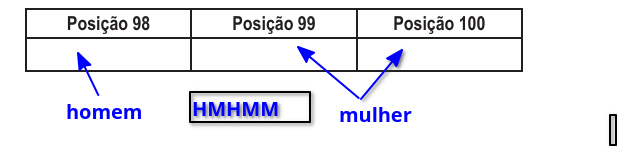
B) Complete the table below by writing man or woman in each position, according to the statement.


- In the first five positions, there are two men, so positions 2, 4 and 5 must be occupied by women.
- On the other hand, in positions 2 to 6, there are already three women and, therefore, the position 6 must be occupied by a man.
- From now on, the pattern repeats itself: in the positions of 3 to 7 there are already two men, so position 7 must be occupied by a woman, and so onwards.
- We observed that, every five years, the sequence of men and women is always the same: HMHMM, HMHMM, HMHMM…
C) Complete the table below by writing man or woman in each position, according to the statement

The correct answer is this because the last positions, from 95 to 100, also present the sequence HMHMM.
Exercise 3
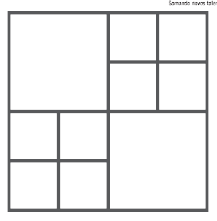
Janaína draws squares formed by smaller squares, whose sides have integer measurements. For example, the figure shows how Janaína drew a square of side 4 formed by ten squares, two of which side 2 and eight sides 1.
A) Show how Janaína can draw a square of side 3 formed with the smallest amount possible of smaller squares with sides of integer measurements.
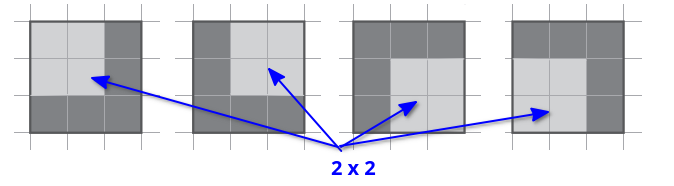
So that the number of squares used to form the square of side 3 is the smallest As possible, Janaína should use the largest squares possible.
- In this case, she can only use one square with side 2, because, if she uses one more, the square will have to have side 4, at least.
- When using a square of side 2, the remainder must be completed by 9 – 4 = 5 squares units.
- There are three other possible positions for this figure, just rotate the first figure or, equivalently, move the side square 2 to the other corners of the side square 3.
B) Janaína wants to draw a large square formed by a square of side 3, some squares of side 2 and the smallest amount possible number of side squares 1. Show, in the box on the side, How can Janaína make this drawing.
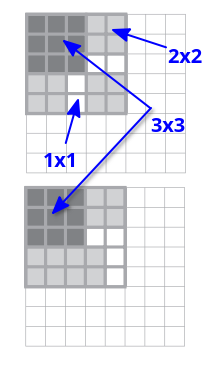
- If Janaína wants to use a square with side 3 and squares side 2 to form the large square, then this must have measurement side 5, at least.
- A square of side 5 corresponds to 25 unit squares. If, in your composition, there is a square of side 3, there remain 25 – 9 = 16 unit squares.
- Each square of side 2 corresponds to 4 unit squares.
- In principle, she could use four squares of side 2, but this configuration is not possible, as can be seen with the all-possibilities test fitting.
- However, it is possible to use three squares of side 2, remaining to be completed with four unitary squares, which is the minimum number sought.
- We see two types different from figures that Janaína can draw.
- She can, As in the previous item, rotate these figures, making other designs.
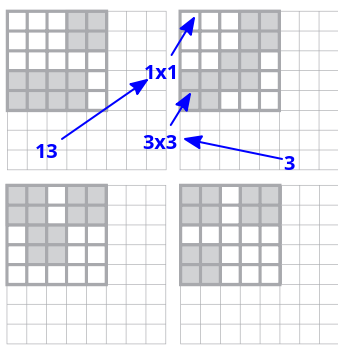
C) Janaína wants to draw a square with the smallest possible side formed by 13 squares of side 1 and by other larger squares with sides of whole measurements. Show, in the box on the side, how Janaína can do this drawing.
-
The smallest square containing 13 unit squares is the square of side 4.
-
But since 16 – 13 = 3, this square does not serve the purpose of Janaína, because, to fill the space of 3 unit squares, it can only use 3 unit squares, and, hence, their total would be 16, contrary to the statement.
-
In the square of side 5, we have 25 – 13 = 12, which corresponds three squares on a side 2.
-
In fact, Janaína can draw the square side 5, as small as possible, with three side squares 2 and 13 squares units in several different ways, four of which are exemplified below.
-
Note that it is not possible to use a square of side 3 to occupy the space of 12 squares unitary squares, as the remaining space (12 – 9 = 3) could only be occupied with unitary squares, increasing their number from 13 to 16.
Exercise 4
Joãozinho made all possible divisions with two different numbers belonging to the set {1, 2, 3, 4, 5, 6, 7, 8, 9}. For example, with the numbers 2 and 5, he made the following divisions
- 2 / 5 = 0,4
- 5 / 2 = 2,5
A) In how many divisions did Joãozinho get a whole number as a result?
The whole numbers in the divisions that Joãozinho made are those in which the dividend is a multiple of the divisor, that is:
- a/b divisions where a is a multiple of b.
Since a and b are two different numbers from the set {1, 2, 3, 4, 5, 6, 7, 8, 9}, for each possible divisor b in {1, 2, 3, 4, 5, 6, 7, 8, 9}, we must count the possibilities of dividend a in {1, 2, 3, 4, 5, 6, 7, 8, 9}, such that a is a multiple of b and different from b. We have:
- for b = 1 the possibilities for a are {2, 3, 4, 5, 6, 7, 8, 9}, that is, 8 possibilities;
- for b = 2 the possibilities for a are {4, 6, 8}, that is, 3 possibilities;
- for b = 3 the possibilities for a are {6, 9}, that is, 2 possibilities;
- for b = 4 the possibility for a is {8}, that is, 1 possibility;
- for b = 5, 6, 7, 8, 9 there are no possibilities for a.
Therefore, Joãozinho obtained as a result an integer in 8 + 3 + 2 + 1 = 14 divisions.
B) In how many divisions did Joãozinho result in a number greater than 0,5?
The numbers greater than 0,5 in the divisions that Joãozinho made are those in which the dividend is greater than half the divisor, that is:
- a/b divisions in which a is greater than half of b.
Since a and b are two different numbers from the set {1, 2, 3, 4, 5, 6, 7, 8, 9}, for each possibility of divisor b in {1, 2, 3, 4, 5, 6, 7, 8, 9}, we must count the possibilities of dividend a in {1, 2, 3, 4, 5, 6, 7, 8, 9} such that a is different from b and greater than half of b. We have:
- for b = 1 the possibilities for a are {2, 3, 4, 5, 6, 7, 8, 9}, that is, 8 possibilities;
- for b = 2 the possibilities for a are {3, 4, 5, 6, 7, 8, 9}, that is, 7 possibilities;
- for b = 3 the possibilities for a are {2, 4, 5, 6, 7, 8, 9}, that is, 7 possibilities;
- for b = 4 the possibilities for a are {3, 5, 6, 7, 8, 9}, that is, 6 possibilities;
- for b = 5 the possibilities for a are {3, 4, 6, 7, 8, 9}, that is, 6 possibilities;
- for b = 6 the possibilities for a are {4, 5, 7, 8, 9}, that is, 5 possibilities;
- for b = 7 the possibilities for a are {4, 5, 6, 8, 9}, that is, 5 possibilities;
- for b = 8 the possibilities for a are {5, 6, 7, 9}, that is, 4 possibilities;
- for b = 9 the possibilities for a are {5, 6, 7, 8}, that is, 4 possibilities.
Therefore, Joãozinho obtained as a result a number greater than 0,5 in 8 + 7 + 7 + 6 + 6 + 5 + 5 + 4 + 4 = 52 divisions.
C) How many different results were obtained by Joãozinho?
The different results in the divisions that Joãozinho made are those in which the dividend and the divisor does not have common factors, that is:
- a/b e, that a and b are primes to each other
since, if there is a common factor k to a and b, then a = k × a’ and b = k × b’, and this common factor k can be canceled in division
$$\frac{a}{b}=\frac{k a^\prime}{k b^\prime}=\frac{a^\prime}{b^\prime}$$and the new division will also be a division made by Joãozinho. Since a and b are two different numbers from the set {1, 2, 3, 4, 5, 6, 7, 8, 9}, for each possibility of divisor b in {1, 2, 3, 4, 5, 6, 7, 8, 9}, we must count the possibilities of dividend a in {1, 2, 3, 4, 5, 6, 7, 8, 9} such that a and b are primes to each other. We have:
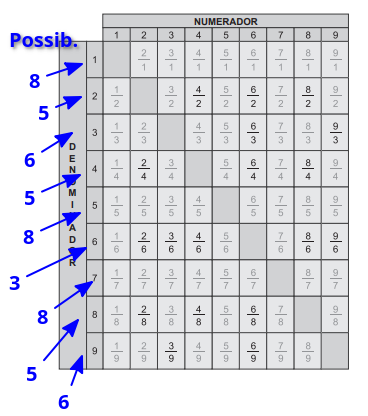
- for b = 1 the possibilities for a are {2, 3, 4, 5, 6, 7, 8, 9}, that is, 8 possibilities;
- for b = 2 the possibilities for a are {1, 3, 5, 7, 9}, that is, 5 possibilities;
- for b = 3 the possibilities for a are {1, 2, 4, 5, 7, 8}, that is, 6 possibilities;
- for b = 4 the possibilities for a are {1, 3, 5, 7, 9}, that is, 5 possibilities;
- for b = 5 the possibilities for a are {1, 2, 3, 4, 6, 7, 8, 9}, that is, 8 possibilities;
- for b = 6 the possibilities for a are {1, 5, 7}, that is, 3 possibilities;
- for b = 7 the possibilities for a are {1, 2, 3, 4, 5, 6, 8, 9}, that is, 8 possibilities;
- for b = 8 the possibilities for a are {1, 3, 5, 7, 9}, that is, 5 possibilities;
- for b = 9 the possibilities for a are {1, 2, 4, 5, 7, 8}, that is, 6 possibilities.
Therefore, Joãozinho obtained 8 + 5 + 6 + 5 + 8 + 3 + 8 + 5 + 6 = 54 different results in his divisions.
Exercise 5
Maria paints, in her notebook, figures formed by trapezoids and hexagons. Each hexagon can be painted blue, beige or gray, and each trapezoid, blue or black. Polygons with a common side cannot have the same color. The following figure is an example of a painting made by Maria.
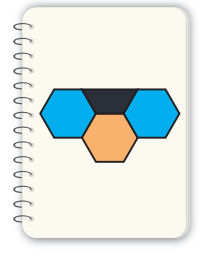
A) In how many ways can Maria paint the figure below?
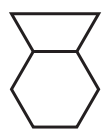
Maria can paint both the hexagon and the trapezoid blue and, therefore, this color must be treated separately.
- Case 1: if the hexagon is painted blue, then, in order not to repeat the same color in the trapezoid, this can only be painted black (1 possibility).
- Case 2: if the hexagon is not painted blue (2 possibilities), Maria can paint the blue or black trapezoid (2 possibilities). $$\text{Caso 2}= 2\times 2 = 4$$
Putting the two cases together, we see that Maria can paint Figure 1 in 1 + 4 = 5 ways different
B) In how many ways can Maria paint the figure below?
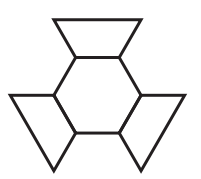
- Case 1: if the hexagon is painted blue by Maria, all three trapezoids must be painted black (1 possibility).
- Case 2: if the hexagon is not painted blue (2 possibilities), each of the three The trapezoids in Figure 2 can be painted blue or black. $$2\times 2 \times 2 \times 2 = 16$$
Putting the two cases together, we see that Maria can paint Figure 2 in 1 + 16 = 17 ways different.
C) In how many ways can Maria paint the picture below
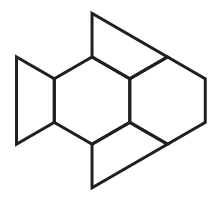
Let’s list the regions according to the figure below:
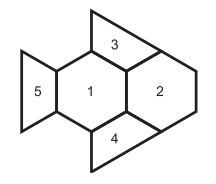
Let’s divide it into 6 cases:
- Hexagon 1 in blue, hexagon 2 in beige. In this case, the trapezoids 3, 4 and 5 must be painted black (1 possibility).
- Hexagon 1 in blue, hexagon 2 in gray. In this case, the trapezoids 3, 4 and 5 must also be painted black (1 possibility).
- Hexagon 1 in beige, hexagon 2 in blue. In this case, the trapezoids 3 and 4 must be painted black, but the trapezoid 5 can be painted blue or black (2 possibilities).
- Hexagon 1 in beige, hexagon 2 in gray. Each trapezoid can be painted in two colors (2 × 2 × 2 = 8 possibilities).
- Hexagon 1 in gray, hexagon 2 in blue. In this case, the trapezoids 3 and 4 must be painted black and the trapezoid 5 can be painted in two colors (2 possibilities).
- Hexagon 1 in gray, hexagon 2 in beige. Each trapezoid can be painted in two colors (2 × 2 × 2 = 8 possibilities).
Therefore, there are 1 + 1 + 2 + 8 + 2 + 8 = 22 different ways for Maria to paint the Figure
Exercise 6
A day is fantastic when its date, written in the form DD/MM/YY, contains all the digits from 0 to 5. Put For example, April 12 of 2053 will be fantastic, because its date, 12/04/53, contains all the digits from 0 to 5. The next day will not be fantastic, as its date, 13/04/53, does not contain the number 2.
A) What will be the last fantastic day of the year 2054?
For a date Dd/Mm/54 to be a fantastic day, D, d, M, m must be
- 0, 1, 2 and 3, in some order, as 4 and 5 are present in the year.
- As we want the last fantastic day of this year, we should look for sometime in December.
- Thus, Mm = 12.
Therefore, as 30 is greater than 03, the last fantastic day of 2054 will be 30/12/54.
B) In the year 2001 there are no fantastic days, as we cannot choose M, since, if
- In the year 2001 there are no fantastic days, as we cannot choose M, since, if Dd/Mm/Aa is fantastic, so M = 0 or M = 1.
Furthermore, in the years 2002, 2003, 2004 or 2005, there can only be a fantastic day if M = 1, since 0 has already been used.
-
In this case, we must necessarily have m = 2, as we cannot repeat 1. This excludes the possibility hope we have a fantastic year in 2002.
-
For one day to be fantastic in 2003, we must have D and d equal to 5 and 4 in some order. This is impossible, because days like this don’t exist.
-
To have a fantastic year in 2004, we must have D and d equal to 3 and 5 in some order. This is also impossible.
-
To have a fantastic year in 2005, we must have D and d equal to 3 and 4 in some order. Impossible again.
-
The next year to be tested is 2010. In this case, M cannot be 1 or 0.
-
Next we test 2012. In this case, M = 0. So D, d and m are 3, 4, 5 in some order (which is impossible).
-
Finally, we test 2013. In this case, M = 0, while D, d and m are, in some order, equal to 2, 4 and 5.
Since D = 0, 1, 2 or 3, we must have D = 2.
So, since we want the first day after January 1st, 2001, the answer is 25/04/13, as it comes before 24/05/13.
C) Between 2001 and 2100, how many years are there at least one fantastic day?
We saw that, between 2001 and 2100,
- the first year with some fantastic date is 2013 (item b) and
- the last one is 2054 (item a).
Keeping the notation Dd/Mm/Aa and remembering that different letters correspond to different numbers from the set {0, 1, 2, 3, 4, 5}, we can divide the count in two disjoint cases:
- Case 1: {A, a} is a subset with two distinct elements of {2, 3, 4, 5}.
- For a day 1d/0m/Aa to be fantastic, it is enough that d, m, A, a are a permutation of {2, 3, 4, 5}. Therefore, if {A, a} is a subset with two distinct elements of {2, 3, 4, 5}, this year will have at least one fantastic day of the type 1d/0m/Aa.
- We can form 4 × 3 = 12 years with this condition.
- Case 2: {A, a} ⊂ {0, 1, 2, 3, 4, 5} is not a subset with two distinct elements of
{2, 3, 4, 5}. There are three subcases:
- A ∈ {2, 3, 4, 5} e a ∉ {2, 3, 4, 5}
- (these are the years of 2020, 2021, 2030, 2031, 2040, 2041,2050 and 2051); or
- A ∉ {2, 3, 4, 5} e a ∈ {2, 3, 4, 5}
- (these are the years 2013, 2014 and 2015, as the years 2002, 2003, 2004, 2005 and 2012 do not have fantastic dates, as they begin to appear in 2013); or
- A ∉ {2, 3, 4, 5} e a ∉ {2, 3, 4, 5}
- (the years 2000, 2001, 2010 and 2011 do not have fantastic dates, as they start to appear in 2013).
- A ∈ {2, 3, 4, 5} e a ∉ {2, 3, 4, 5}
The years 2020, 2030, 2040 and 2050 (ending in 0) do not have fantastic dates. In fact, in these cases, M = 1, D = 2 (the case D = 3 would force d = 0 or d = 1, already used) and m does not could be none of its possible values 0, 1 or 2, as they have already been used.
The year 2021 has no fantastic dates. In this case, as before, M = 0, D = 2 and not we could choose m.
All the remaining years ― 2013, 2014, 2015, 2031, 2041, 2051 ― have fantastic dates, which are in the form 2d/0m/A1 or in the form 2d/0m/1a, just choose d, m and a as elements of a permutation of {3, 4, 5}. In the total of case 2, there is, therefore, 6 possibilities. Putting together the cases 1 and 2, we see that there are a total of 12 + 6 = 18 years with at least one day fantastic. The years that have some fantastic date are the following.
- 2013 (25/04/13 is an example)
- 2014 (23/05/14)
- 2015 (23/04/15)
- 2023 (14/05/23)
- 2024 (15/03/24)
- 2025 (13/04/25)
- 2031 (24/05/31)
- 2032 (14/05/32)
- 2034 (12/05/34)
- 2035 (14/02/35)
- 2041 (23/05/41)
- 2042 (13/05/42)
- 2043 (12/05/43)
- 2045 (13/02/45)
- 2051 (23/04/51)
- 2052 (13/04/52)
- 2053 (14/02/53)
- 2054 (30/12/54)
The other years between 2001 and 2100 do not have fantastic dates.