
Euler's Eyes
2026-10-15
The life of Évariste Galois
Timeline
- 1811Born on 25 October in Bourg-la-Reine, near Paris.
- 1823Enters the Louis-le-Grand college in Paris.
- 1827Discovers mathematics and abandons everything else.
- 1828Fails the École Polytechnique entrance examination for the first time.
- 1829Publishes his first paper. Sends work to the Academy. His father commits suicide. Second failure at the Polytechnique. Enters the École Normale.
- 1830The paper entered for the Grand Prize is lost when Fourier dies. July Revolution.
- 1831Expelled from the École Normale. Poisson rejects his memoir. Arrested twice.
- 1832Dies on 31 May, aged 20, after being wounded in a duel.
- 1846Joseph Liouville publishes his works.
- He is born in the town where his father will be mayor. His mother teaches him at home until he is 12.
- At school he discovers mathematics at 15, “the frenzy of mathematics dominates him”. Having failed the Polytechnique twice, he enters the École Normale in 1829 and is expelled in 1831.
- On 14 July he is arrested on the bridge, wearing the uniform of the disbanded artillery and armed.
- He spends eight months in prison. In July 1831 he receives Poisson’s rejection.
- Wounded in the duel of 30 May, he is taken to the hospital, where he dies on the morning of 31 May, aged 20.
- 1811–1823 · Bourg-la-Reine
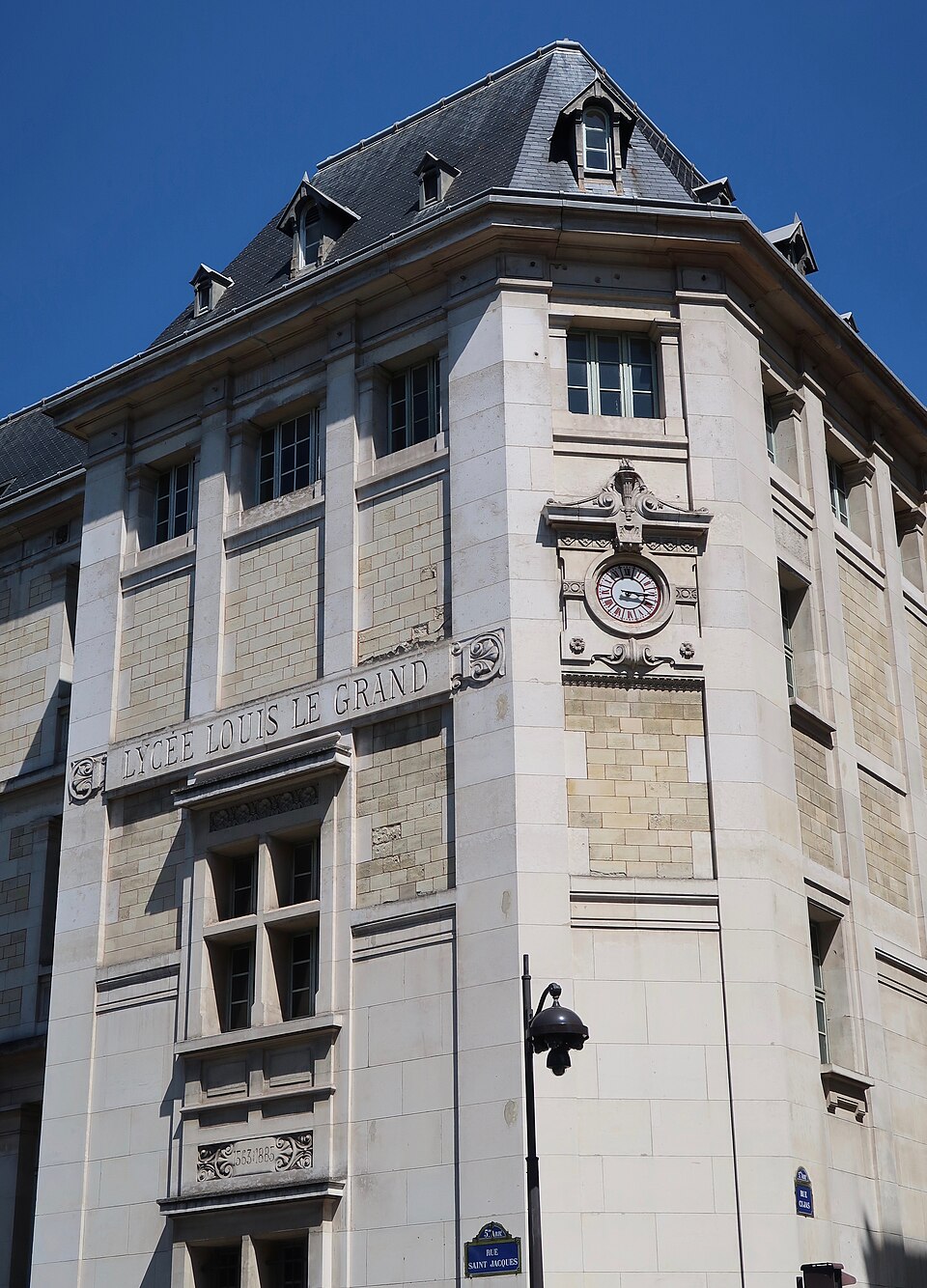
- 1823–1829 · Louis-le-Grand
- 1831 · Pont Neuf
- 1831–1832 · Sainte-Pélagie prison
- 1832 · Cochin hospital
The mayor’s son
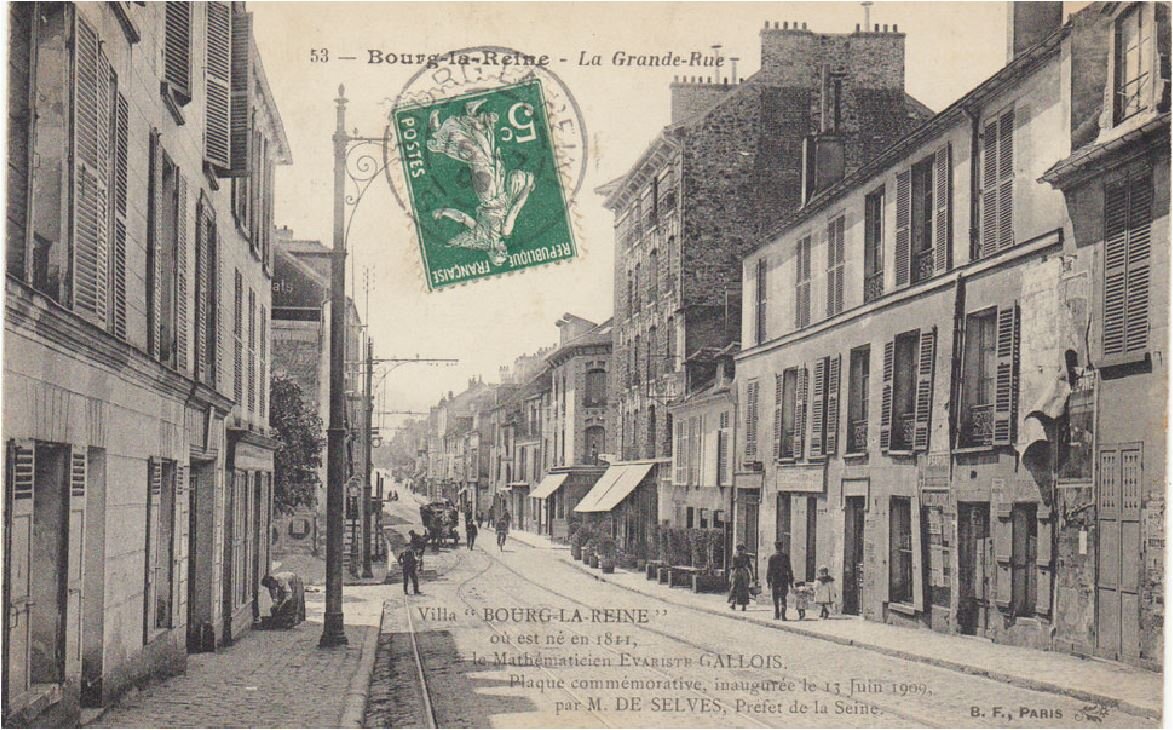
Évariste Galois was born on 25 October 1811 in Bourg-la-Reine, a small town south of Paris. His father, Nicolas-Gabriel Galois, ran a boarding school and was a liberal, an opponent of the restored monarchy; in 1815 he was elected mayor of the town. His mother, Adélaïde-Marie Demante, the daughter of lawyers, taught her son at home until he was 12: Latin, Greek and religion.
In 1823 Évariste went to the Louis-le-Grand college in Paris, one of the most prestigious schools in France and one of the strictest. In his first months the pupils rebelled against the headmaster, and dozens were expelled. Galois was a good pupil, but at around 15 he grew tired of the classical subjects and had to repeat a year.
The mathematical frenzy
In 1827, at 15, he attended his first mathematics class. He read Legendre’s Elements of geometry, meant for a two-year course, as one reads a novel, and went straight on to Lagrange’s memoirs on equations. His teachers wrote in their reports: “the frenzy of mathematics dominates him”. One of them, Louis Richard, wrote that the pupil was interested only in the highest regions of mathematics.
In 1828, a year earlier than usual and without proper preparation, Galois sat the examination for the École Polytechnique, the best science school in France. He failed. The following year he published his first paper, on continued fractions, and sent the Academy of Sciences two papers on the solution of equations. Cauchy was put in charge of examining them and gave no report.
The year 1829
In July 1829 the priest of Bourg-la-Reine circulated obscene verses signed with the mayor’s name. Humiliated, Nicolas-Gabriel Galois killed himself in a flat in Paris, near his son’s school. At the funeral there was a fight in the street between the mayor’s supporters and his opponents.
A few weeks later Galois sat the Polytechnique examination for the second and last time. It is said that, irritated by a question, he threw the board rubber at the examiner. The story may be an exaggeration, but the outcome is certain: he failed again. He then entered the École Normale, which trained teachers and had much less prestige.
The lost papers
In February 1830 Galois rewrote his discoveries and entered them for the Academy’s Grand Prize in mathematics. The secretary, Joseph Fourier, took the manuscript home and died in May. The text was never found. That year’s prize was given to Abel, already dead, and to Jacobi.
In July 1830 Paris overthrew King Charles X in three days of barricades. The director of the École Normale locked the students in so that they could not go out into the streets. Galois, a passionate republican, never forgave him: he attacked him in a letter published in a newspaper and was expelled in January 1831. In the same month, at Poisson’s invitation, he sent the Academy a third version of the memoir. In July the reply came, signed by Poisson and Lacroix: the arguments “are neither sufficiently clear nor sufficiently developed to allow us to judge their rigour”.
Prison
Galois joined the artillery of the National Guard, a militia full of republicans, which the new king, Louis-Philippe, soon disbanded. In May 1831, at a republican banquet, he raised his glass with a knife in his hand and toasted: “To Louis-Philippe!” He was arrested the next day for threatening the king, and acquitted in June. On 14 July, the anniversary of the storming of the Bastille, he was arrested again on the Pont Neuf, wearing the uniform of the disbanded artillery and armed. He spent eight months in the Sainte-Pélagie prison.
In March 1832 a cholera epidemic struck Paris, and Galois was moved to a nursing home. There he fell in love with Stéphanie-Félicie Poterin du Motel, the daughter of the resident physician. The fragments of letters that survive show that she ended the affair.
The last night
On 29 May 1832 Galois was challenged to a duel, or challenged someone. The reasons and the name of his opponent remain uncertain: it may have been a quarrel over Stéphanie, it may have been a republican, it may have been a police trap. Galois thought he would die. He spent the night writing. In a letter to the republicans he said he was dying the victim of “an infamous coquette”. In the letter to his friend Auguste Chevalier he summarised his whole theory in a few pages and asked that it be shown to Jacobi or Gauss. In the margin of one of the manuscripts he revised that night, he wrote:
There is something to complete in this demonstration. I do not have the time.
— Évariste Galois, note in the margin of a manuscript (1832)
The margins of the papers from that night are full of scribbles: the name Stéphanie, written and crossed out, the words Une femme, “a woman”, and the republican motto Liberté, égalité, fraternité ou la mort. In the letter to Chevalier he defended himself in advance:
I have often in my life ventured to put forward propositions of which I was not sure. But everything I have written here has been in my head for nearly a year, and it is too much in my interest not to be mistaken for anyone to suspect me of stating theorems of which I did not have the complete proof.
— Évariste Galois, letter to Auguste Chevalier (29 May 1832)
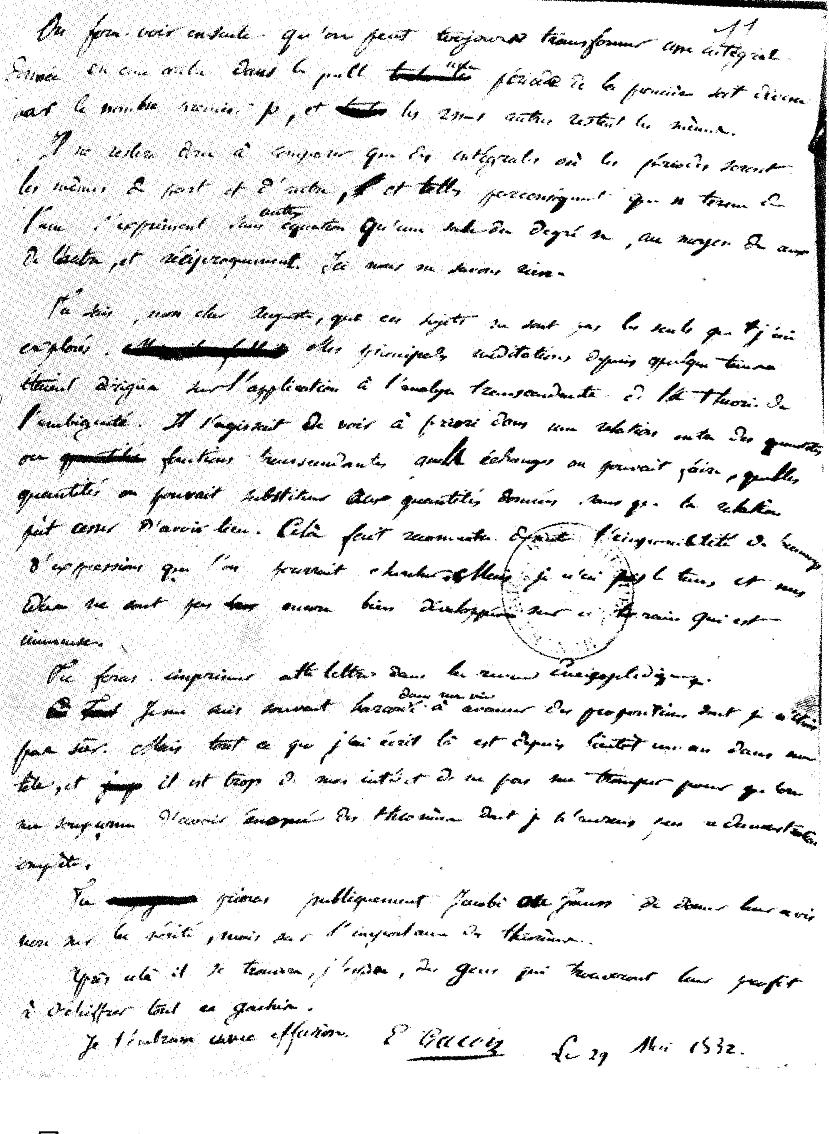
On the morning of 30 May he was hit by a shot in the abdomen and left on the ground. Hours later a passer-by found him, and he was taken to the Cochin hospital. To his younger brother Alfred, who was weeping, he said: “Don’t cry. I need all my courage to die at twenty.” He died on the morning of 31 May. He was buried in a common grave in the Montparnasse cemetery; the exact spot is unknown.
Sources: Laura Toti Rigatelli, Évariste Galois, 1811–1832 (Birkhäuser, 1996) · Peter M. Neumann, The Mathematical Writings of Évariste Galois (European Mathematical Society, 2011) · Galois biography, MacTutor.
All topics on Évariste Galois · Shuffling the roots: the group of an equation →