
Euler's Eyes
2026-10-15
Dividing the lemniscate with ruler and compass
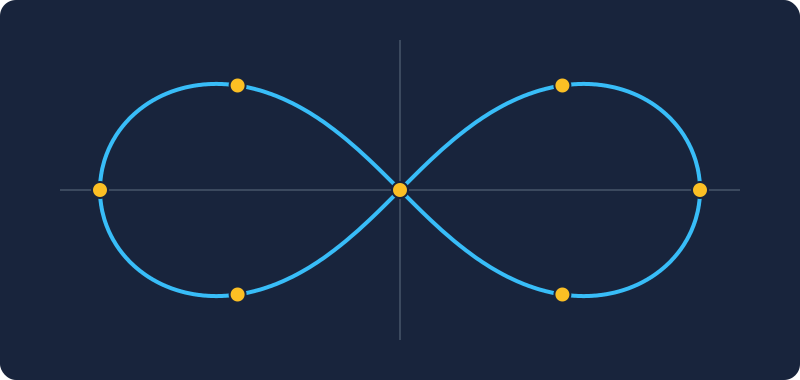
In 1694 Jakob Bernoulli studied a curve shaped like a figure eight lying on its side, which he called lemniscus, a ribbon bow. With its foci at the points $(\pm\frac1{\sqrt2},0)$, it is the set of points whose distances to the two foci have product $\frac12$. Its equation is
$$(x^2+y^2)^2=x^2-y^2,$$or, in polar coordinates, $r^2=\cos2\theta$. A century and a half later Abel proved about it a theorem that seems to have come out of Euclid’s book: for which numbers $n$ can the lemniscate be divided into $n$ arcs of equal length using only ruler and compass?
The arc length
First, how long is a piece of the curve? In polar coordinates a tiny piece of arc has $ds^2=dr^2+r^2\,d\theta^2$. Differentiating $r^2=\cos2\theta$,
$$2r\,dr=-2\sin2\theta\,d\theta,\qquad\sin2\theta=\sqrt{1-\cos^22\theta}=\sqrt{1-r^4},$$so $d\theta=-\dfrac{r\,dr}{\sqrt{1-r^4}}$ and
$$ds^2=dr^2+\frac{r^4\,dr^2}{1-r^4}=\frac{dr^2}{1-r^4}.$$The arc from the centre to a point at distance $r$ from the centre therefore measures
$$\boxed{s=\int_0^r\frac{dt}{\sqrt{1-t^4}}.}$$This is the lemniscatic integral, the same one that defines the lemniscatic sine. In other words: the point of the lemniscate at arc distance $s$ from the centre is at distance $\operatorname{sl}(s)$ from the centre. The lemniscatic sine does for the lemniscate what the sine does for the circle. From the centre to the tip the arc measures $\frac\varpi2\approx1.3110$, and the whole curve $2\varpi\approx5.2441$.
Christmas 1751
In 1718 the Italian count Giulio Fagnano discovered how to double an arc of the lemniscate with ruler and compass: given an arc, to construct another of twice the length. Nobody paid much attention. On 23 December 1751 the Berlin Academy handed Euler Fagnano’s books for him to give an opinion. Euler saw at once what was there and generalised Fagnano’s formula into an addition formula for these integrals. Almost a century later Jacobi said that day was the birthday of elliptic functions.
Dividing into eight
Let us use Fagnano’s formula, written with the lemniscatic sine:
$$\operatorname{sl}(2u)=\frac{2\operatorname{sl}(u)\sqrt{1-\operatorname{sl}(u)^4}}{1+\operatorname{sl}(u)^4}.$$To divide the curve into eight equal parts, it is enough to find the point that halves the arc from the centre to the tip. The tip is at $r=1$, so we look for $s=\operatorname{sl}(u)$ with $\operatorname{sl}(2u)=1$:
$$1+s^4=2s\sqrt{1-s^4}.$$Squaring and writing $w=s^2$:
$$(1+w^2)^2=4w(1-w^2)\quad\Longrightarrow\quad w^4+4w^3+2w^2-4w+1=0.$$The polynomial is a perfect square: $(w^2+2w-1)^2$. So $w^2+2w-1=0$, and the positive root is $w=\sqrt2-1$. The point we want is at distance
$$\boxed{r=\sqrt{\sqrt2-1}\approx0.6436}$$from the centre. It is a number involving only square roots, and square roots can be constructed with ruler and compass. Drawing the circle of radius $\sqrt{\sqrt2-1}$ around the centre of the curve, it cuts the lemniscate at the four middle points of the figure above.
Abel’s theorem
Gauss had proved in 1796 that the regular 17-gon can be constructed with ruler and compass, and more generally that the circle can be divided into $n$ equal parts when $n$ is a power of 2 times distinct Fermat primes, such as 3, 5, 17, 257 and 65537. In his 1801 book he left a mysterious sentence: the same principles also applied to the integral $\int\frac{dx}{\sqrt{1-x^4}}$. He published nothing more about it.
Abel did. In 1827, in the Researches on elliptic functions, he proved:
The lemniscate can be divided into $n$ equal arcs with ruler and compass for the same values of $n$ as the circle.
The proof uses the addition formula of the lemniscatic sine and the two periods, and it is one of the first places where the structure now called complex multiplication appears. The converse, that for the other values of $n$ it is impossible, was only proved in 1981, by the American Michael Rosen.
Exercise: how do you construct the length √(√2 − 1) with ruler and compass?
The diagonal of a square of side 1 measures $\sqrt2$. Taking away 1 leaves $a=\sqrt2-1\approx0.4142$. For the root of $a$, use the geometric mean: on a line mark segments $AB=a$ and $BC=1$, draw the semicircle with diameter $AC$ and raise the perpendicular at $B$. The height up to the semicircle measures $\sqrt{a\cdot1}=\sqrt a\approx0.6436$, by the same similarity argument as in the Pythagorean theorem.
Exercise: for which n between 3 and 20 can the lemniscate be divided into n equal arcs with ruler and compass?
The values are powers of 2 times distinct Fermat primes: $3, 4, 5, 6, 8, 10, 12, 15, 16, 17$ and $20$. Left out are $7, 9, 11, 13, 14, 18$ and $19$. The 9 is excluded because $9=3\cdot3$ repeats the Fermat prime 3; 7, 11, 13 and 19 are not Fermat primes.
Sources: Niels Henrik Abel, “Recherches sur les fonctions elliptiques”, Journal für die reine und angewandte Mathematik 2 (1827) · Michael Rosen, “Abel’s theorem on the lemniscate”, The American Mathematical Monthly 88 (1981) · Carl Friedrich Gauss, Disquisitiones arithmeticae (1801), article 335.
All topics on Niels Henrik Abel · ← Inverting the integral: elliptic functions · Abelian groups: when order does not matter →