
Euler's Eyes
2026-10-13
The object and its representations: the case of fractions
The number five can be written $5$, $\text{V}$, “five”, cinco, $101$ in base two or with five tally marks in a notebook. The scripts change; the number stays the same. Nothing surprising so far.
The surprise comes when you ask: so where is the number five, then? Not on the paper, because the paper only has the scripts. Not in a collection of five apples, because apples have colour, weight and smell, and the number has none of that. Nobody has ever seen, or ever will see, the number five “in person”. We only see its representations.
The French psychologist and philosopher Raymond Duval, who studied for decades how mathematics is learned, gave this problem a name:
Mathematical objects are not accessible through perception, as objects of the physical world are. We have access to them only through representations. And yet the object must not be confused with any of its representations.
— Raymond Duval, on the “cognitive paradox” of mathematics (2006, paraphrase)
In biology, anyone who doubts a photo of a frog can go to the pond and see the frog. In mathematics there is no pond. That is why learning mathematics is, to a large extent, learning to recognise the same object in different representations, and not to confuse any of them with it.
One fraction, many readings
Look at $\frac12$. What do you see? A stroke with two digits? A division? A chocolate bar broken in half? A point between $0$ and $1$ on the number line?
| Situation | Reading of $\frac12$ |
|---|---|
| a pizza cut into two equal parts | one of the parts of a whole |
| a litre of juice shared between two people | the quotient $1\div2$: half a litre each |
| the number line | the number halfway between $0$ and $1$ |
| “half of 30 pupils” | an operator: multiply by $\frac12$ |
| “one goal for every two shots” | a ratio between two quantities |
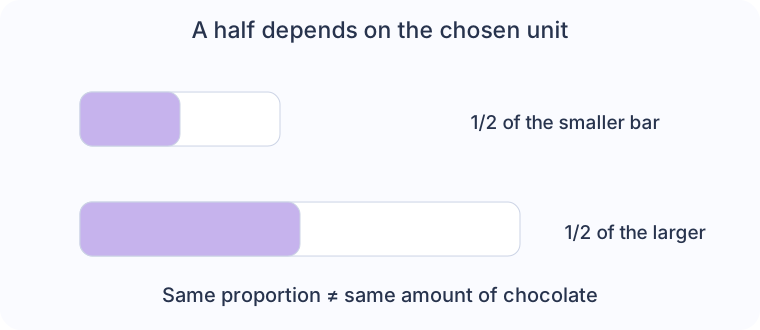
All these readings are right, and all refer to the same number. But each lights up a different part of it. The part-of-a-whole reading requires knowing what the whole is: half of a small bar and half of a big bar are the same fraction and different amounts of chocolate.
Who counts and who names
The very names of the parts of a fraction hold a lesson in semiotics. Denominator comes from the Latin denominare, “to give a name”: the bottom number says what kind of part it is, whether halves, thirds or quarters. Numerator comes from numerare, “to count”: the top number says how many of those parts there are. In $\frac34$, the $4$ gives the name (quarters) and the $3$ counts (three of them). It is exactly how we speak: “three quarters”.
The bar between them also has a history. Indian mathematicians wrote one number above the other, with no stroke at all. The Arabs of North Africa added the horizontal stroke around the twelfth century, and it was from them that Leonardo of Pisa learned it. In the Liber abbaci of 1202 he gave the definition the old texts on this site liked to quote:
When above any number a bar appears, and above it any other number is written, the upper number stands to the lower; the lower is called the denominator and the upper the numerator.
— Leonardo of Pisa, Liber abbaci (1202), free translation
Notice “the upper number stands to the lower”: for Fibonacci a fraction was already a ratio, a relation between two numbers, not just a slice of pizza. The slanted bar, $3/4$, came much later. It appears in a Mexican newspaper in 1784 and was championed in 1845 by the Englishman Augustus De Morgan for a practical reason: in a line of printed text, the horizontal bar forced the typesetter to build three lines of type, while the slanted one fitted in a single line. Space was gained and a little clarity lost, as we will see in the text on the grammar of formulas.
The same number, four scripts
$$\frac12=\frac24=0.5=50\%.$$Each script is best for something. The fraction $\frac24$ is the right one when the pizza came cut into four. The decimal $0.5$ is right for the calculator and for comparing with $0.48$. The percentage is right for comparing with other percentages, such as a bank’s interest rate. Choosing the representation is already part of the solution: the problem “which is bigger, $\frac38$ or $0.4$?” becomes easy once both quantities are in the same script.
The Egyptians and unit fractions
More than 3,500 years ago the Egyptian scribe Ahmes copied onto a papyrus, now called the Rhind papyrus, a table that still intrigues historians. The Egyptians wrote almost every fraction as a sum of different fractions with numerator $1$. For them $\frac25$ was not an acceptable script; the right way was
$$\frac25=\frac13+\frac1{15}.$$It looks like a complicated way of writing something simple. But try sharing $2$ loaves among $5$ people. With the Egyptian script the recipe is ready: cut $\frac13$ of a loaf for each person (that uses $\frac53$ of a loaf), and cut the $\frac13$ left over into five pieces of $\frac1{15}$. Everyone gets one big piece and one little piece, and nobody ends up with a “crooked” slice. The Egyptian representation was excellent for sharing and poor for multiplying. Ours is the opposite.
The question that separates
Faced with any representation, it is worth asking: what belongs to the object and what belongs only to the script? The line of a drawn triangle has thickness; the triangle of geometry does not. The fraction $\frac24$ has a $4$ underneath; the number it represents is not “four of anything”. The pizza has a flavour; the half does not. Anyone who confuses the object with its representation ends up thinking $\frac24$ is bigger than $\frac12$ “because it has bigger numbers”, a very common mistake among children, and an entirely semiotic one.
Exercise: which is bigger, 3/8 or 0.4?
Put everything in the same script. As a decimal, $\frac38=0.375$, which is less than $0.4$. As a fraction, $0.4=\frac25=\frac{16}{40}$ and $\frac38=\frac{15}{40}$: again $\frac38<0.4$. Both conversions give the same answer, as they should, because the object is the same.
Exercise: write like an Egyptian
Write $\frac27$ as a sum of different fractions with numerator $1$. Try starting with the largest unit fraction less than $\frac27$, which is $\frac14$. What remains is $\frac27-\frac14=\frac{8-7}{28}=\frac1{28}$. So
$$\frac27=\frac14+\frac1{28},$$exactly what is in Ahmes’s table. To share $2$ loaves among $7$ people: a quarter loaf each, and the quarter left over cut into seven.
Chapter index · ← Peirce: icon, index and symbol · The grammar of formulas: brackets, order and space →