Invito patre sidera verso. (Against my father’s will, I study the stars.)
— Jakob Bernoulli's motto
James Bernoulli (1655–1705), whom the Swiss call Jakob and the French Jacques, was the first mathematician of a family that gave Europe eight of them in three generations. His father wanted a pastor; he studied theology to obey and mathematics in secret. He learned Leibniz’s calculus practically on his own, taught it to his younger brother Johann, and then spent years quarrelling with him in public.
He was the first to use the word integral in a paper, found the number $e$ while doing interest calculations, showed that the sum $1+\frac12+\frac13+\cdots$ has no end and asked Europe for help in adding up the reciprocals of the squares, the problem that Euler would solve. His most important work, the Ars conjectandi, only came out eight years after his death. It contains the first proof that the frequency of an event, over many trials, approaches its probability.
In this track we tell the life of James Bernoulli and redo, with all the calculations shown, six of his discoveries.
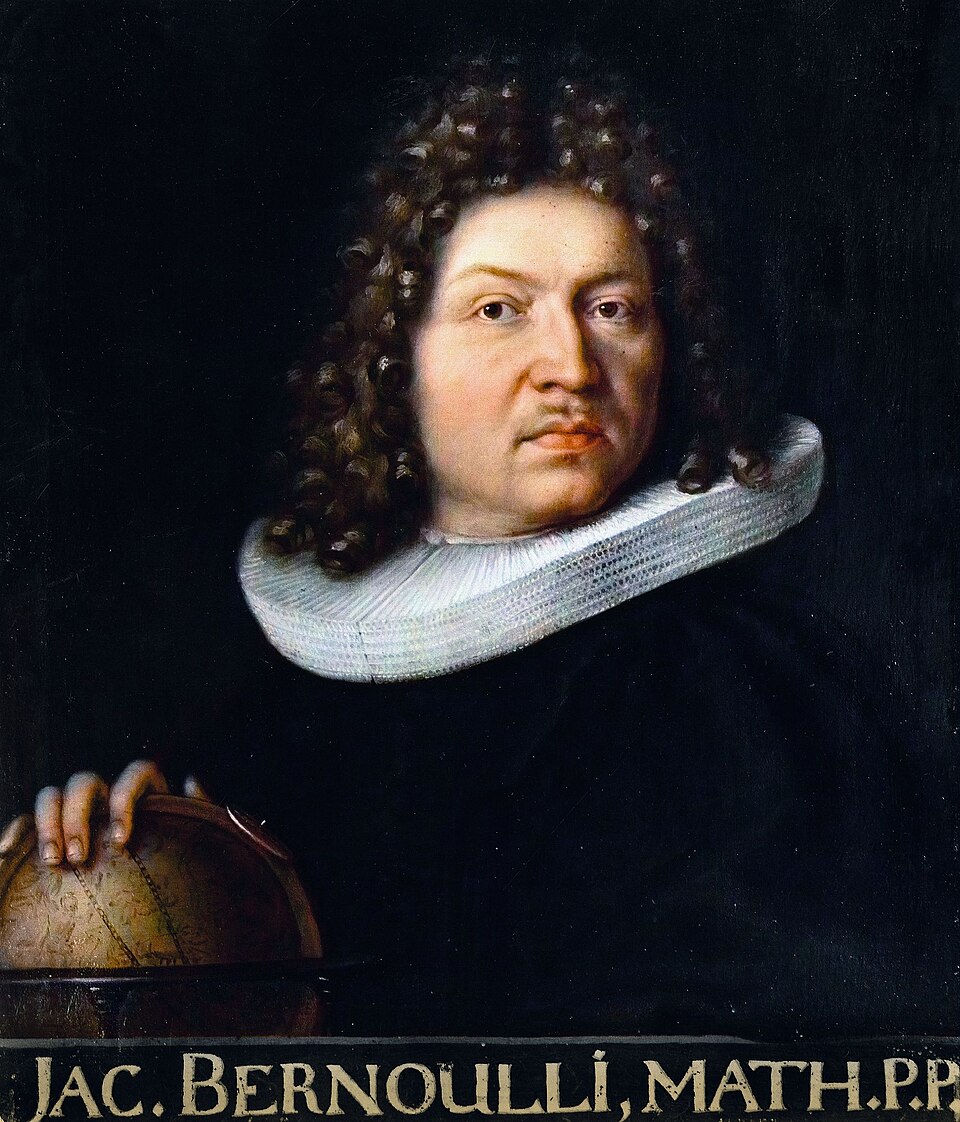
Who he was
James (Jakob) Bernoulli
- Nascimento
- 6 January 1655, Basel
- Morte
- 16 August 1705, Basel
- Origem
- Switzerland
- Áreas
- Probability, series, calculus and the geometry of curves
Reading guide
Biography
Discovery and proof
- Interest that never ends and the number e
- The harmonic series and the call for help
- The marvellous spiral and the lemniscate
- The art of conjecturing: counting the chances
- The golden theorem: the law of large numbers
- The Bernoulli numbers: adding a thousand powers in seven minutes