
Euler's Eyes
2026-10-11
The weight of air: the Puy de Dôme experiment
For two thousand years scholars repeated a saying of Aristotle’s: nature abhors a vacuum. If you suck the air out of a straw, the liquid rises because nature will not let the space stay empty. It seemed to explain everything.
But the well-diggers of Florence had a problem. Suction pumps could not raise water more than about 10 metres, however hard they tried. Why would nature’s horror of the vacuum stop at 10 metres?
Torricelli’s tube
In 1643 the Italian Evangelista Torricelli, a pupil of Galileo, filled a one-metre glass tube, closed at one end, with mercury. He covered the other end with his finger, turned the tube upside down in a basin of mercury and let go. The mercury dropped and stopped at a height of about 76 cm, leaving an empty space at the top.
Torricelli’s explanation was bold: what holds the column up is not the horror of the vacuum but the weight of the air pressing on the surface of the basin. We live, he wrote, at the bottom of an ocean of air. Mercury is about 13.6 times denser than water, and $76\ \text{cm}\times13.6\approx10.3$ m: the same limit as the Florentine pumps.
Pascal takes the idea uphill
Pascal heard about the experiment in 1646 and repeated it in Rouen, with giant glass tubes full of water and wine. But he wanted a decisive test. His reasoning was this: if the weight of the air holds the mercury up, then at the top of a mountain, where there is less air above, the column must be lower. If the cause were the horror of the vacuum, altitude would make no difference.
Pascal lived in Paris and was in poor health. In November 1647 he wrote to his brother-in-law, Florin Périer, who lived in Clermont, at the foot of the Puy de Dôme, an extinct volcano almost 1500 metres high.
19 September 1648
Périer climbed the mountain with a group of priests and notables of Clermont, so as to have witnesses. They took two tubes and mercury. The experiment had a modern idea in it: before climbing, they set up both tubes in the garden of the Minim friars’ convent, at the lowest point of the town, and checked that they gave the same height. One tube stayed there with a friar, Father Chastin, whose job was to watch it all day. The other went up.
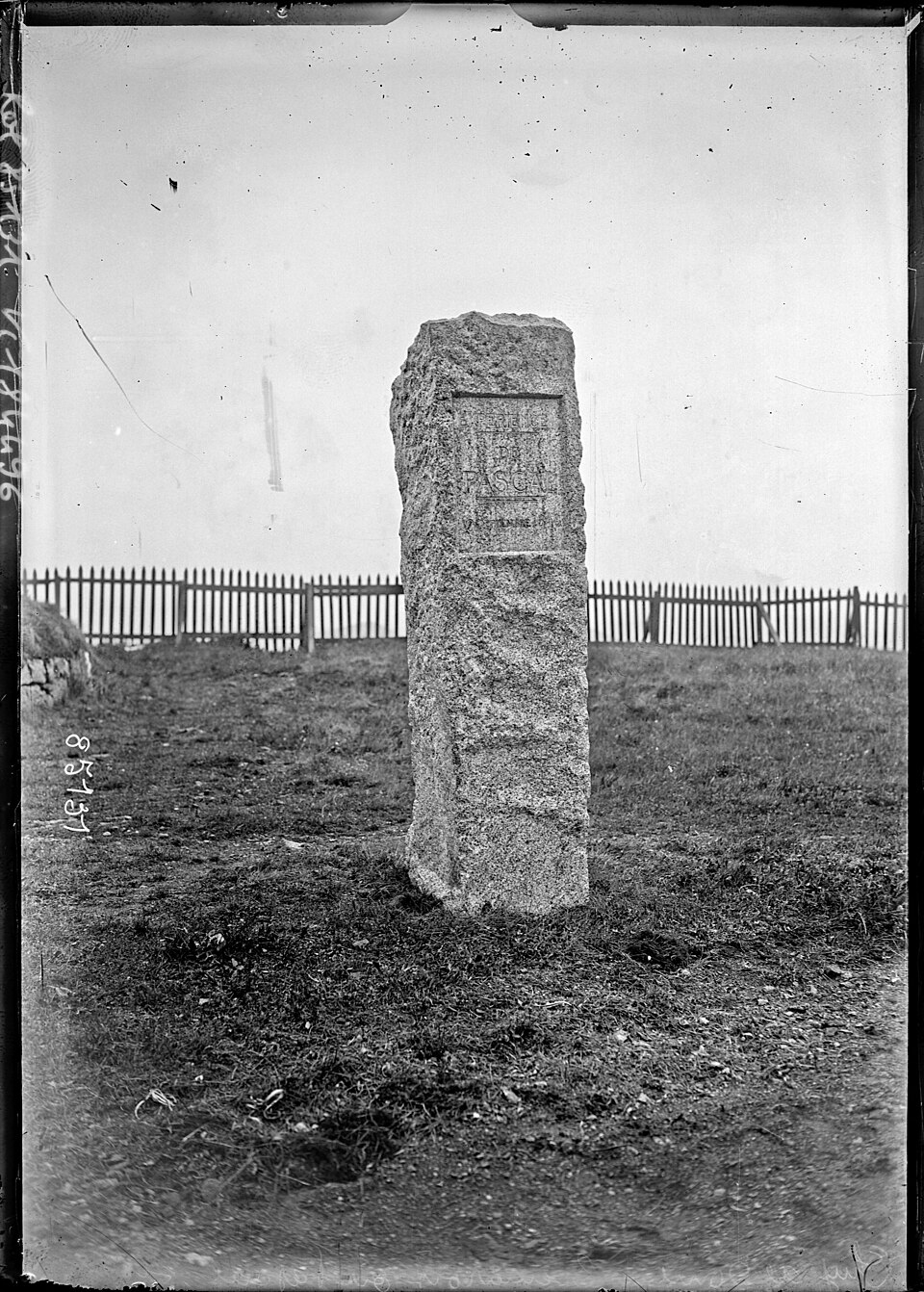
The measurements, in the units of the time, were:
| Place | Height of the mercury |
|---|---|
| Garden of the Minims, in Clermont | 26 inches and 3½ lines |
| Top of the Puy de Dôme, some 500 toises higher | 23 inches and 2 lines |
A French inch (pouce) was about $27.07$ mm, and a line was $\frac1{12}$ of an inch. Converting:
$$h_{\text{base}}\approx711.7\ \text{mm},\qquad h_{\text{top}}\approx627.1\ \text{mm}.$$At the top the column was 8.5 cm lower. On the way down Périer repeated the measurement halfway and found an intermediate value. In Clermont, Father Chastin reported that the tube in the garden had not changed all day, even though the weather had gone from sun to rain, fog and wind.
This filled us all with admiration and astonishment, and surprised us so much that, for our own satisfaction, we wanted to repeat it.
— Florin Périer, letter to Pascal (22 September 1648)
The pressure calculation
The pressure that holds up a column of mercury of height $h$ is $p=\rho gh$, with $\rho=13{,}600\ \text{kg/m}^3$ and $g=9.81\ \text{m/s}^2$. So
$$p_{\text{base}}\approx13{,}600\cdot9.81\cdot0.7117\approx94{,}950\ \text{Pa},$$$$p_{\text{top}}\approx13{,}600\cdot9.81\cdot0.6271\approx83{,}670\ \text{Pa}.$$The difference is about $11{,}300$ Pa. That should be the weight of the layer of air between the base and the top, about a thousand metres thick. Air has a density of about $1.1\ \text{kg/m}^3$:
$$\rho_{\text{air}}\,g\,\Delta h\approx1.1\cdot9.81\cdot1000\approx10{,}800\ \text{Pa}.$$The two calculations almost coincide. The mercury fell by just what the weight of the air left below would explain.
How much all the air weighs
Pascal went further. If every patch of ground holds up the weight of a column of air equal to about 10 metres of water, you only need to multiply by the area of the Earth to get the weight of the whole atmosphere. In the Treatise on the weight of the mass of the air he arrived at about
$$8\times10^{18}\ \text{livres}$$“eight million million million pounds”. With the Paris livre of about $0.49$ kg, that gives some $4\times10^{18}$ kg. The modern value is about $5\times10^{18}$ kg. With a ruler, a glass tube and a multiplication, Pascal weighed the sky and was not far off.
Exercise: how high would the mercury stand at sea level, where the pressure is 101,325 Pa?
$h=\dfrac{p}{\rho g}=\dfrac{101{,}325}{13{,}600\cdot9.81}\approx0.760$ m, Torricelli’s 76 cm. That is why atmospheric pressure is also measured in millimetres of mercury: $1\ \text{atm}=760$ mmHg.
Exercise: estimate the weight of all the air on Earth
The area of the Earth is about $5.1\times10^{14}\ \text{m}^2$. The weight of the air is pressure times area: $101{,}325\cdot5.1\times10^{14}\approx5.2\times10^{19}$ N. Dividing by $g$, the mass is about $5.3\times10^{18}$ kg.
Sources: Florin Périer’s letter to Pascal (1648), on Wikisource (French) · Treatise on the weight of the mass of the air, chapter IX, on Wikisource (French).
All Pascal topics · ← Pascal’s principle: multiplying forces with water · Pascal’s wager: a calculation, not a proof →