
Euler's Eyes
2026-10-22
The life of Siméon Denis Poisson
Timeline
- 1781Born on 21 June in Pithiviers, son of a former soldier.
- 1796After failing as a surgeon’s apprentice, studies at the École Centrale of Fontainebleau.
- 1798Enters the École Polytechnique in first place.
- 1800Still a student, publishes two papers praised by Legendre; becomes a tutor at the school.
- 1806Succeeds Fourier as professor at the École Polytechnique.
- 1809Introduces the brackets that bear his name, studying the stability of the Solar System.
- 1812Elected to the Academy of Sciences. Publishes the theory of electricity in conductors.
- 1813Writes Poisson’s equation.
- 1818Predicts the bright spot at the centre of the shadow of a disc.
- 1831With Lacroix, turns down Galois’s memoir on equations.
- 1837Publishes the Researches on the probability of judgements. Made a peer of France.
- 1840Dies on 25 April at Sceaux, aged 58.
The baby on the nail
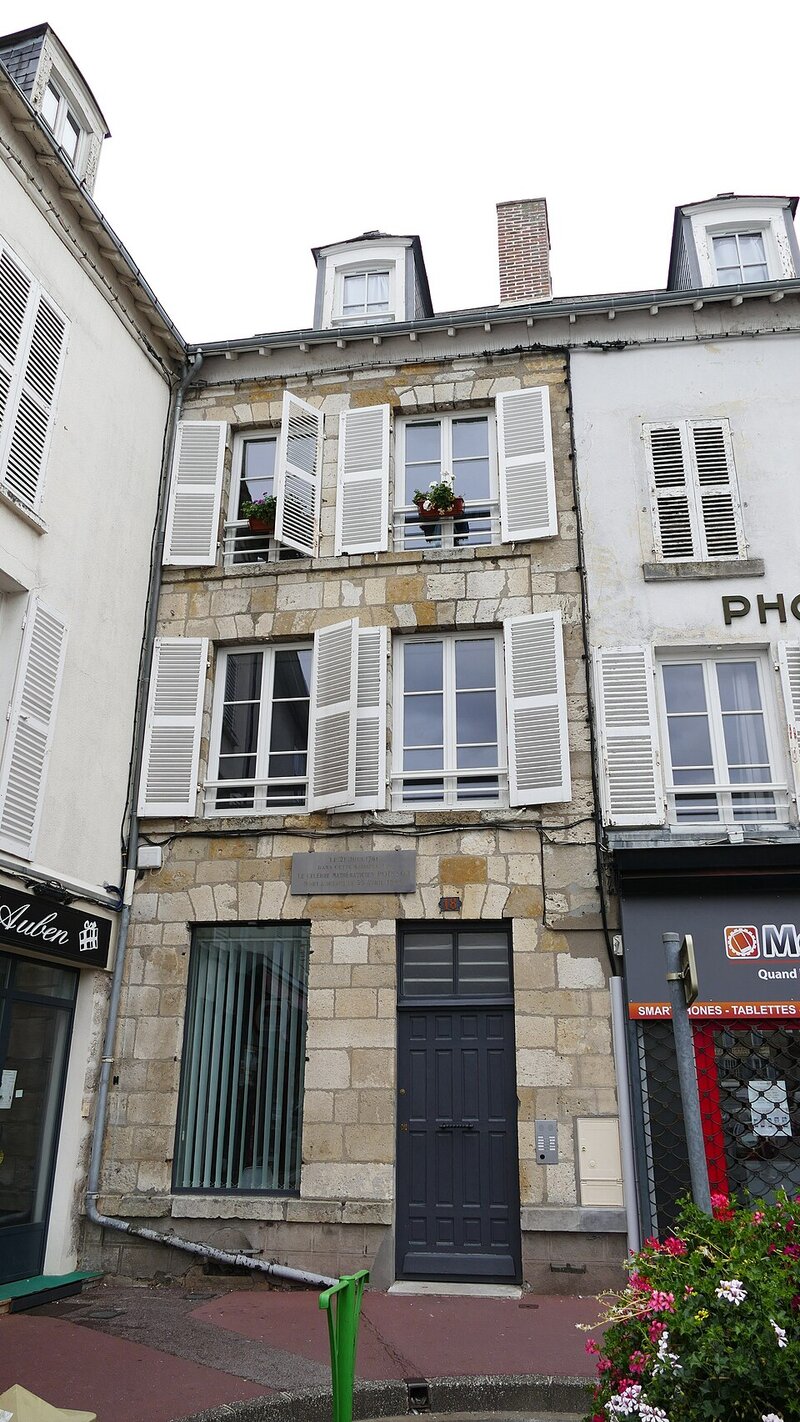
Siméon Denis Poisson was born on 21 June 1781 in Pithiviers, a small town about eighty kilometres south of Paris. His father, also called Siméon, had been a soldier and, after leaving the army, bought a modest post in local administration. The family was large and the mother could not look after all the children on her own, so little Siméon was handed over to a nurse.
When the Revolution broke out in 1789, the father, enthusiastic about the new ideas, became president of the district administration. He wanted a solid profession for his son and chose medicine. At fifteen, Siméon was sent to Fontainebleau, to the house of an uncle who was a surgeon, to learn the trade.
The surgeon’s apprentice
It did not work. The boy was clumsy with his hands. The story goes that his uncle made him practise bloodletting by pricking the veins of cabbage leaves with a lancet, and that he could not hit them. Worse: a patient on whom he applied a treatment died a few hours later. The death probably had nothing to do with him, but Poisson refused to go on and went back to Pithiviers.
At home, his father received the Journal de l’École polytechnique, which printed the problems set for the students, and Siméon began solving them on his own. According to Arago, it was then that someone put an old puzzle to him: two friends have a twelve-pint jug of wine and want to share it equally, but they only have two empty vessels, one of eight and one of five pints. How can it be done? Poisson solved the problem and, says Arago, decided at that moment that his vocation was mathematics. In 1796 he entered the École Centrale of Fontainebleau, where the mathematics teacher, Billy, soon realised that his pupil knew more than he did.
The École Polytechnique
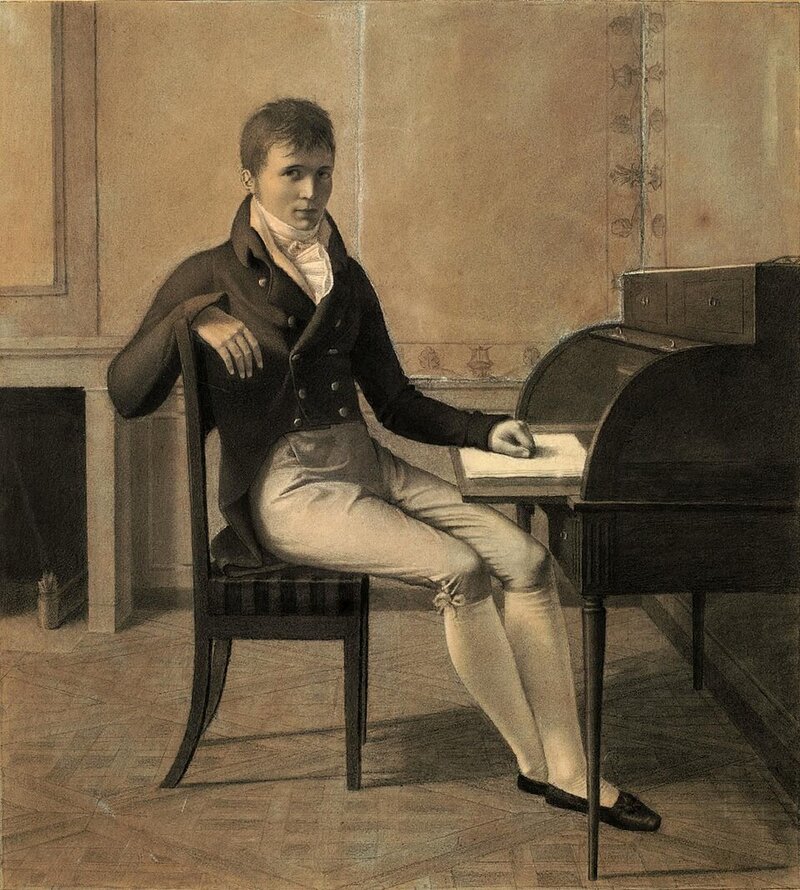
In 1798, at seventeen, Poisson entered the École Polytechnique in first place. The professors were the greatest mathematicians in France: Lagrange, Laplace, Monge, Fourier. Lagrange and Laplace quickly noticed the student’s talent and took him under their protection. While still a student, in 1800, Poisson wrote two papers, one on elimination in algebraic equations and one on finite-difference equations, which Legendre recommended for publication in the Academy’s collection of works by outside scholars, a rare honour for a young man of eighteen.
On finishing the course he was excused from the engineering service, the usual destination of the students, and stayed at the school as a tutor. In 1802 he began standing in for Fourier, who had gone to Grenoble as prefect, and in 1806 he became full professor.
The Laplace years
From then on Poisson’s career was a succession of posts: astronomer at the Bureau des Longitudes in 1808, professor of rational mechanics at the Faculty of Sciences in 1809, member of the Academy in 1812, examiner for the Military School and the École Polytechnique, councillor of the University. In 1817 he married Nancy de Bardi, born in England to French émigrés; they had four children.
Poisson was Laplace’s right-hand man, and Laplace’s programme was to explain all physical phenomena by forces between particles, like gravity between the planets. Within this programme Poisson treated the stability of the Solar System, gravity and electricity, heat, capillarity and elasticity. The same programme put him on the wrong side of a great dispute: the one over the nature of light, which gave rise to Poisson’s spot.
He survived every regime. A republican in his youth, he accepted the return of the Bourbons in 1815; he received the title of baron but never used it, and in 1837 he was made a peer of France. He worked without pause and published more than three hundred works. Arago reports that he used to say: “Life is good for only two things: doing mathematics and teaching it.”
The last years
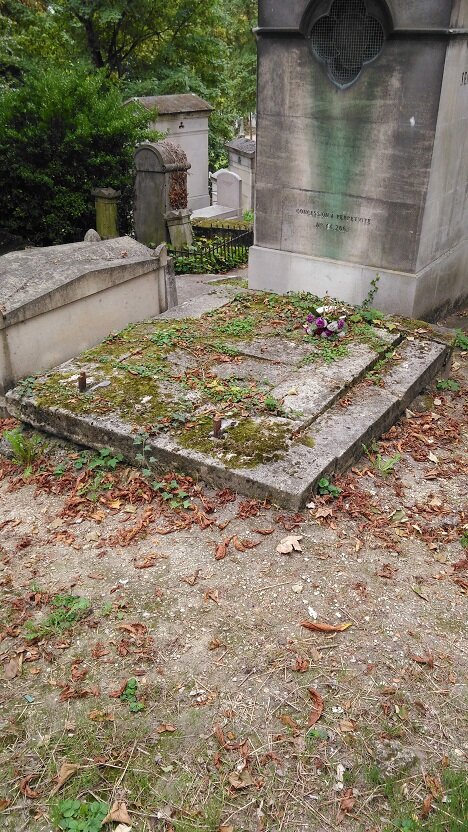
In 1837 he published the Researches on the probability of judgements, the book in which he named the law of large numbers and in which, almost in passing, the distribution that now bears his name appears. He went on teaching and examining students to the end, even when ill. He died at Sceaux, near Paris, on 25 April 1840, aged 58, and was buried in the cemetery of Père-Lachaise.
Exercise: the jug puzzle
A jug holds 12 pints of wine, and there are two empty vessels of 8 and 5 pints. How can the wine be divided into two parts of 6 pints, only by pouring from one vessel into another?
Write the contents as (12-pint jug, 8-pint vessel, 5-pint vessel). A solution in seven pourings:
$$(12,0,0) \to (4,8,0) \to (4,3,5) \to (9,3,0) \to (9,0,3) \to (1,8,3) \to (1,6,5) \to (6,6,0).$$At each step either the receiving vessel is filled or the pouring one is emptied. At the end there are 6 pints in the jug and 6 in the 8-pint vessel.
Exercise: Poisson's ages
Poisson was born on 21 June 1781 and died on 25 April 1840. How old was he when he entered the École Polytechnique at the end of 1798, when he wrote the equation of 1813, and when he died?
At the end of 1798, after his June birthday: $1798 - 1781 = 17$ years. In 1813, depending on the month, 31 or 32 years. In April 1840 he had not yet had his birthday that year: $1840 - 1781 - 1 = 58$ years.
Sources: François Arago, “Poisson”, eulogy read in 1850, in Œuvres complètes de François Arago, vol. 2 (1854) · Michel Métivier, Pierre Costabel and Pierre Dugac (eds.), Siméon-Denis Poisson et la science de son temps (1981) · Poisson biography, MacTutor · René Taton, “Sur les relations scientifiques d’Augustin Cauchy et d’Évariste Galois”, Revue d’histoire des sciences 24 (1971).