
Euler's Eyes
2022-11-28
First Degree Functions
The beginning of learning about functions goes through first degree functions. In this post, we will present some first-degree functions. Among them are constant, linear and related.

Constant function
The constant function is a plateau, something flat or simply a horizontal line. Below we present the formal definition.

Definition (Constant Function): an application $f$ of $\mathbb{R}$ in $\mathbb{R}$ is called a constant function when each element $x \in\mathbb{R}$ always associates the same element $c \in\mathbb{R}$.

The graph of the constant function is a straight line parallel to the x-axis passing through by the point (0, c).
The image is the set $(\Im = \\{c\\})$
Examples
Build the graphs of applications from $(\mathbb{R})$ to $(\mathbb{R})$ defined by:
- $y = 3$
- $y = -1$
For y equal to 3 or -1 they will be the straight line where we replace c with these numbers.
The graph is a constant function and is a straight line parallel to the $x$ axis and passing through the point $(0,c)$.
Example 1: Construct the graphs of applications from $\mathbb{R}$ to $\mathbb{R}$ defined by $y=4$.

identity function
Definition (Identity Function): an application $f$ of $\mathbb{R}$ in $\mathbb{R}$ receives the name identity function when each element $x \in\mathbb{R}$ associates $x \in\mathbb{R}$ itself.


The graph of the identity function is a straight line that contains the angle bisectors of the 1 and 3 quadrants.
The image is $(Im = \mathbb{R})$
Linear function
Definition (Linear Function): an application $f$ of $\mathbb{R}$ in $\mathbb{R}$ is called a linear function when each element $x \in\mathbb{R}$ associates the element $ax \in\mathbb{R}$, with $a\neq 0$, a real number.

It is demonstrated that the graph of the linear function is a straight line that passes through the origin.
The image is $(Im = \mathbb{R})$
In fact, whatever the y $\in$ $\mathbb{R}$, there exists $x=(\frac{y}{a})$, $a \neq 0,$ such that
$$f(x) = f\left(\frac{y}{a}\right) = a~ .~\left(\frac{y}{a}\right) = y.$$
Example 2: Construct the graphs of applications from $\mathbb{R}$ to $\mathbb{R}$ defined by $y=ax$ for a=1.
In this case it is the same definition as the identity graph.
Example 2: Construct the graphs of applications from $\mathbb{R}$ to $\mathbb{R}$ defined by $y=ax$ for a=-2.

Affine function
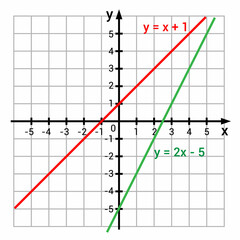
Definition (Affine Function): an application $f$ of $\mathbb{R}$ in $\mathbb{R}$ receives the name of an affine function when each element $x \in\mathbb{R}$ associates the element $(ax+b) \in\mathbb{R}$, with $a\neq 0$, a real number.
These are the concepts of functions. Wait for the next posts.