
Euler's Eyes
2026-10-11
Projections and distance
The shadow of an object with the Sun overhead is an orthogonal projection. Engineers turned this idea into a drawing method still used today.
Who discovered
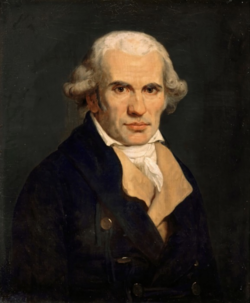
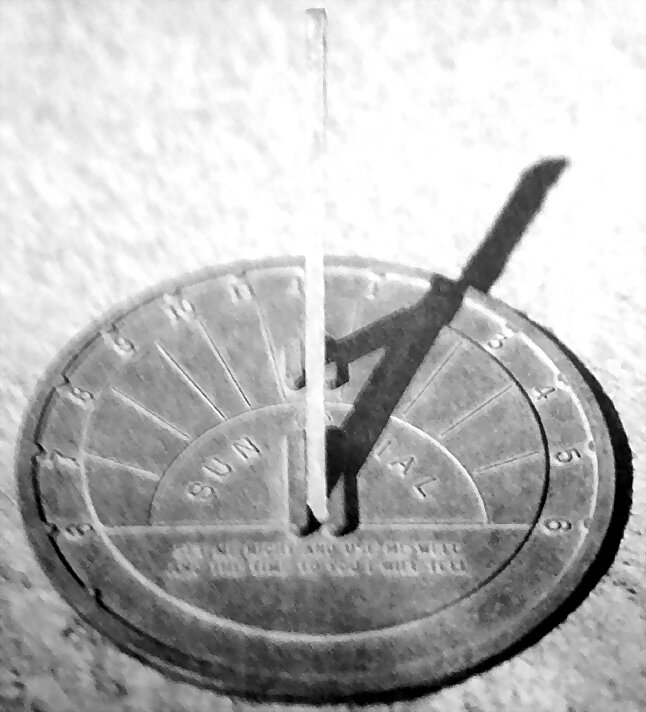
The idea of projecting figures onto a plane is old — sundials already read the projected shadow of the gnomon. The person who transformed it into a method was the Frenchman Gaspard Monge (1746–1818), creator of descriptive geometry. Monge represented objects by their orthogonal projections on two perpendicular planes, the plan and the elevation, and thus solved construction problems on paper. The distance from a point to a straight line as the length of the perpendicular is a classic result of The Elements of Euclid.

The story
Monge developed the method around 1765, as a draftsman at the Mézières military school, to calculate fortifications without long calculations. The method was considered a military secret for years; only after the French Revolution was he able to teach it publicly, at the newly created Paris Polytechnic School, and publish it in 1799.
Every architectural plan and every technical drawing of parts still follows Monge’s projections. 3D modeling programs use projections to generate front, top, and side views of an object.
In everyday life
- Property plans. The floor plan is the orthogonal projection of the house on the ground plane.
- Shadow at midday. With the Sun at its height, the shadow of a tilted stick is its projection on the ground — and is always smaller than the stick.
- Distance to road. The distance from a house to a straight road is measured by the perpendicular, the smallest possible segment.
- Equidistance. The place of a table that is the same distance from two corner walls is on the angle bisector of the angle between them.
Sources: Monk (MacTutor) · Elements, proposition I.12.
Theory and constructions
DefiniçãoOrthogonal projection
- The projection (orthogonal) of a point $P$ on a straight line $r$ is the point $P^{\prime}$ where the perpendicular to $r$ through $P$ cuts $r$. If $P \in r$, then $P^{\prime} = P$.
- The projection of a segment $\overline{AB}$ (not perpendicular to $r$) onto $r$ is the segment $\overline{A^{\prime}B^{\prime}}$, where $A^{\prime}$ and $B^{\prime}$ are the projections of $A$ and $B$.
Perpendicular segment and oblique segments
Through a point $P$ outside $r$, we draw the perpendicular segment $\overline{PP^{\prime}}$ and oblique segments $\overline{PA}$, $\overline{PB}$, … up to $r$.
PropriedadeObliques Comparison
- The perpendicular segment is smaller than any oblique segment (it is the side of right triangles that have the obliques as the hypotenuse).
- Obliques with congruent projections are congruent, and vice versa (LAL and catheto-hypotenuse cases).
- Of two obliques with non-congruent projections, the one with largest projection is larger, and vice versa.
- Of two non-congruent obliques, the larger forms with its projection a smaller angle, and vice versa.
See demos of items 3 and 4
3. If $P^{\prime}C > P^{\prime}A$, with $A$ and $C$ on the same side as $P^{\prime}$, then $A$ is between $P^{\prime}$ and $C$. The angle $P\hat{A}C$ is obtuse, as it is external to $\triangle PP^{\prime}A$, which has a right angle in $P^{\prime}$. In $\triangle PAC$, $P\hat{A}C$ (obtuse) is greater than $P\hat{C}A$ (acute), and the largest angle is opposed by the largest side: $PC > PA$. The reciprocal comes out by exclusion.
4. If $PD > PC$, then $P^{\prime}D > P^{\prime}C$. Take $C^{\prime}$ between $P^{\prime}$ and $D$ with $P^{\prime}C^{\prime} = P^{\prime}C$; then $P\hat{C^{\prime}}P^{\prime} \equiv P\hat{C}P^{\prime}$. By the external angle theorem in $\triangle PC^{\prime}D$, $P\hat{D}C^{\prime} < P\hat{C^{\prime}}P^{\prime}$, therefore $P\hat{D}P^{\prime} < P\hat{C}P^{\prime}$. The reciprocal comes out by exclusion.
DefiniçãoDistances
- The distance from a point to a straight line is the distance from the point to its projection onto the straight line: $d_{P,r} = d_{P,P^{\prime}}$. If $P \in r$, it is null.
- The distance between two parallel lines is the distance from any point on one of them to the other: $d_{r,s} = d_{P,s}$, with $P \in r$.
TeoremaParallels are equidistant
If two distinct lines are parallel, the points on one of them are at the same distance from the other.
View the demo
Let $A, B \in r$ and $A^{\prime}, B^{\prime}$ be your projections on $s$. The angle $\hat{A}$ of the quadrilateral is collateral to $\hat{A^{\prime}}$, which is right, so it is also straight. In triangles $AA^{\prime}B^{\prime}$ and $B^{\prime}BA$ (with the common diagonal): $\overline{AB^{\prime}}$ common, alternate congruent angles and right angles. By LAAₒ, they are congruent, and $AA^{\prime} = BB^{\prime}$: $d_{A,s} = d_{B,s}$.
perpendicular bisector and angle bisector: places of equidistant points
Propriedadeperpendicular bisector Points
Every point on perpendicular bisector of a segment is equidistant from the ends of the segment (LAL case):
$$(m \text{ é mediatriz de } \overline{AB},\ P \in m) \Rightarrow PA = PB.$$Propriedadeangle bisector Points
Every point on angle bisector of an angle is equidistant from the sides of the angle (LAAₒ case):
$$(s \text{ é bissetriz de } a\hat{O}b,\ P \in s) \Rightarrow d_{P,a} = d_{P,b}.$$Two very used properties
TeoremaAngles of perpendicular sides (exercise 194)
Two angles of respectively perpendicular sides are congruent or supplementary.
TeoremaMedian relative to the hypotenuse (exercise 200)
The median relative to the hypotenuse of a right triangle measures half the hypotenuse: $AM = \dfrac{BC}{2}$. Thus, $MA = MB = MC$, and the triangles $AMB$ and $AMC$ are isosceles.
View the book demo
- Take $P$ on the ray $\overrightarrow{AM}$, with $M$ between $A$ and $P$, so that $PM = AM$.
- By LAL, $\triangle AMB \equiv \triangle PMC$. Hence $A\hat{B}M \equiv P\hat{C}M$; as are internal alternates, $\overleftrightarrow{BA} \parallel \overleftrightarrow{PC}$.
- From $\overleftrightarrow{BA} \parallel \overleftrightarrow{PC}$ and $B\hat{A}C$ straight, $P\hat{C}A$ is straight (internal collaterals).
- In triangles $BAC$ and $PCA$: $BA = PC$, $\hat{A} \equiv \hat{C}$ (straight) and $\overline{AC}$ common. By LAL, they are congruent, therefore $AP = BC$. As $AP = 2AM$, comes $AM = \dfrac{BC}{2}$.