
Euler's Eyes
2026-09-26
FUVEST 2023 – 1st phase: Mathematics solved
Source: FUVEST – proof (version V) and official answer key of the 1st phase (General Knowledge Test, applied in 04/12/2022).
The 1st phase of FUVEST 2023 had 90 questions from all subjects. This post brings the mathematics questions: 21, 22, 24, 36, 58 and 84 to 90. The numbering is that of Proof V; in other versions (K, Q, X and Z) the same questions appear in another order. The question 58 is interdisciplinary (CO₂ emissions), but is resolved with graph reading and area estimation, that’s why it’s here.
Template
| Question | Subject | Template |
|---|---|---|
| 21 | Functions: progressive discount price | B |
| 22 | Arithmetic progression: sum of the installments | D |
| 24 | Linear system and percentage: fuel prices | B |
| 36 | Powers: Pythagorean scale | C |
| 58 | Graph Reading: Area Under the Curve | D |
| 84 | Combinatorial analysis: combinations | E |
| 85 | Exponential function and logarithm: FIFA ranking | C |
| 86 | Cylinder volume: volume of a stone | B |
| 87 | Prime numbers: primordial | C |
| 88 | Regular polygons: uniform tiling | E |
| 89 | Analytical geometry: region area | A |
| 90 | Logarithms: system of equations | A |
Question 21: Rice price with progressive discount (functions)
Statement
At an organic products fair, rice is sold in bulk. The fair manager decided to offer progressive discounts on the sale of rice, in accordance with the following criteria:
- Whoever buys exactly 1 kg of rice pays R$ 5,00.
- The greater the quantity the customer purchases, the greater the total amount to be paid.
- The greater the quantity the customer purchases, the lower the price per kilo.
Each of the alternatives listed presents a possible formula for the total that the customer will pay, in reais, if he buys a quantity $x$, in kilos, of rice. The only alternative that meets the established criteria is:
- A) $5x^2$
- B) $5\sqrt{x}$
- C) $\dfrac{5}{x}$
- D) $5x$
- E) $5x - x^2$
Resolution
Call $T(x)$ the total paid for $x$ kilos. The value per kilo is $\dfrac{T(x)}{x}$. The three criteria say:
- $T(1) = 5$;
- $T(x)$ is increasing;
- $\dfrac{T(x)}{x}$ is decreasing.
1. Testing each alternative.
| Alternative | $T(1)$ | $T$ grows? | Value per kilo $T(x)/x$ | Does it decrease? |
|---|---|---|---|---|
| A) $5x^2$ | 5 | Yes | $5x$ | no (grows) |
| B) $5\sqrt{x}$ | 5 | Yes | $5/\sqrt{x}$ | yes |
| C) $5/x$ | 5 | no (decreases) | $5/x^2$ | Yes |
| D) $5x$ | 5 | Yes | $5$ | no (constant) |
| E) $5x - x^2$ | 4 | only up to $x = 2{,}5$ | $5 - x$ | Yes |
2. Conclusion. Only $T(x) = 5\sqrt{x}$ meets the three criteria: 5 is valid in $x = 1$, grows with $x$, and the price per kilo, $\dfrac{5\sqrt{x}}{x} = \dfrac{5}{\sqrt{x}}$, decreases when $x$ increases. For example, 4 kg costs $5\sqrt{4} = 10$ reais, or that is, R$ 2,50 per kilo.
Answer: alternative B ($5\sqrt{x}$).
Beware of the catch: alternative D ($5x$) fulfills the first two criteria, but the price per kilo is always R$ 5,00: there is no discount. Alternative C makes the price per kilo fall, but the total also falls, which contradicts the second criterion.
To review, see Function Concept.
Question 22: Cell phone installments in arithmetic progression
Statement
Joana bought a cell phone and divided the payment into 24 monthly installments that form an increasing arithmetic progression. The first three installments were R$ 120,00, R$ 126,00 and R$ 132,00. Knowing that, in the end, it was found that Joana did not pay the 19th installment, the amount paid was:
- A) R$ 3.954,00
- B) R$ 4.026,00
- C) R$ 4.200,00
- D) R$ 4.308,00
- E) R$ 4.382,00
Resolution
1. Identify the PA. The first term is $a_1 = 120$ and the reason is $r = 126 - 120 = 6$. The general term is $a_n = a_1 + (n-1)r$.
2. Last installment.
$$a_{24} = 120 + 23 \cdot 6 = 120 + 138 = 258$$3. Sum of 24 installments.
$$S_{24} = \frac{(a_1 + a_{24}) \cdot 24}{2} = \frac{(120 + 258) \cdot 24}{2} = 378 \cdot 12 = 4536$$4. Installment that was not paid.
$$a_{19} = 120 + 18 \cdot 6 = 228$$5. Amount paid.
$$4536 - 228 = 4308$$Answer: alternative D (R$ 4.308,00).
To review, see Arithmetic Progression.
Question 24: Ratio between the prices of ethanol and gasoline
Statement
André and Bianca have cars that can be fueled with ethanol, gasoline or a mixture of the two fuels. At the same gas station, André filled your car with 18 liters from the ethanol pump and 32 liters from the fuel pump. gasoline; Bianca already filled her car with 30 liters from the ethanol pump and 20 liters from the gas pump. Knowing that the total amount paid by André was 10% higher than that paid by Bianca, the ratio between the prices, per liter, of ethanol and gasoline is:
- A) $5/8$
- B) $2/3$
- C) $7/10$
- D) $3/4$
- E) $4/5$
Resolution
Let $e$ be the price of a liter of ethanol and $g$ be the price of a liter of gasoline.
1. Set up the equation. André paid $18e + 32g$; Bianca paid $30e + 20g$. “10% greater” means multiplying Bianca’s value by $1{,}1$:
$$18e + 32g = 1{,}1 \cdot (30e + 20g) = 33e + 22g$$2. Isolate the reason.
$$32g - 22g = 33e - 18e \quad\Rightarrow\quad 10g = 15e \quad\Rightarrow\quad \frac{e}{g} = \frac{10}{15} = \frac{2}{3}$$3. Checking with numbers. With $e = 2$ and $g = 3$: André pays $36 + 96 = 132$ and Bianca pays $60 + 60 = 120$; and $132 = 1{,}1 \cdot 120$. Right.
Answer: alternative B ($2/3$).
To review, see Percentage Basics.
Question 36: Pythagorean scale (powers)
Statement
In music theory, the interval between two notes is measured by the ratio of their frequencies (measured in Hz). In the Pythagorean scale, the intervals of a tone and a semitone correspond, respectively, to the ratios $\frac{9}{8}$ and $\frac{256}{243}$. The sum of intervals corresponds to the product of the ratios. By For example, in the two-tone interval, the ratio between the frequencies is $\frac{9}{8} \cdot \frac{9}{8} = \frac{81}{64}$.
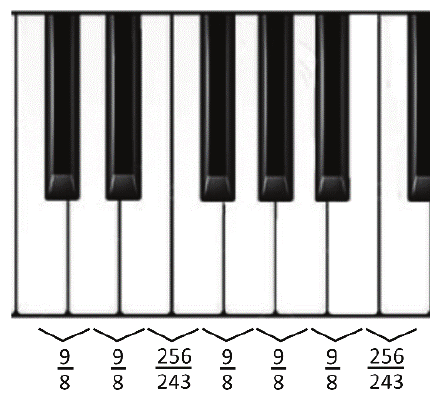
On an instrument tuned according to the Pythagorean scale, if the interval between a note of 220 Hz and another of 990 Hz is composed of $n$ tones and $m$ semitones, the sum $m + n$ is equal to:
- A) 13
- B) 14
- C) 15
- D) 16
- E) 17
Resolution
1. Ratio between frequencies. The interval is measured by the ratio (not the difference):
$$\frac{990}{220} = \frac{9}{2}$$2. Assemble the equation. $n$ tones and $m$ semitones correspond to the product
$$\left(\frac{9}{8}\right)^n \cdot \left(\frac{256}{243}\right)^m = \frac{9}{2}$$3. Factor into primes. $\frac{9}{8} = \frac{3^2}{2^3}$, $\frac{256}{243} = \frac{2^8}{3^5}$ and $\frac{9}{2} = \frac{3^2}{2^1}$. Then
$$\frac{3^{2n}}{2^{3n}} \cdot \frac{2^{8m}}{3^{5m}} = 3^{2n - 5m} \cdot 2^{8m - 3n} = 3^2 \cdot 2^{-1}$$4. Compare exponents (prime factorization is unique):
From the first, $n = \dfrac{2 + 5m}{2}$. Replacing in the second: $16m - 3(2 + 5m) = -2$, that is, $16m - 6 - 15m = -2$, then $m = 4$ and $n = \dfrac{2 + 20}{2} = 11$.
5. Conference. $2 \cdot 11 - 5 \cdot 4 = 2$ and $8 \cdot 4 - 3 \cdot 11 = -1$. Right. Then $m + n = 4 + 11 = 15$.
Answer: alternative C (15).
To review, see Power of Integers.
Question 58: Total CO₂ emission between 1950 and 1990 (graph reading)
Statement
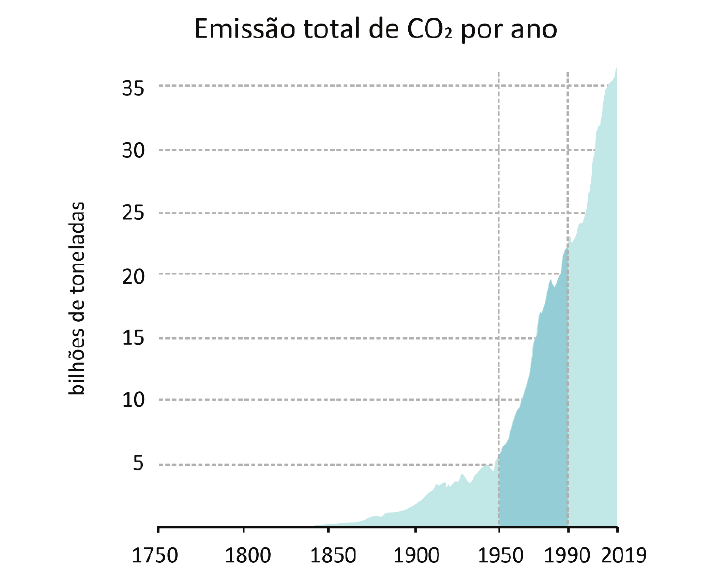
The graph shows the amount of CO₂ emission (in billions of tons) in year function.
Available at https://www.bbc.com/. Adapted.
The total CO₂ emission, in billions of tons, between the years 1950 and 1990, is between
- A) 1 e 5.
- B) 5 e 100.
- C) 100 e 300.
- D) 300 e 800.
- E) 800 e 1000.
Resolution
The graph shows the emission per year. The total issued from 1950 to 1990 is the sum of the emissions from around 40 years, which corresponds to the area of the highlighted region (darker) under the curve.
1. Read the graph. The curve is increasing during this period. In 1950 the broadcast is around 6 billion tons; at 1970, close to 15; in 1990, a little above from 20 (about 22).
2. Limit each half of the period. As the curve grows, in each stretch the annual issue is between the starting value and the ending value:
- from 1950 to 1970 (20 years): between $20 \cdot 6 = 120$ and $20 \cdot 15 = 300$;
- from 1970 to 1990 (20 years): between $20 \cdot 15 = 300$ and $20 \cdot 22 = 440$.
Adding up: the total is between $120 + 300 = 420$ and $300 + 440 = 740$ billions of tons.
3. Direct estimation. Approximating the region by a trapezoid of bases 6 and 22 and height 40 years:
$$\text{total} \approx \frac{(6 + 22) \cdot 40}{2} = 560$$The two accounts point to a value between 300 and 800.
Answer: alternative D (between 300 and 800).
Be careful with the catch: alternative B (5 and 100) attracts those who only look at the axis vertical, where annual values range from about 5 to 22. The question is the total of the period, that is, the sum of 40 years of emissions.
Question 84: Assembling tests (combinations)
Statement
A teacher needs to prepare a multidisciplinary test that consists of two questions from Mathematics and six from Physics. He must choose questions from a bank of data that contains three questions from Mathematics and eight from Physics. The number of tests possible, without taking into account the order in which the questions appear, is:
- A) 42
- B) 54
- C) 62
- D) 72
- E) 84
Resolution
The order doesn’t matter, so each choice is a combination.
1. Mathematics Questions: choose 2 between 3:
$$C_{3,2} = \frac{3!}{2! \cdot 1!} = 3$$2. Physics Questions: choose 6 between 8 (the same as choosing the 2 that are left out):
$$C_{8,6} = C_{8,2} = \frac{8 \cdot 7}{2} = 28$$3. Multiplicative principle. Each Mathematics choice can be combined with each Physics choice:
$$3 \cdot 28 = 84$$Answer: alternative E (84).
To review, see Pascal’s Triangle.
Question 85: FIFA Ranking (exponential and logarithm)
Statement
FIFA (International Football Federation) implemented, in 2018, the most recent ranking of the selections. Suppose selections A and B, with scores $P_A$ and $P_B$, respectively, will compete in a World Cup final. The score update of selection A after the match will be given by
$$P_A' = P_A + 60(V_A - E_A),$$where
$$E_A = \frac{10^{\frac{P_A - P_B}{600}}}{1 + 10^{\frac{P_A - P_B}{600}}}$$and the value of $V_A$ depends on the result of the match according to the table:
| Match result | Value of $V_A$ |
|---|---|
| A’s victory | 1 |
| Draw | 0,5 |
| A’s defeat | 0 |
Knowing that $P_A - P_B = 360$, if selection A wins the match, its score will increase by
- A) 6 points.
- B) 10 points.
- C) 12 points.
- D) 15 points.
- E) 20 points.
Note and adopt: $\log_{10} 2 = 0{,}3$
Resolution
1. The exponent. $\dfrac{P_A - P_B}{600} = \dfrac{360}{600} = 0{,}6$.
2. Calculate $10^{0{,}6}$ with the data. As $\log_{10} 2 = 0{,}3$, we have $10^{0{,}3} = 2$. Then
$$10^{0{,}6} = \left(10^{0{,}3}\right)^2 = 2^2 = 4$$3. Result expectation.
$$E_A = \frac{4}{1 + 4} = \frac{4}{5} = 0{,}8$$4. Score increase on victory($V_A = 1$):
$$P_A' - P_A = 60(1 - 0{,}8) = 60 \cdot 0{,}2 = 12$$Answer: alternative C (12 points).
To review, see Properties of Logarithms.
Question 86: Volume of an irregular stone (cylinder)
Statement
To measure the volume of an irregularly shaped stone, Ana used a container cylindrical with radius $r = 8$ cm and with water up to a height of 20 cm. After placing the stone in the container, the height of the water rose to 23,5 cm.
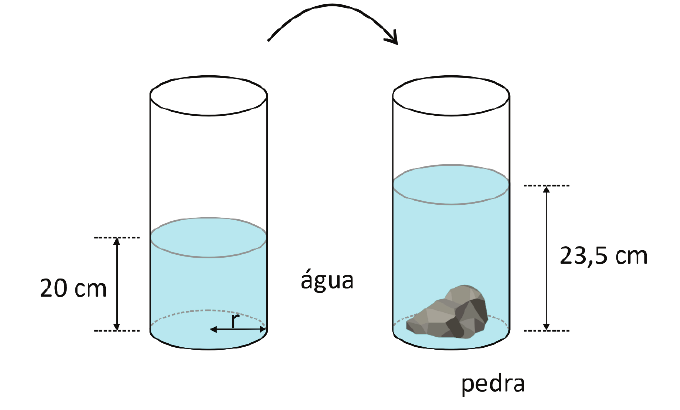
The volume of the stone is:
- A) $128\pi$ cm³
- B) $224\pi$ cm³
- C) $240\pi$ cm³
- D) $282\pi$ cm³
- E) $320\pi$ cm³
Resolution
The stone, completely submerged, takes the place of an equal volume of water. That’s why the level rises: the volume of the stone is the volume of the “cylinder” of water that rose.
1. How much water rose. $23{,}5 - 20 = 3{,}5$ cm.
2. Volume of this cylinder (radius 8 cm, height 3.5 cm):
$$V = \pi r^2 h = \pi \cdot 8^2 \cdot 3{,}5 = 64 \cdot 3{,}5 \cdot \pi = 224\pi \text{ cm}^3$$Answer: alternative B ($224\pi$ cm³).
To review, see Circle Area.
Question 87: Primordial (prime numbers)
Statement
Given a natural number $n \geq 2$, the prime of $n$, denoted by $n\\#$, is the product of all prime numbers less than or equal to $n$. For example,
$$6\\# = 2 \cdot 3 \cdot 5 = 30.$$The smallest number of the form $n\\#$ that is greater than $2000$ is:
- A) 2300
- B) 2305
- C) 2310
- D) 2312
- E) 2322
Resolution
The prime only changes when $n$ passes through a prime number, so just go multiplying the primes in order:
| Cousins even | Primal |
|---|---|
| 2 | 2 |
| 3 | $2 \cdot 3 = 6$ |
| 5 | $6 \cdot 5 = 30$ |
| 7 | $30 \cdot 7 = 210$ |
| 11 | $210 \cdot 11 = 2310$ |
The last value below 2000 is 210 (for $7 \leq n \leq 10$). The next one, for $n = 11$ (and even $n = 12$), is $2310$, the first greater than 2000.
Conference by alternatives: a primordial with $n \geq 5$ is a multiple of $2 \cdot 3 \cdot 5 = 30$. Of the options, only 2310 is a multiple of 30 (2300 and 2305 are not multiples of 3; 2312 and 2322 are not multiples of 5).
Answer: alternative C (2310).
To review, see Prime numbers.
Question 88: Uniform floor tiling (regular polygons)
Statement
A tiling is called uniform if it is composed of regular polygons that fill the entire plane without overlapping and, furthermore, the pattern is the same in each vertex. To classify them, we use a notation given by a sequence of numbers that is defined this way: we choose any vertex and indicate the number of sides of each polygon that contains this vertex, following the direction counterclockwise, starting with the polygons with the fewest sides, as shown in the examples:
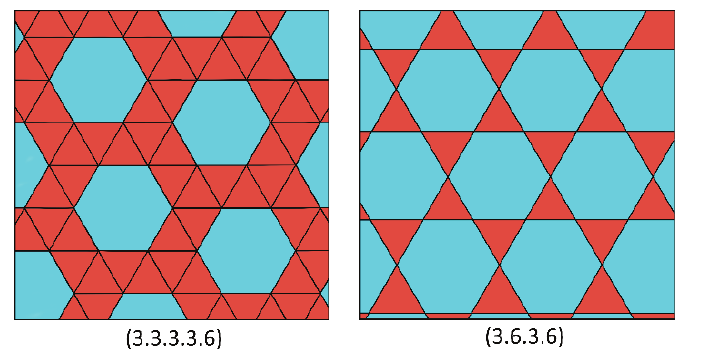
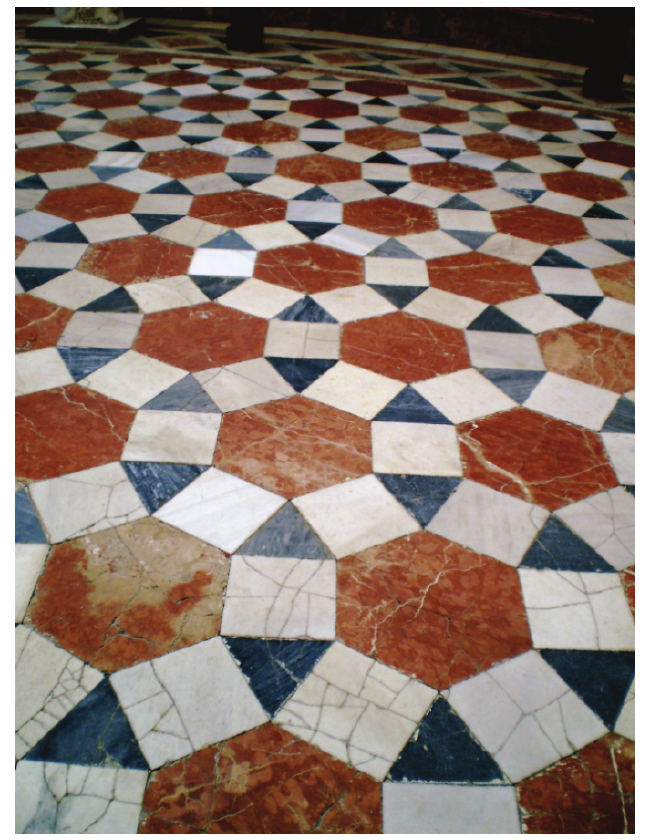
The photo shows the floor of a museum in Seville.
The notation that represents the floor tiling pattern is:
- A) (3 . 3 . 3 . 4)
- B) (3 . 3 . 4 . 6)
- C) (3 . 4 . 4 . 4)
- D) (3 . 4 . 4 . 6)
- E) (3 . 4 . 6 . 4)
Resolution
1. Interior angles. The polygons in the photo are triangles (60°), squares (90°) and regular hexagons (120°). At each vertex, the angles must add exactly $360^\circ$.
2. Test the sum of each alternative.
| Alternative | Sum of angles | Closes 360°? |
|---|---|---|
| A) 3.3.3.4 | $60 + 60 + 60 + 90 = 270^\circ$ | no |
| B) 3.3.4.6 | $60 + 60 + 90 + 120 = 330^\circ$ | no |
| C) 3.4.4.4 | $60 + 90 + 90 + 90 = 330^\circ$ | no |
| D) 3.4.4.6 | $60 + 90 + 90 + 120 = 360^\circ$ | Yes |
| E) 3.4.6.4 | $60 + 90 + 120 + 90 = 360^\circ$ | Yes |
3. Look at the order in the photo. That leaves D and E, which have the same polygons in order different. In the photo, at each vertex there is a triangle, a square, a hexagon and another square: the two squares are not neighbors, they are separated by triangle on one side and a hexagon on the other. Starting with the triangle and rotating counterclockwise: triangle, square, hexagon, square, i.e. (3 . 4 . 6 . 4).
Answer: alternative E (3 . 4 . 6 . 4).
Be careful with the catch: alternative D has the same polygons and also adds 360°, but places the two squares side by side. The notation records the order of the polygons around the vertex, and in the photo the squares are separated.
To review, see Regular Polygons.
Question 89: Area of the square without the circular sector (analytical geometry)
Statement
Consider the region of the Cartesian plane
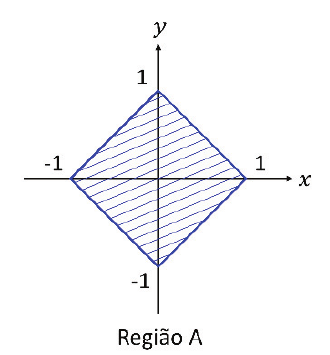
$$A = \\{(x, y) \in \mathbb{R}^2 : |x| + |y| \leq 1\\}$$sketched in the figure.
Given $B = \\{(x, y) \in \mathbb{R}^2 : (x + 1)^2 + y^2 \geq 1\\}$, the area of the region $A \cap B$ is:
- A) $2 - \frac{\pi}{4}$
- B) $2 - \frac{\pi}{2}$
- C) $4 + \frac{\pi}{2}$
- D) $4 - \frac{\pi}{4}$
- E) $2 + \frac{\pi}{2}$
Resolution
1. The region $A$. Is the square of vertices $(1,0)$, $(0,1)$, $(-1,0)$ and $(0,-1)$. Its diagonals measure 2, so its area is
$$\text{área}(A) = \frac{2 \cdot 2}{2} = 2$$2. The region $B$. $(x+1)^2 + y^2 \geq 1$ are the points outside (or on the edge) of the circle with center $(-1, 0)$ and radius 1. So $A \cap B$ is the square $A$ without the part of this circle that is within him.
3. The part of the circle inside $A$. The center $(-1, 0)$ is a vertex of the square, where the internal angle is $90^\circ$. The sides leaving this vertex measure $\sqrt{2} > 1$, and the other two sides are in the distance $\frac{|-1 - 1|}{\sqrt{2}} = \sqrt{2} > 1$ from the center. Therefore, the part of the circle inside the square is exactly one sector of 90° (a quarter of the circle):
$$\text{área do setor} = \frac{\pi \cdot 1^2}{4} = \frac{\pi}{4}$$4. Area requested.
$$\text{área}(A \cap B) = 2 - \frac{\pi}{4}$$Answer: alternative A ($2 - \frac{\pi}{4}$).
Be careful with the catch: alternative B ($2 - \frac{\pi}{2}$) discounts half circle. But only a quarter of the circle goes into the square, because the angle of the square at the vertex $(-1, 0)$ is straight.
To review, see Circle Area.
Question 90: Logarithmic function graph
Statement
In the Cartesian plane, the points $(3, 2)$ and $(5, 4)$ belong to the graph of the function given by
$$y = \log_2(ax + b).$$The value of $a + b$ is:
- A) $-8$
- B) $-6$
- C) $0$
- D) $4$
- E) $8$
Resolution
1. Use the logarithm definition. $y = \log_2(ax + b)$ is equivalent to $ax + b = 2^y$.
- Point $(3, 2)$: $3a + b = 2^2 = 4$.
- Point $(5, 4)$: $5a + b = 2^4 = 16$.
2. Solve the system.
Subtracting the first from the second: $2a = 12$, then $a = 6$ and $b = 4 - 18 = -14$.
3. Conference. $\log_2(6 \cdot 3 - 14) = \log_2 4 = 2$ and $\log_2(6 \cdot 5 - 14) = \log_2 16 = 4$. Right.
$$a + b = 6 + (-14) = -8$$Answer: alternative A ($-8$).
To review, see Introduction to Logarithm Table.