
Euler's Eyes
2020-06-19
OBMEP 2021 - First Phase
IMPA Portal Videos - Sixth Year Exercises
OBMEP 2021 - Level 3
Exercise 1:
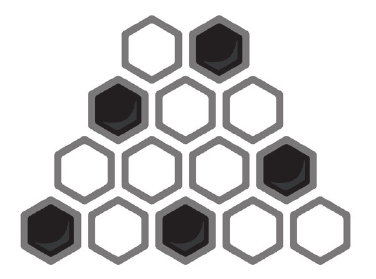
The little black houses in the comb below are full of honey and the little white houses are empty. How many empty houses must the bees still fill with honey so that the number of empty houses is equal to the number of houses with honey?
-
(A) 1
-
(B) 2
-
(C) 3
-
(D) 4
-
(E) 5
Answer: B
-
Total: 14 little houses
-
Objective: 7 white and 7 black.
-
2 little white houses should turn black.
Exercise 2:
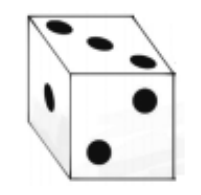
On the die, the sum of the numbers on any two opposite faces is 7. What is the sum of the numbers on the three faces that are not visible?
-
(A) 10
-
(B) 11
-
(C) 12
-
(D) 14
-
(E) 15
Answer: E
-
Faces not visible:
- Number 6 (opposite to 1)
- Number 5 (opposite to 2)
- Number 4 (opposite to 3)
-
Objective: Sum of non-visible numbers.
$$S=6+5+4=15$$
Exercise 3:
Which number is greater than 0,37 and less than 0,7?
-
(A) 0,307
-
(B) 0,073
-
(C) 0,737
-
(D) 0,377
-
(E) 0,703
Answer: D
-
Statement:
- Lowest value: 0,37
- Highest value: 0,7
-
Objective: What number between 0,37 and 0,7.
Initially, it is worth remembering that:
$$0,37 = 0,370$$$$0,7 = 0,700$$
In mathematical notation:
- < is the less than symbol (if we cut the symbol it resembles 4).
- > is the greater than symbol (if we cut the symbol, it resembles 7).
The next step is to order the numbers.
Exercise 4:
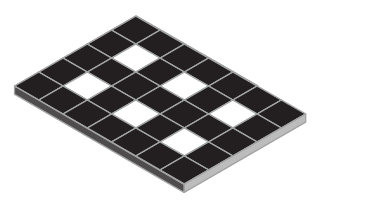
Roberto put new flooring in his garage. He used all the white and black tiles he bought. Each white tile cost R$ 5,00 and each black tile cost R$ 2,00. How much did he spend on purchasing the tiles?
-
(A) R$ 85,00
-
(B) R$ 88,00
-
(C) R$ 145,00
-
(D) R$ 150,00
-
(E) R$ 175,00
Answer: B
-
Statement:
- white tile cost R$ 5,00
- black tile cost R$ 2,00
-
Objective: How much did you spend on purchasing the tiles.
-
white tile:
- Cost R$ 5,00
- Number of white tiles: 6 $$\text{Ladrilho Branco} = LB = R\$ 5 \times 6 = R\$ ~ 30,00$$
-
black tile:
- Cost R$ 2,00
- Number of white tiles: 29 $$\text{Ladrilho Preto} = LP = R\$ 2 \times 29 = R\$ ~58,00$$
$$\text{Total gasto} = R\$~ 88,00$$
Exercise 5:
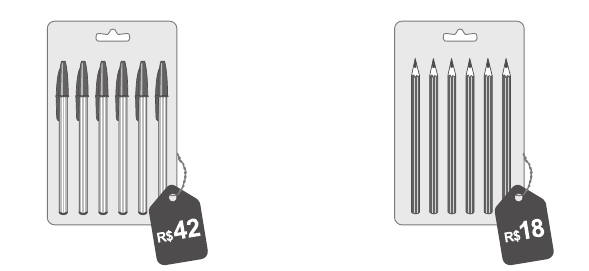
A stationery store sells pencils and pens in cases of 6 units. If unit prices don’t change, how much does a case of three pencils and two pens cost?
-
(A) 20
-
(B) 22
-
(C) 23
-
(D) 24
-
(E) 30
Answer: C
-
Statement:
- Case with 6 pens costs R$ 42,00
- Case with 6 pencil costs R$ 18,00
-
Objective: How much does a pencil case with 3 pencils and 2 pens cost.
-
Cost of each pencil:
- R$ 18,00 divided by 6 = R$ 3,00
-
Cost of each pen:
- R$ 42,00 divided by 6 = R$ 7,00
-
Cost of 3 pencils:
- R$ 3,00 multiplied by 3 = R$ 9,00
- Cost of 2 pens:
- R$ 7,00 multiplied by 2 = R$ 14,00
Therefore, the case with 3 pencils and 2 pens:
$$\text{Estojo} = E = C + L = 14 + 9 = 23$$$$\text{Estojo} = R\$ 23,00$$
Exercise 6:
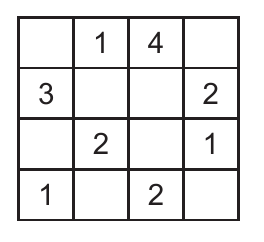
Margarida filled in the eight empty spaces in the table with the numbers 1, 2, 3 and 4. She did this and noticed that in no line or column did two identical numbers appear. What is the product of the numbers that appear in the four corners of the table?
-
(A) 20
-
(B) 22
-
(C) 23
-
(D) 24
-
(E) 30
Answer: E
-
Objective: What is the product of the numbers in the 4 corners of the table.
Solution 1: Algorithm:
-
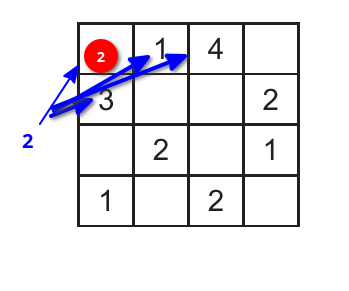
In the upper left box, place the number 2, because around this box we have 1, 4 and 3.
-
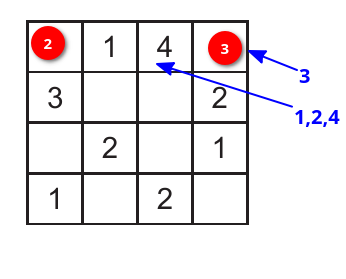
In the upper right box, place the number 3, as the numbers before it are 2, 1 and 4.
-
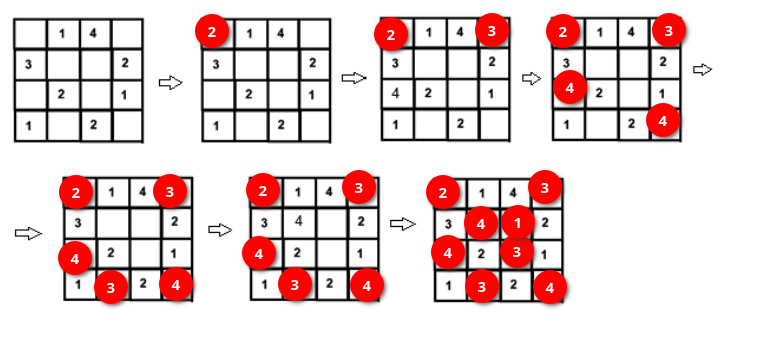
The others follow this idea and are composed in the following form:
It is worth remembering that the product of numbers is equal to the multiplication between numbers. In this way, we have:
$$\text{Produto} = P = 1\times 2\times 3\times 4\times = 24$$Solution 2:
The numbers in a sudoku do not repeat. This way, the only option for the corners is 1,2,3,4.
$$\text{Produto} = P = 1\times 2\times 3\times 4\times = 24$$Exercise 7:
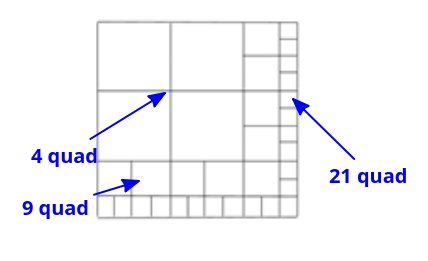
Open cut a sheet of paper into smaller squares, leaving no folds. He cut four squares of area equal to 400 cm² each, 9 squares of area 100 cm² each and 21 small squares of area 25 cm² each. What was the side measurement of the sheet before Alberto cut it?
-
(A) 25
-
(B) 30
-
(C) 40
-
(D) 50
-
(E) 55
Answer: E
-
Statement:
- Cut 4 squares of area 400 cm²
- Cut 9 squares of area 100 cm²
- Cut 21 squares of area 25 cm²
-
Objective: What is the measurement of the side of the sheet, before Alberto cuts it.
- Area Calculation:
-
Cut 4 squares of area 400 cm²
$$A_1 = 4\text{ quadrados } \times 400 ~cm^2 = 1600 ~cm^2$$ -
Cut 9 squares of area 100 cm²
$$A_2 = 9\text{ quadrados } \times 100 ~cm^2 = 900 ~cm^2$$ -
Cut 21 squares of area 25 cm²
$$A_3 = 21\text{ quadrados } \times 25 ~cm^2 = 525 ~cm^2$$ -
Total:
$$\text{Área total} = A_T = A_1 + A_2 + A_3 = 1600 + 900 + 525 = 3025 ~cm^2$$
-
Exercise 8:
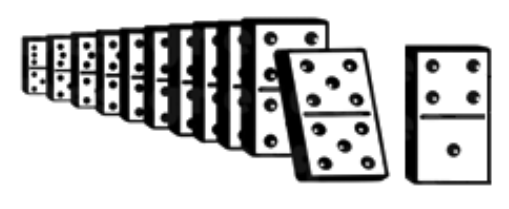
A game of dominoes is made up of 28 different rectangular pieces, each divided into two squares. In each of these squares, 0 to 6 dots appear. How many pieces have a total number of balls equal to or greater than 7?
-
(A) 9
-
(B) 10
-
(C) 12
-
(D) 21
-
(E) 24
Answer: C
-
Statement:
- 28 different rectangular pieces.
- Each divided into 2 squares.
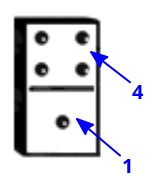
- In each square, numbers from 0 to 6 appear. In the following example, 4 and 1 appear in the squares, respectively.
-
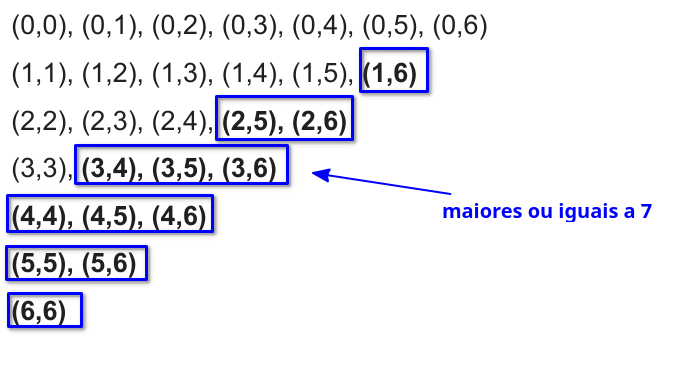
Objective: How many pieces have a total number of balls equal to or greater than 7.
The combinations of marbles that have a total number of marbles equal to or greater than 7 are:
Exercise 9:
Patrícia has five pieces of cardboard made from identical squares: four with two squares each and one with a single square.
She formed a square with these pieces and wrote the first nine letters of the alphabet on them.
We can say with certainty that the letter corresponding to the piece of a single square
-
(A) is a vowel
-
(B) is the letter C
-
(C) is the letter G
-
(D) is not any of the letters B, D, F or H.
-
(E) is one of the letters in the corners of the square
Answer: D
-
Statement:
- 5 cardboard pieces made from identical squares:
- 4 with 2 squares
- 1 with 1 square
- 5 cardboard pieces made from identical squares:
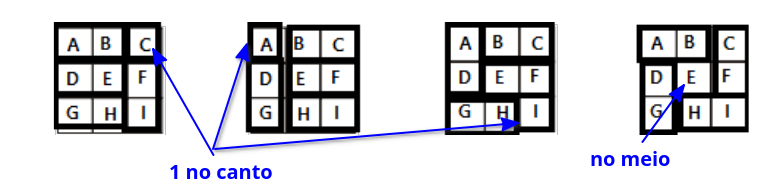
The following combination eliminates answers A, B, C and E
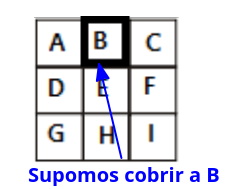
To prove that it is D, let’s absurdly assume that the piece to be covered is B.
The only option for possible double pieces next to the B piece.
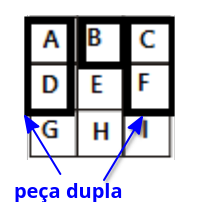
It remains to fill in the next double piece. We can choose (E, H), (G, H) or (H, I). Let us choose without loss of generality a (E, H).
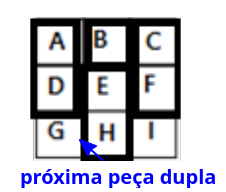
This way, it is impossible to cover squares G and I with a double piece. Likewise, you can do the same for D, F or H.
Exercise 10:
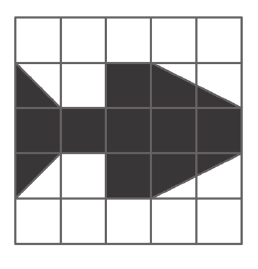
In the figure we see a large square divided into 25 equal squares. The gray area corresponds to what fraction of the area of the large square.
-
(A) 1/2
-
(B) 1/3
-
(C) 2/5
-
(D) 3/5
-
(E) 1/25
Answer: C
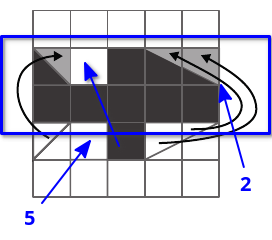
Just transfer the symmetrical pieces as shown in the figure:
Exercise 11:
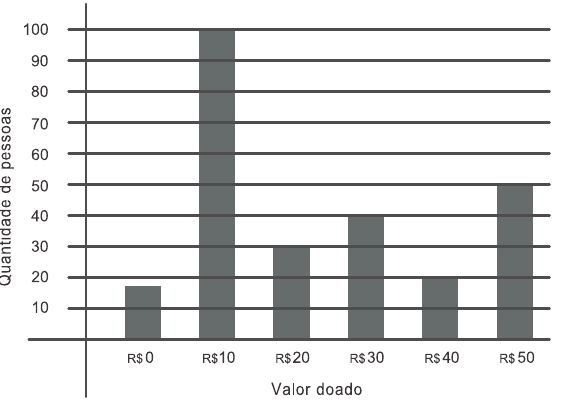
In the community of Quixajuba, a fundraising campaign was carried out to renovate the sports court. The graph shows how many people donated the same amount in reais. For example, 40 people donated 30 reais. What was the total amount of money raised, in reais?
-
(A) 4000
-
(B) 5000
-
(C) 5100
-
(D) 6000
-
(E) 6100
Answer: E
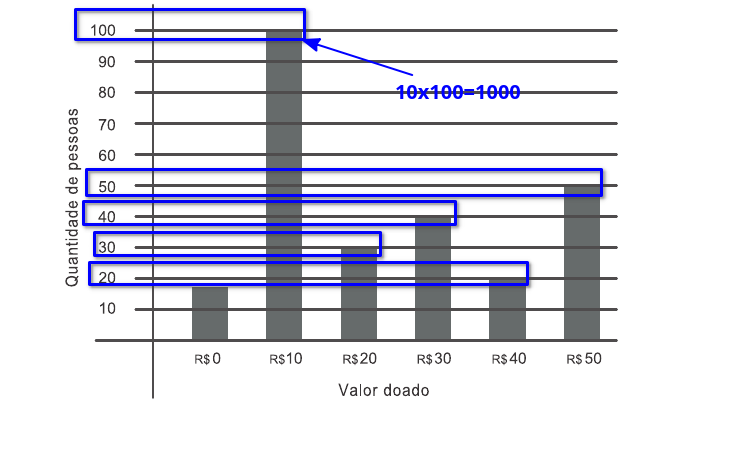 $$\text{Arrecadação} = 10\times 100 + 30 \times 20 + 40\times 30 + 20\times 40 + 50 \times 50$$
$$\text{Arrecadação} = 1000 + 600 + 1200 + 800 + 2500$$
$$\text{Arrecadação} = 6100~\text{ reais} $$
Exercise 12:
A gymnastics competition classifies only the first and second placed, as follows: either both can take first place and in this case no one takes second place. Another of them comes first and another comes second. Almira, Betânia, Cecília, Dinorá and Esmeralda participate in this competition. How many different ways can they be classified?
-
(A) 5
-
(B) 15
-
(C) 20
-
(D) 30
-
(E) 120
Answer: D
-
Statement:
- 2 people can get me first. None come second.
- 1 comes first and the other comes second.
- Competitors:
- A = Almira,
- B = Bethany,
- C = Cecilia,
- D = Dinora,
- E = Emerald.
The first possibility is Almira with the others:
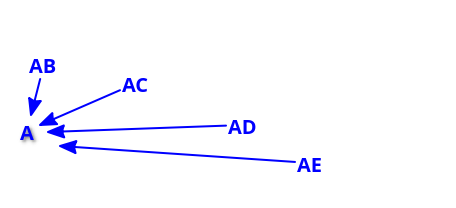
As Almira has already been, let’s put Belmira as the winner:
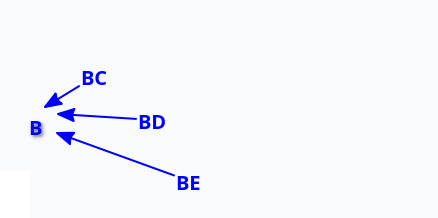
As Almira and Belmira have already been, let’s put Cecília as the winner:
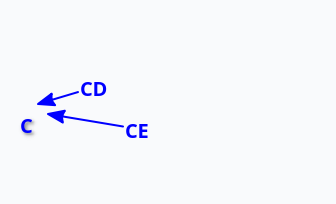
As Almira, Belmira and Cecília have already been, we will place Dinirá as the winner. As repetition is not valid, it makes no difference to Dinorá as the winner or Esmeralda as the winner:
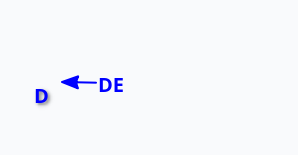
Thus, we have (AB, AC, AD, AE, BC, BD, BE, CD, CE, DE) as possibilities of winning or possibilities of (first, first).
Now the possibility of (first, second) repetition is valid, that is, twice as much as (AB, AC, AD, AE, BC, BD, BE, CD, CE, DE)
Exercise 13:
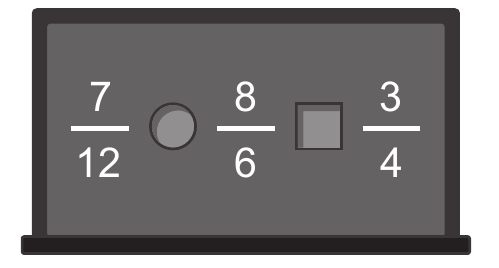
What are the signs that we must place inside the circle and square, in this order, to obtain correct equality?
-
(A) = e x
-
(B) x e =
-
(C) = e +
-
(D) + e =
-
(E) = e -
Answer: E
-
A’s calculation (Wrong):
$$\frac{7}{12}= \frac{8}{6} \times \frac{3}{4}$$
$$\frac{7}{12}\neq 1$$ -
B’s calculation (Wrong):
$$\frac{7}{12}\times \frac{8}{6} = \frac{3}{4}$$
$$\frac{7}{9}\neq \frac{3}{4}$$ -
C’s calculation (Wrong):
$$\frac{7}{12}= \frac{8}{6} + \frac{3}{4}$$
$$\frac{7}{12}\neq \frac{25}{12}$$ -
D’s calculation (Wrong):
$$\frac{7}{12}+ \frac{8}{6} = \frac{3}{4}$$
$$\frac{23}{12}\neq \frac{3}{4}$$ -
E’s cache (Right):
$$\frac{7}{12}= \frac{8}{6} - \frac{3}{4}$$
$$\frac{7}{12}= \frac{8\times \color{red}{4} }{6\times \color{red}{4} } - \frac{3\times \color{red}{6} }{4\times \color{red}{6} }=\frac{32}{24} - \frac{18}{24} $$
$$\frac{7}{12}= \frac{14}{24}= \frac{7 \times \color{red}{2} }{12 \times \color{red}{2} }$$
Exercise 14:
Alfredo invents passwords in the following way:
- It chooses a sequence of 5 letters
- Next, it exchanges the letters in the chosen sequence for numbers from two algorithms, using the following table to encode letters. The letter A is encoded as 05, the letter B as 06 and so on until the letter Z is encoded as 47.
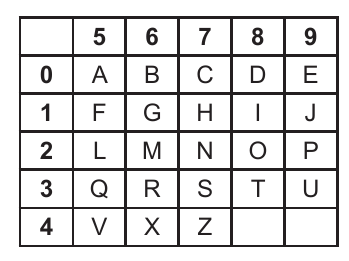
When creating a certain password, the numbers obtained were mixed up, but Alfredo noted that they were 1, 2, 4, 4, 4, 5, 6, 7, 8 and 8. It is correct to say that in this password, between the encoded letters appears.
-
(A) the letter F
-
(B) the letter G
-
(C) the letter H
-
(D) the letter L
-
(E) the letter Z
Answer: E
| Letter | Codification |
|---|---|
| A | 05 |
| B | 06 |
| C | 07 |
| D | 08 |
| E | 09 |
| F | 15 |
| G | 16 |
| H | 17 |
| I | 18 |
| J | 19 |
| L | 25 |
| M | 26 |
| N | 27 |
| O | 28 |
| P | 29 |
| Q | 35 |
| R | 36 |
| S | 37 |
| T | 38 |
| U | 39 |
| V | 45 |
| X | 46 |
| Z | 47 |
Observe the following texts:
- A letter cannot be encoded by a number ending in 4 (4 in units).
- The letters starting with 4 (4 in tens) are X, Y and Z.
- This way, Z appears in Alfredo’s password.
- The other letters are I and O.
Exercise 15:
Last week, Aunt Zulmira bought 12 balls of wool and 18 buttons at her neighborhood store. Your purchase was 36 reais in total. Today she returned to the store and saw that the balls were on sale and that the buttons were still the same price. She took advantage and bought 36 balls of yarn and 54 buttons, spending a total of 72 reais. What discount did the store give on each ball?
-
(A) R$ 0,25
-
(B) R$ 0,50
-
(C) R$ 0,75
-
(D) R$ 1,00
-
(E) R$ 1,25
Answer: D
-
Statement:
- Day 1 purchased:
- 12 balls of wool
- 18 buttons
- Total spent 36 reais
- Day 2 purchased:
- 36 balls of wool
- 54 buttons
- Total spent 72 reais
- Day 1 purchased:
Note that:
- Day 2 purchased:
- 36 balls of wool = 3 x 12 balls of wool
- 54 buttons = 3 x 18 buttons
- Total spent 72 reais
- Price without discount on the second purchase would be triple the price of the first purchase:
- 3 x 36 = 108
- Difference with total paid:
- 108 - 72 = 36 real
- As 36 balls were purchased in the second purchase and the discount was 36 reais.
- Discount of 36 divided by 36 than 1 real per ball of discount.
Exercise 16:
Some Martians have 7 antennae on their heads and others have 9 antennae. On a flying saucer with a Martian crew, the total number of antennas on the heads is 69. We can say that in this flying saucer there is exactly.
-
(A) 6 martians
-
(B) 9 martians
-
(C) 10 martians
-
(D) 11 martians
-
(E) 12 martians
Answer: B
The sum of Martians with 7 antennas and Martians with 9 antennas is given by:
The next step is to decompose 69:
$$69 = 3\times 13$$In this way, we have to
- the sum of the Martians is a multiple of 3.
- zero cannot be in sets.
- and we will discard m2 times 9, as it gives 81 which is greater than 69
To understand, let’s build the combinations:
| Marciano 7 antennas (m1) | Marciano 9 antennas (m2) | Sum |
|---|---|---|
| 1 | 3 | $$1\times 7 + 3\times 9 = 7 + 27 = 34$$ |
| 1 | 6 | $$1\times 7 + 6\times 9 = 7 + 54 = 61$$ |
| 3 | 1 | $$3\times 7 + 1\times 9 = 21 + 9 = 30$$ |
| 3 | 3 | $$3\times 7 + 3\times 9 = 21 + 27 = 48$$ |
| 3 | 6 | $$3\times 7 + 6\times 9 = 21 + 54 = 75$$ |
| 6 | 3 | $$6\times 7 + 3\times 9 = 42 + 27 = 69$$ |
Therefore,
$$m_1+m_2 = 3+6=9$$Exercise 17:
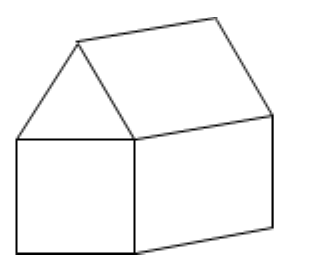
João has 3 pencils in yellow, beige and gray. He wants to paint the drawing below so that polygons with a common side do not have the same color. How many different ways can he paint the drawing?
-
(A) 6
-
(B) 12
-
(C) 18
-
(D) 24
-
(E) 36
Answer: C
-
Case 1:
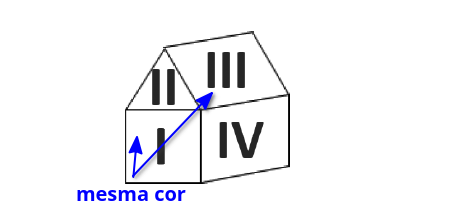
- We assume 3 possibilities to paint I.
- With this, we have 1 possibility to paint III, which is the same as I.
- 2 possibilities for II, as they will have to have different colors than I and III.
- 2 possibilities for IV, as they will have to have different colors than I and III.
Then,
$$C_1 = 3\times 1\times 2\times 2 = 12$$- Case 2:
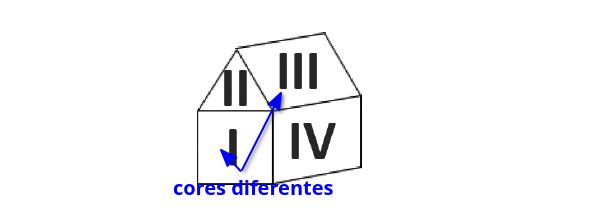
- We assume 3 possibilities to paint I.
- With this, we have 2 possibilities to paint III, which are different from I.
- 1 possibility for II, as it is the remaining color.
- 1 possibility for IV, as it is the remaining color.
Then,
$$C_2 = 3\times 2\times 1\times 1 = 6$$Therefore, we have a total of:
$$\text{Total} = C_1+C_2 = 12+6=18$$Exercise 18:
The rectangle PQRS has a perimeter of 76 cm and was divided into nine smaller rectangles, indicated in the figure by the letters A to I. Knowing that the perimeters of rectangles B, D, F and H are respectively 22, 18, 32 and 26 cm, what is the perimeter of region E?
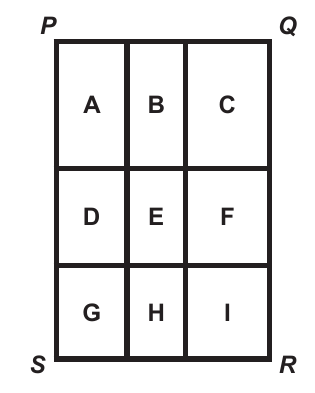
-
(A) 16 cm
-
(B) 20 cm
-
(C) 22 cm
-
(D) 24 cm
-
(E) 26 cm
Answer: C By symmetry, we can note that:
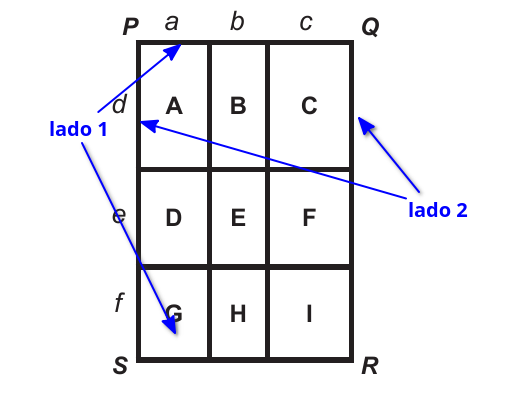
In this case, we will geometrically show one of the perimeters of the rectangles.
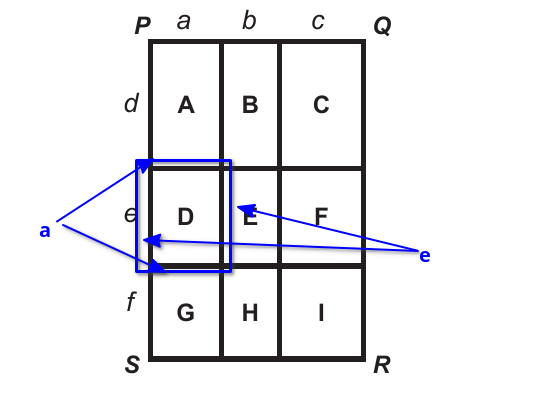 $$\text{Perímetro}_D = 2a+ 2e = 18$$
In a similar way:
$$\text{Perímetro}_B = 2b+ 2d = 22$$$$\text{Perímetro}_F = 2c+ 2e = 32$$
$$\text{Perímetro}_H = 2b+ 2f = 26$$
In summary:
When we add the 2 sides: $$$$