
Euler's Eyes
2026-10-15
The legacy of John Napier
By shortening the labours, the invention of logarithms doubled, so to speak, the life of the astronomer.
— Saying attributed to Pierre-Simon Laplace
Few inventions spread so quickly. In less than ten years logarithms were in use in England, Holland, Germany and Italy. For three and a half centuries they were humanity’s main calculating tool.
Kepler
The first great user was Johannes Kepler, who saw Napier’s tables in 1617 and was delighted. In 1619 he wrote a letter of thanks to the Scottish baron, not knowing he had been dead for two years, and dedicated his Ephemerides of 1620 to him. Kepler computed his own tables of logarithms and used them in the Rudolphine Tables of 1627, the most accurate tables of planetary positions of the time, which confirmed the elliptical orbits.
The natural logarithm
The mathematics of logarithms took on a life of its own. In 1647 the Belgian Grégoire de Saint-Vincent and his pupil Alphonse de Sarasa realised that the area under the hyperbola $y=1/x$ behaves like a logarithm. The natural logarithm, written $\ln$, has base $e\approx2.71828$, the number that Euler studied and named, and that was hidden in Napier’s definition with the two points. Today logarithms appear in the Richter scale for earthquakes, in the decibels of sound, in the pH of chemistry, in computer memory and in the complexity of algorithms.
Other contributions
- The decimal point. Decimal fractions had been championed by the Fleming Simon Stevin in 1585, with a complicated notation. Napier, in the Rabdologia and the Construction, wrote numbers with a point separating the whole part, as in 25.803, and helped spread the custom.
- Spherical triangles. Napier created memory rules, the rules of circular parts, which reduce to two sentences the ten formulas for right spherical triangles used in astronomy and navigation. Napier’s analogies still appear in books on spherical trigonometry.
- The neper. The unit that measures logarithmic ratios in telecommunications is called the neper in his honour. So is a crater on the Moon.
What remained
- Calculation. Logarithms, which turn multiplications into sums and powers into products.
- Instruments. Napier’s bones, the promptuary and, through Gunter and Oughtred, the slide rule.
- Notation. The decimal point and the word logarithm.
- Trigonometry. The rules of circular parts and Napier’s analogies.
- Science. Kepler’s tables, navigation and the engineering of the next three centuries.
To remember
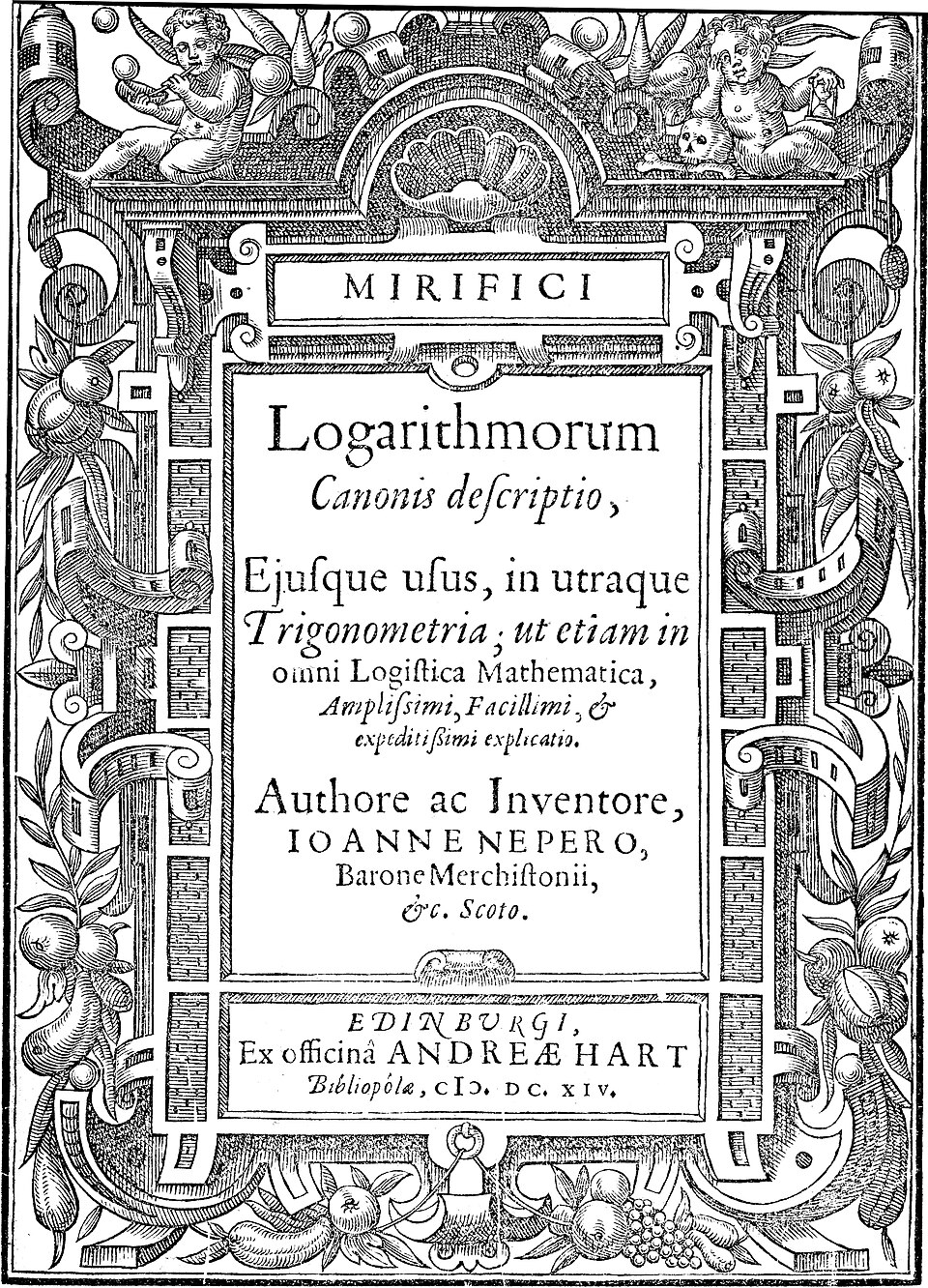
- John Napier lived from 1550 to 1617. He published logarithms in 1614, after twenty years of calculation.
- Multiplying in the geometric progression is adding in the arithmetic one: $2^a\times2^b=2^{a+b}$.
- Napier defined the logarithm with two moving points; in modern language, $\operatorname{NapLog}(x)=10^7\ln(10^7/x)$.
- With Briggs he adopted base 10: $\log1=0$, $\log10=1$, and $\log2\approx0.30103$ follows from $2^{10}\approx10^3$.
- Napier’s bones multiply by reading one row of the times table and adding along the diagonals.
- The slide rule multiplies by adding lengths proportional to logarithms.
Sources: Julian Havil, John Napier: Life, Logarithms, and Legacy (2014) · Eli Maor, e: The Story of a Number (1994) · Napier biography, MacTutor.
All topics on John Napier · ← The slide rule: logarithms that slide · Image credits →