
Euler's Eyes
2026-10-11
Congruence, addition and inequality of arcs
Measuring an arc in degrees is so natural today that we forget where it came from: from observing the sky.
Who discovered
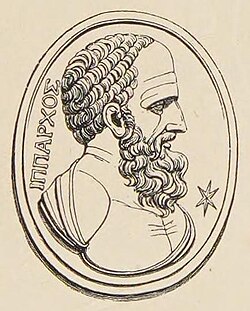
The Babylonian astronomers divided the Sun’s path across the sky into 12 signs of 30 parts, totaling 360. The Greek Hyparchus of Nicaea (2nd century BC) took this measurement to geometry and created the first known chord table, which related each arc to the corresponding chord — the beginning of trigonometry. Claudius Ptolemy expanded the table in Almagest (c. 150 AD), with chords of half degrees. The comparison and sum of arcs of the same circle follow book III of The Elements by Euclid.


The story
To ancient astronomers, the sky was a large sphere revolving around the Earth, and the positions of the stars were arcs above it. Adding arcs, comparing them and knowing when two were equal was the daily work of those who made calendars and predicted eclipses.
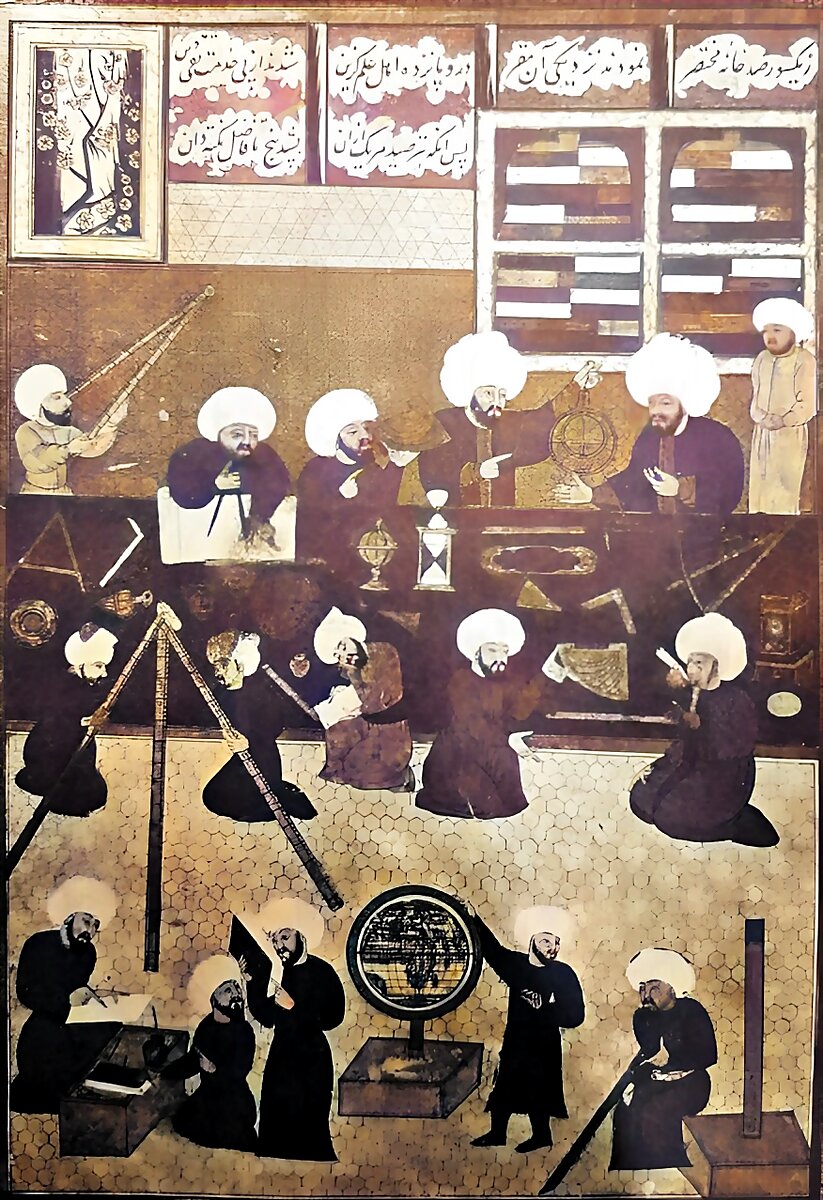
Ptolemy’s table was used for over a thousand years. Indian mathematicians replaced strings with sine, which was more practical for calculations, and astronomers in the Islamic world — such as those at the Istanbul observatory — adopted and improved these tables. The word sine arrived in Latin through a mistranslation of the Arabic jiba.
In everyday life
- Clock. The dial is divided into 12 equal arcs of 30°; the hour hand moves through one of them every hour.
- Time zones. The Earth rotates 360° in 24 hours, 15° per hour: each zone corresponds, in theory, to an arc of 15° in longitude.
- Compass Rose. The cardinal and collateral points divide the circumference into arcs of 45°.
- Pizza and pie. Cutting into 8 equal slices is dividing the edge into 8 congruent arcs of 45°.
Sources: Hiparchus (MacTutor) · Ptolemy (MacTutor) · Taqi al-Din (Wikipedia).
Theory and constructions
Two circles are congruent if they have equal radii. In a circle with center $O$, the arcs are compared by the central angles that determine them:
DefiniçãoCongruent arcs, sum and inequality
$$\overset{\frown}{AB} \equiv \overset{\frown}{CD} \iff A\hat{O}B \equiv C\hat{O}D, \qquad \overset{\frown}{AB} = \overset{\frown}{AC} + \overset{\frown}{CB} \iff A\hat{O}B = A\hat{O}C + C\hat{O}B,$$$$\overset{\frown}{AB} > \overset{\frown}{CD} \iff A\hat{O}B > C\hat{O}D.$$
These concepts also apply to arcs with congruent circles, and adapt to sectors and circular segments.