
Euler's Eyes
2026-11-04
EJU 2016 (2nd session) – Mathematics Course 1 solved
Source: JASSO – Mathematics paper in English, in Japanese and official answer key. Files on the page for the 2nd session of 2016.
Course 1 is the basic mathematics paper of the EJU. Each letter $\boxed{\text{A}}$, $\boxed{\text{B}}$, … is a digit from 0 to 9 or the minus sign; in some blanks the answer is the number of a choice. The statements below are summarized from the official English version.
Answer key
| Question | Topic | Answers |
|---|---|---|
| I Q1 | Quadratic from its maximum and roots | A=1, BC=16, D=3, E=5, FG=−1, H=2, IJ=15 |
| I Q2 | Cards 0 to 9 | K=1, LM=12, NO=13, PQ=40, R=1, S=8 |
| II Q1 | A factorization | A=2, B=1, C=2, D=3, E=2, F=3, G=8, H=1, I=2, J=1, K=2, L=2 |
| II Q2 | Chords of the parabola | M=2, N=4, O=2, P=2, Q=2, R=4, S=4, T=1, U=3, V=2, W=1, X=2, Y=3, Z=4 |
| III | Remainders and base 3 | A=5, B=4, C=1, DE=15, FG=26, H=9, I=1, J=0 |
| IV | Bisector of 60° | A=3, B=1, C=2, D=3, EF=16, G=4, H=3, I=4, J=3, K=4, L=1, M=4, N=3, OP=25 |
Question I
Q1: a quadratic from its maximum and roots
Statement. The function $y = ax^2 + bx + c$ ① has maximum 16 at $x = 1$, and its graph meets the $x$-axis at two points 8 apart. Then $y = a\left(x - \boxed{\text{A}}\right)^2 + \boxed{\text{BC}}$, the intercepts are $\left(-\boxed{\text{D}}, 0\right)$ and $\left(\boxed{\text{E}}, 0\right)$, $a = \boxed{\text{FG}}$, $b = \boxed{\text{H}}$ and $c = \boxed{\text{IJ}}$.
Solution. The vertex is $(1, 16)$: $y = a(x - 1)^2 + 16$. The roots are symmetric about $x = 1$ and 8 apart, so they are $1 \pm 4$: $-3$ and $5$. At $x = 5$: $16a + 16 = 0$, $a = -1$. So $y = -(x - 1)^2 + 16 = -x^2 + 2x + 15$.
Answers: A=1, BC=16, D=3, E=5, FG=−1, H=2, IJ=15.
Q2: cards 0 to 9
Statement. A box holds ten cards numbered 0 to 9. Three cards are drawn in two ways.
- Drawing all three at once:
- the probability that all three numbers are between 2 and 6 is $\dfrac{\boxed{\text{K}}}{\boxed{\text{LM}}}$;
- the probability that the smallest is at most 2 and the largest is at least 8 is $\dfrac{\boxed{\text{NO}}}{\boxed{\text{PQ}}}$.
- Drawing a card, recording it and putting it back, three times: the probability that the smallest is at least 2 and the largest at most 6 is $\dfrac{\boxed{\text{R}}}{\boxed{\text{S}}}$.
Solution. There are $\binom{10}{3} = 120$ simultaneous draws.
1. (i) All three among the five cards $2, \dots, 6$: $\frac{\binom53}{120} = \frac{10}{120} = \frac{1}{12}$.
1. (ii) By complement. Let $E_1$ be “the smallest is at least 3” (three cards among $3, \dots, 9$: $\binom73 = 35$) and $E_2$ “the largest is at most 7” (among $0, \dots, 7$: $\binom83 = 56$). Both: among $3, \dots, 7$, $\binom53 = 10$. By inclusion–exclusion, the good cases are $120 - 35 - 56 + 10 = 39$: $\frac{39}{120} = \frac{13}{40}$.
2. With replacement, smallest $\ge 2$ and largest $\le 6$ means all three numbers are between 2 and 6: $\left(\frac{5}{10}\right)^3 = \frac18$.
Answers: K=1, LM=12, NO=13, PQ=40, R=1, S=8.
Question II
Q1: when xⁿ + yⁿ + zⁿ + a(xy + yz + zx) is divisible by x + y + z
Statement. Let $n$ be a natural number and $a \ne 0$ a real number such that
$$x^n + y^n + z^n + a(xy + yz + zx) = (x + y + z)P \quad \text{①}$$for some polynomial $P$ in $x, y, z$. We want $n$ and $a$. The identity holds for all $x, y, z$; take two triples with $x + y + z = 0$: $x = y = 1$, $z = -\boxed{\text{A}}$, and $x = y = -\dfrac{\boxed{\text{B}}}{\boxed{\text{C}}}$, $z = 1$. Substituting:
$$\left(-\boxed{\text{A}}\right)^n = \boxed{\text{D}}\,a - \boxed{\text{E}} \quad \text{②}, \qquad \left(-\frac{\boxed{\text{B}}}{\boxed{\text{C}}}\right)^n = \frac{\boxed{\text{F}}}{\boxed{\text{G}}}a - \frac{\boxed{\text{H}}}{\boxed{\text{I}}} \quad \text{③}.$$From ② and ③, $\left(\boxed{\text{D}}\,a - \boxed{\text{E}}\right)\left(\frac{\boxed{\text{F}}}{\boxed{\text{G}}}a - \frac{\boxed{\text{H}}}{\boxed{\text{I}}}\right) = \boxed{\text{J}}$, hence $a = \boxed{\text{K}}$ and $n = \boxed{\text{L}}$.
Solution.
1. The first triple. With $(1, 1, -2)$ the right-hand side is zero, and $1 + 1 + (-2)^n + a(1 - 2 - 2) = 0$, or $(-2)^n = 3a - 2$.
2. The second triple. With $\left(-\frac12, -\frac12, 1\right)$: $2\left(-\frac12\right)^n + 1 + a\left(\frac14 - \frac12 - \frac12\right) = 0$, or $\left(-\frac12\right)^n = \frac38a - \frac12$.
3. Multiplying. $(-2)^n\left(-\frac12\right)^n = 1$, so $(3a - 2)\left(\frac38a - \frac12\right) = 1$, that is, $(3a - 2)(3a - 4) = 8$, or $9a^2 - 18a = 0$. Since $a \ne 0$, $a = 2$, and $(-2)^n = 4$ gives $n = 2$.
4. The converse. With $n = 2$ and $a = 2$, the polynomial is $x^2 + y^2 + z^2 + 2(xy + yz + zx) = (x + y + z)^2$, and $P = x + y + z$.
Answers: A=2, B=1, C=2, D=3, E=2, F=3, G=8, H=1, I=2, J=1, K=2, L=2.
Q2: the lowest midpoint of a chord of the parabola
Statement. Consider the segments $PQ$ of length 2 with endpoints on the parabola $y = x^2$, and let $M$ be the midpoint. We want the $M$ closest to the $x$-axis. With $P(p, p^2)$ and $Q(q, q^2)$, the $y$-coordinate of $M$ is $m = \dfrac{p^2 + q^2}{\boxed{\text{M}}}$ ①, and $(p - q)^2 + (p^2 - q^2)^2 = \boxed{\text{N}}$ ②. With $t = pq$, ① and ② give
$$\boxed{\text{O}}\,m^2 + m - \boxed{\text{P}}\,t^2 - t - \boxed{\text{Q}} = 0.$$Solving, with $m > 0$, $m = -\dfrac{1}{\boxed{\text{R}}} + \sqrt{\left(t + \dfrac{1}{\boxed{\text{S}}}\right)^2 + \boxed{\text{T}}}$. So $m$ is smallest at $t = -\frac{1}{\boxed{\text{S}}}$. In that case $p^2 + q^2 = \dfrac{\boxed{\text{U}}}{\boxed{\text{V}}}$ and $p + q = \pm\boxed{\text{W}}$, and the lowest points $M$ are $\left(\pm\dfrac{1}{\boxed{\text{X}}}, \dfrac{\boxed{\text{Y}}}{\boxed{\text{Z}}}\right)$.
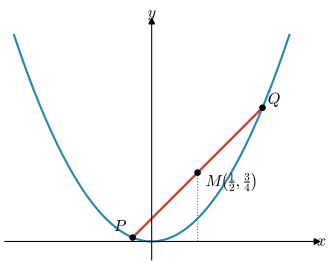
Solution.
1. $m = \frac{p^2 + q^2}{2}$ and, by Pythagoras, $(p - q)^2 + (p^2 - q^2)^2 = 4$.
2. In terms of $m$ and $t$. $p^2 + q^2 = 2m$, $(p - q)^2 = 2m - 2t$ and $(p + q)^2 = 2m + 2t$. Since $(p^2 - q^2)^2 = (p - q)^2(p + q)^2 = 4(m^2 - t^2)$, ② becomes $2m - 2t + 4m^2 - 4t^2 = 4$, or $2m^2 + m - 2t^2 - t - 2 = 0$.
3. $m$ as a function of $t$.
$$m = \frac{-1 + \sqrt{1 + 8(2t^2 + t + 2)}}{4} = -\frac14 + \sqrt{t^2 + \frac t2 + \frac{17}{16}} = -\frac14 + \sqrt{\left(t + \frac14\right)^2 + 1}.$$4. The minimum. At $t = -\frac14$, $m = -\frac14 + 1 = \frac34$. Then $p^2 + q^2 = \frac32$ and $(p + q)^2 = \frac32 - \frac12 = 1$, $p + q = \pm1$. ($p$ and $q$ exist: they are the roots of $s^2 \mp s - \frac14 = 0$, whose discriminant is positive.) The $x$-coordinate of $M$ is $\frac{p + q}{2} = \pm\frac12$.
Answers: M=2, N=4, O=2, P=2, Q=2, R=4, S=4, T=1, U=3, V=2, W=1, X=2, Y=3, Z=4.
Question III: remainders, base 3 and conditions
Statement.
- (i) The integer $a$ leaves remainder 4 on division by 5: $a = \boxed{\text{A}}\,k + \boxed{\text{B}}$ ($k$ an integer). Then $a^2$ leaves remainder $\boxed{\text{C}}$. (ii) The number $120_{(3)}$ is $\boxed{\text{DE}}$ in base 10. The largest three-digit number in base 3 is $\boxed{\text{FG}}$ in base 10, and the smallest is $\boxed{\text{H}}$.
- Choose $\boxed{\text{I}}$ and $\boxed{\text{J}}$ from ⓪ necessary but not sufficient condition, ① sufficient but not necessary condition, ② necessary and sufficient condition, ③ neither necessary nor sufficient. Let $a$ be an integer and $b$ a natural number. (i) “$a$ leaves remainder 4 on division by 5” is $\boxed{\text{I}}$ for “$a^2$ leaves remainder $\boxed{\text{C}}$ on division by 5”. (ii) “$6 \le b \le 30$” is $\boxed{\text{J}}$ for “$b$ has three digits in base 3”.
Solution.
1. $a = 5k + 4$ and $a^2 = 25k^2 + 40k + 16 = 5(5k^2 + 8k + 3) + 1$: remainder 1. $120_{(3)} = 9 + 6 + 0 = 15$. The three-digit numbers in base 3 run from $100_{(3)} = 9$ to $222_{(3)} = 26$.
2. (i) If $a \equiv 4$, then $a^2 \equiv 1$: the condition is sufficient. But $a = 1$ also gives $a^2 \equiv 1$: it is not necessary (①).
2. (ii) “$b$ has three digits in base 3” means $9 \le b \le 26$, which implies $6 \le b \le 30$; the converse fails ($b = 6$). So “$6 \le b \le 30$” is necessary but not sufficient (⓪).
Answers: A=5, B=4, C=1, DE=15, FG=26, H=9, I=1, J=0.
Question IV: the bisector of a 60° angle
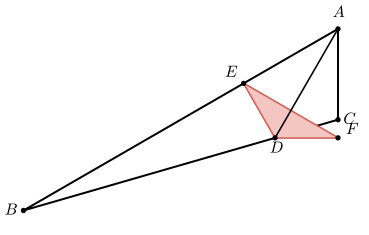
Statement. In triangle $ABC$, $\angle BAC = 60^\circ$. The bisector of $\angle BAC$ meets $BC$ at $D$, and $DE$ and $DF$ are the perpendiculars from $D$ to sides $AB$ and $AC$. Let $x = \frac{AB}{AC}$ and $k = \frac{\triangle DEF}{\triangle ABC}$ (areas).
- Since $\triangle ABD + \triangle ACD = \triangle ABC$, with $b = AB$, $c = AC$ and $d = AD$, $d = \dfrac{\sqrt{\boxed{\text{A}}}\,bc}{b + c}$ ①. Since $DE = DF = \dfrac{\boxed{\text{B}}}{\boxed{\text{C}}}d$, $\triangle DEF = \dfrac{\sqrt{\boxed{\text{D}}}}{\boxed{\text{EF}}}d^2$ ②. From ① and ②, $k = \dfrac{d^2}{\boxed{\text{G}}\,bc} = \dfrac{\boxed{\text{H}}\,bc}{\boxed{\text{I}}(b + c)^2}$, and $k = \dfrac{\boxed{\text{J}}\,x}{\boxed{\text{K}}\left(x + \boxed{\text{L}}\right)^2}$.
- If $BD = 8$ and $BC = 10$, then $x = \boxed{\text{M}}$ and $k = \dfrac{\boxed{\text{N}}}{\boxed{\text{OP}}}$.
Solution.
1. $d$. Each half of the angle measures $30^\circ$: $\frac12 bd\sin30^\circ + \frac12 cd\sin30^\circ = \frac12 bc\sin60^\circ$, or $\frac{d(b + c)}{4} = \frac{\sqrt3\,bc}{4}$, so $d = \frac{\sqrt3\,bc}{b + c}$.
2. Triangle $DEF$. $DE = DF = d\sin30^\circ = \frac d2$. The quadrilateral $AEDF$ has right angles at $E$ and $F$ and $60^\circ$ at $A$, so $\angle EDF = 120^\circ$, and
$$\triangle DEF = \frac12\left(\frac d2\right)^2\sin120^\circ = \frac{\sqrt3}{16}d^2.$$3. $k$. $\triangle ABC = \frac{\sqrt3}{4}bc$, so
$$k = \frac{\sqrt3\,d^2/16}{\sqrt3\,bc/4} = \frac{d^2}{4bc} = \frac{3bc}{4(b + c)^2} = \frac{3x}{4(x + 1)^2}.$$4. By the angle bisector theorem, $x = \frac{AB}{AC} = \frac{BD}{DC} = \frac82 = 4$, and $k = \frac{12}{4\cdot25} = \frac{3}{25}$.
Answers: A=3, B=1, C=2, D=3, EF=16, G=4, H=3, I=4, J=3, K=4, L=1, M=4, N=3, OP=25.