Euler's Eyes
2026-10-11
Tangent segments — circumscribable quadrilaterals
From a point outside a circle two tangents come out, and the two segments to the points of contact have the same length.
Who discovered
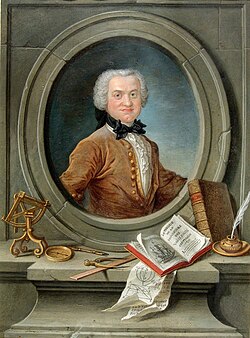
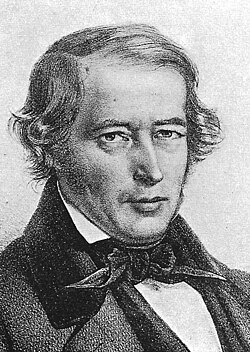
The equality of tangent segments is a direct consequence of proposition III.17 of The Elements of Euclid, which teaches how to draw the tangent through an exterior point. This gives rise to Pitot’s theorem: in a quadrilateral that has an inscribed circle, the sums of the opposite sides are equal. The French engineer Henri Pitot published it in 1725 (see the curiosity about him below). The reciprocal — if the sums of the opposite sides are equal, the quadrilateral has an inscribed circumference — was proven in the 19th century and is usually attributed to Jakob Steiner.

The story
The proof of Pitot’s theorem is a good example of how a simple property yields a lot: each vertex of the quadrilateral is a point outside the circle and has two equal tangent segments. Adding the opposite sides, each segment appears exactly once in each sum.
Pitot was not a mathematician by profession. A hydraulic engineer, he built aqueducts and bridges in the south of France and invented the Pitot tube, which measures the speed of liquids and gases and also powers modern airplanes.
In everyday life
- Belts and pulleys. The straight sections of a belt that embraces two pulleys are tangent to the wheels; on equal pulleys, they have the same length.
- Bicycle chain. It leaves tangent to the crown and arrives tangent to the ratchet.
- View of a lighthouse. From the top of a lighthouse, the two lines of sight that touch a round island have the same length up to the points of contact.
- Speed of planes. The Pitot tube, invented by the same engineer as the theorem, is the sensor that measures the speed of the plane in relation to the air.
Sources: Elements, proposition III.17 · Henri Pitot (Wikipedia) · Steiner (MacTutor).
Theory and constructions
TeoremaTangent segments
If from a point $P$ we drive the segments $\overline{PA}$ and $\overline{PB}$, both tangent to a circle, with $A$ and $B$ on the circle, then $PA = PB$. Additionally, the center is at angle bisector of $A\hat{P}B$.
Demonstration. The triangles $PAO$ and $PBO$ are rectangles in $A$ and $B$ (tangent ⊥ radius), have $OA = OB$ (cathets) and $\overline{OP}$ common (hypotenuse). Due to the special case, they are congruent: $PA = PB$.
TeoremaCircumscribed quadrilateral (Pitot theorem)
A convex quadrilateral is circumscribed to a circle if its four sides are tangent to it.
a) If a convex quadrilateral is circumscribed by a circle, the sum of two opposite sides is equal to the sum of the other two: $AB + CD = AD + BC$.
b) Reciprocal: if in a convex quadrilateral $AB + CD = AD + BC$, then it is circumscriptible.
Therefore, this equality is a necessary and sufficient condition for a convex quadrilateral to be circumscribable.
View the demos
a) Let $X$, $Y$, $Z$, $T$ be the points of tangency at $\overline{AB}$, $\overline{BC}$, $\overline{CD}$, $\overline{DA}$. Through the tangent segments, $AX = AT$, $BX = BY$, $CZ = CY$ and $DZ = DT$. Adding: $AX + BX + CZ + DZ = AT + BY + CY + DT$, that is, $AB + CD = AD + BC$.
b) Let $\lambda$ be the circle tangent to $\overline{AB}$, $\overline{BC}$ and $\overline{CD}$. If $ABCD$ were not circumscribed, there would be $ABCX$, with $X$ on the line $CD$, circumscribed to $\lambda$: $AB + CX = BC + AX$ (1). From the hypothesis, $AB + CX \pm XD = AD + BC$, that is, $AB + CX = AD + BC \mp XD$ (2). From (1) and (2), $AX = AD \mp XD$ — which is absurd in the triangle $ADX$ (triangular inequality).