
Euler's Eyes
2026-10-11
Infinite descent: a smaller solution leads to a contradiction
Imagine a staircase where each step has a positive whole number. You can go down: 10, 7, 4, 2, 1… but at some point the staircase ends. There is no infinite sequence of ever-smaller positive integers.
It seems obvious. Fermat turned this obvious fact into one of the most powerful tools in number theory: infinite descent.
How it works
To prove that an equation has no solution in positive integers:
- Suppose it has a solution.
- From it, build another solution, also in positive integers, but smaller.
- Repeat: from this new solution comes another, smaller one, and so on, forever.
- That is impossible, because the staircase of positive integers ends. So the solution in step 1 did not exist.
Fermat was proud of the method. In a 1659 letter to the mathematician Pierre de Carcavi, he said it was how he had proved most of his results about numbers.
Example: the square root of 2
The Greeks already knew that $\sqrt2$ is not a fraction. Infinite descent gives a short, beautiful proof.
Suppose $\sqrt2=\dfrac ab$, with $a$ and $b$ positive integers. Squaring:
$$a^2=2b^2.$$The right side is even, so $a^2$ is even. Since the square of an odd number is odd, $a$ must be even: $a=2c$. Substituting:
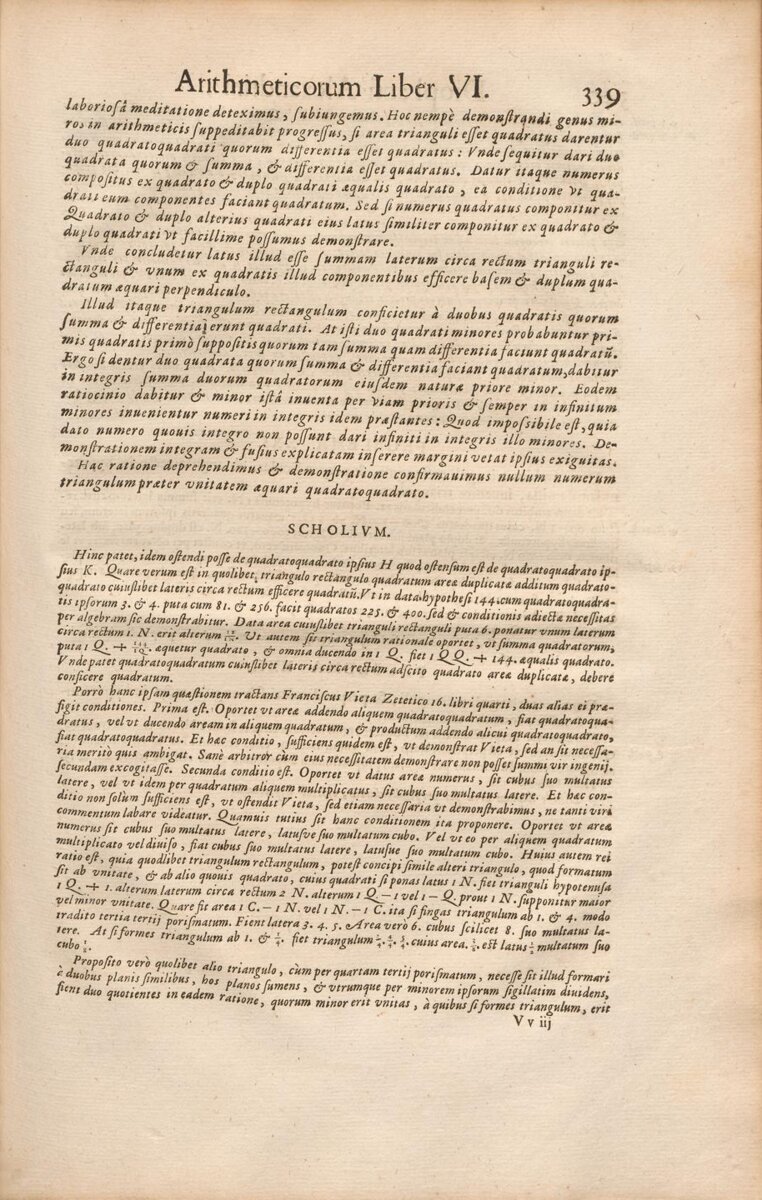
$$4c^2=2b^2\qquad\Longrightarrow\qquad b^2=2c^2.$$Look what happened: the pair $(b,c)$ satisfies the same equation as $(a,b)$. That is, $\sqrt2=\dfrac bc$. And this new fraction has smaller numbers: since $a^2=2b^2<4b^2$, we have $a<2b$, and so $c=\dfrac a2 Repeating, we get $\dfrac cd$, then $\dfrac de$…, with denominators $b>c>d>e>\cdots$ ever smaller and always positive. The staircase would go down forever. Contradiction: $\sqrt2$ is not a fraction. Fermat’s own most famous example is about right triangles with whole-number sides, such as $3,4,5$. He proved that the area of such a triangle is never a perfect square. For $3,4,5$, for example, the area is $6$, which is not a square. The proof, written in a margin of Diophantus’s Arithmetica, is the only complete number-theory proof Fermat left. It starts from a triangle whose area would be a square and builds, with great ingenuity, another triangle of the same kind with smaller sides. Infinite descent. Describing the method is easy. The difficulty lies in step 2: discovering how to build the smaller solution. For $\sqrt2$, dividing by 2 was enough. For Fermat’s triangle, the construction is clever and long. For harder problems, nobody knows how. Descent is not an automatic recipe but a strategy that needs a new idea each time. Notice also that the method depends on integers. With real numbers, a sequence can go down forever without trouble: $1,\frac12,\frac14,\frac18,\ldots$ never ends and never becomes negative. Because $1,\frac12,\frac14,\frac18,\ldots$ is infinite, positive and always decreasing. Descent only works with positive integers, which cannot decrease forever. If $a^2=3b^2$, then 3 divides $a^2$ and, since 3 is prime, divides $a$: $a=3c$. Then $9c^2=3b^2$, or $b^2=3c^2$. The pair $(b,c)$ is a new solution. Since $a^2=3b^2<9b^2$, we have $a<3b$ and therefore $c=\frac a3 Sources: Fermat biography, MacTutor. All Fermat topics · ← Fermat’s principle: light takes the fastest path · Fermat’s last theorem: from the margin to Wiles’s proof →Fermat’s triangle
The secret is in the construction
Exercise: why does a decreasing sequence of positive real numbers not give the same contradiction?
Exercise: adapt the proof to show that √3 is not a fraction