Euler's Eyes
2026-10-11
Cases (criteria) of similarity
To ensure that two triangles are similar, it is not necessary to check everything: two angles, or three ratios between sides, are enough.
Who discovered
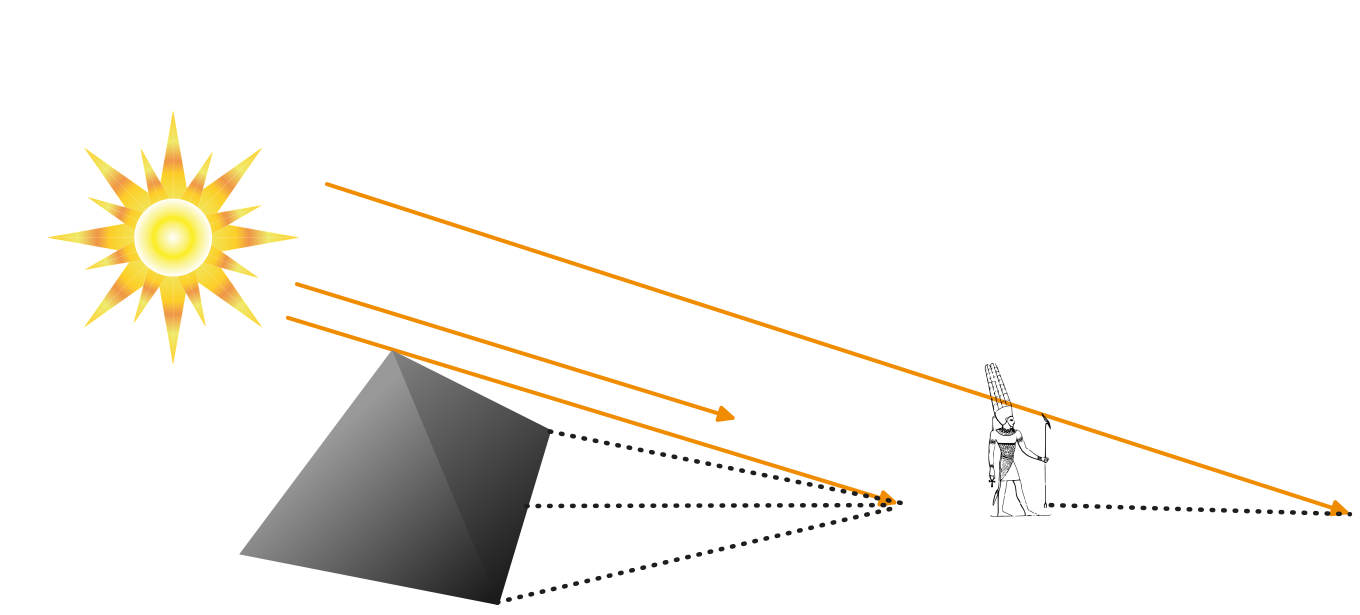
The three criteria are in book VI of The Elements by Euclid (c. 300 BC): triangles equiangular have proportional sides (VI.4, the case AA), triangles with three proportional sides are similar (VI.5, LLL), and two proportional sides with the angle between them equal are also sufficient (VI.6, LAL). Much earlier, tradition attributes to Tales the use of triangles of the same shape to measure inaccessible distances.

The story
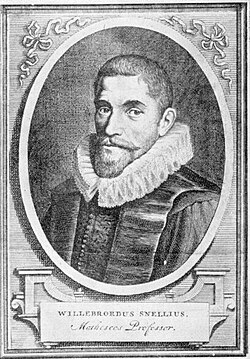
The similarity criteria were the tool of triangulation, the method that measured entire countries. In 1615, the Dutchman Willebrord Snellius measured the distance between Alkmaar and Bergen op Zoom with a chain of triangles and estimated the size of the Earth. In the 18th century, the Cassini family produced the first general map of France in the same way.
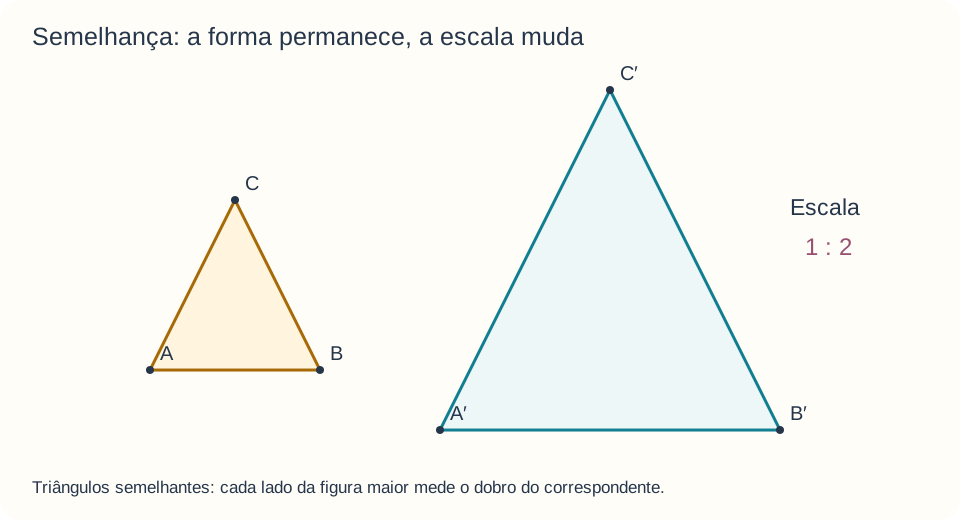
The AA case is especially powerful: two angles can be measured with simple instruments, even from afar, and guarantee the proportion of all sides.
In everyday life
- Width of a river. Two similar triangles are marked on the bank, with stakes and sights; the side that crosses the river is calculated by proportion.
- Camera obscura and eye. The object and its image form similar triangles opposed by the apex in the hole (case AA).
- Ramp and stairs. Two ramps with the same inclination have similar profiles, whatever the length.
- Squares. Squares of different sizes, with the same angles (45° or 30° and 60°), are similar.
Sources: Elements, proposition VI.4 · Elements, proposition VI.6 · Snellius (MacTutor).
Theory and constructions
Teorema1st case — AA (two angles)
If two triangles have two angles that are orderly congruent, then they are similar (and hence have proportional homologous sides).
Demonstration. If they were not congruent, suppose $AB > A^{\prime}B^{\prime}$ and take $D$ in $\overline{AB}$ with $AD = A^{\prime}B^{\prime}$ and $E$ in $\overline{AC}$ with $\hat{D} \equiv \hat{B}^{\prime}$. By ALA, $\triangle ADE \equiv \triangle A^{\prime}B^{\prime}C^{\prime}$. As $\hat{D} \equiv \hat{B}^{\prime} \equiv \hat{B}$, $\overline{DE} \parallel \overline{BC}$, and by the fundamental theorem $\triangle ABC \sim \triangle ADE \equiv \triangle A^{\prime}B^{\prime}C^{\prime}$.
Teorema2nd case — LAL (proportional sides and angle)
If two sides of a triangle are proportional to the counterparts of another and the angles comprised are congruent, then the triangles are similar.
Teorema3rd case — LLL (three proportional sides)
If two triangles have homologous proportional sides, then they are similar.
The demonstrations of the 2nd and 3rd cases are analogous to the 1st, using the congruence cases LAL and LLL instead of ALA.
ExemploA pair that is not parallel
In the book figure, $\hat{S} \equiv \hat{B}$, with $AB = 10$ cm, $BC = 8$ cm, $AC = 14$ cm and $AS = 5$ cm; $\overline{RS}$ is not parallel to $\overline{BC}$. Even so, as $\hat{A}$ is common, $\triangle ARS \sim \triangle ACB$ (case AA). Assembling the proportion with homologous sides — those opposite equal angles —:
$$\frac{x}{8} = \frac{5}{10} = \frac{y}{14} \Rightarrow RS = x = 4 \text{ cm e } AR = y = 7 \text{ cm}.$$ResumoIf the similarity ratio is k
Then the ratio $k$ between: homologous sides, perimeters, homologous heights, homologous medians, angle bisectors homologous internals, radii of inscribed and circumscribed circles — any pair of homologous linear elements —, and the homologous angles are congruent.