
Euler's Eyes
2026-10-11
Definitions and elements
All points at the same distance from a center: the definition of the circle fits on a line, and yet it hides the number π.
Who discovered
The circle is one of the oldest forms in human history, from the wheels of Mesopotamia (c. 3500 B.C.) to stone monuments. The rigorous definition is from Euclid (definitions I.15 to I.18 of The Elements): a figure limited by a line whose points are all at the same distance from an interior point, the center. His third postulate guarantees that it is possible to draw a circle with any center and any radius. The first person to accurately calculate the ratio between contour and diameter was Archimedes (3rd century BC).

The story
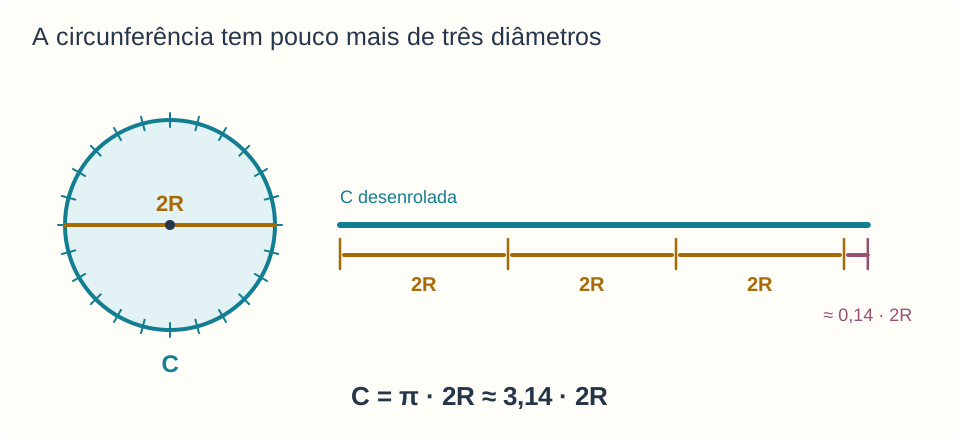
All circles have the same shape, they only change size. Therefore, the ratio between the length $C$ and the diameter $2R$ is always the same — the number we today call π. The Babylonians used 3 or $3\tfrac{1}{8}$; the Rhind papyrus gives a value close to 3,16.
Archimedes enclosed the circle between polygons with 96 sides, one inscribed and the other circumscribed, and concluded that π is between $3\tfrac{10}{71}$ and $3\tfrac{1}{7}$. The symbol π was used by the Welshman William Jones in 1706 and popularized by Euler.


In everyday life
- Wheels. A wheel rotates smoothly because all points on the edge are the same distance from the axis.
- Manhole covers. They are round because a circle does not fall through the opening in any position.
- Pizza and clock. Pizza slices are circular sectors; the hands of the clock are rays that sweep across the dial.
- Compass and GPS. The range of an antenna or radio signal from a point is a circle.
Sources: Elements, definition I.15 · Archimedes (MacTutor) · History of π (MacTutor).
Theory and constructions
DefiniçãoCircumference
Circumference is the set of points on a plane whose distance to a given point on that plane (the center) is equal to a given non-zero distance (the radius):
$$\lambda(O, r) = \lbrace P \in \alpha \mid d_{P,O} = r \rbrace.$$Position of a point. A point $X$ is internal to the circle if $d_{X,O} < r$, belongs to it if $d_{X,O} = r$ and is external if $d_{X,O} > r$. The set of internal points is the interior; that of the external, the exterior.
DefiniçãoChord, diameter, radius and arcs
- Rope is a segment with ends on the circle. Diameter is a chord that passes through the center. Radius is a segment from the center to a point on the circumference.
- If $A$ and $B$ are on the circle and are not ends of a diameter, the minor arc $\overset{\frown}{AB}$ is formed by $A$, $B$ and the points on the circle interior to the angle $A\hat{O}B$; the major arch $\overset{\frown}{AXB}$, on the outside. Unless noted, “arc $AB$” is the smallest.
- If $A$ and $B$ are ends of a diameter, each half is a semicircle.
DefiniçãoCircle, sector, segment and semicircle
- Circle (or disc) is the set of points on the plane whose distance from the center is less than or equal to the radius: the circumference together with its interior.
- Circular sector $AOB$ is formed by the radii $\overline{OA}$, $\overline{OB}$ and the points of the circle interior to the angle $A\hat{O}B$.
- Circular segment is the intersection of the circle with an origin half-plane on the straight line $AB$ (the smallest is the one that does not contain the center).
- Semicircle is the intersection of the circle with an origin half-plane on the straight line of a diameter.