
Euler's Eyes
2026-10-25
Reading with the hands and the ears: Braille and the Nemeth code
Ordinary mathematical writing is two-dimensional. In $\frac{x+1}{2}$, what is above the bar is divided by what is below it; in $x^2$, the $2$ is up high and therefore an exponent; in $\sqrt{x+1}$, the stroke of the root covers exactly what is inside. Position is part of the sign, like the place of a digit in a numeral. The eye reads all this at once. But what about someone who does not read with the eye?
Braille’s dots
In 1829 the Frenchman Louis Braille, blind since the age of five and a teacher at the Royal Institute for Blind Youth in Paris, published a writing system with six raised dots arranged in two columns of three. Each combination is a sign: there are $2^6 - 1 = 63$ combinations with at least one dot, enough for letters, punctuation and numbers. For numbers, Braille used an economical trick: a number sign before the first ten letters makes $a$ worth $1$, $b$ worth $2$, up to $j$ worth $0$.
Braille is a linear script: one sign after another, on a line. To write mathematics in it, one has to say with signs what ordinary writing says with position: where a fraction begins and ends, where an exponent ends, how far a root extends.
The cubarithm
For calculations, schools for the blind long used the cubarithm: a grid of square cells into which small cubes fit, each face bearing a Braille digit. The pupil sets out a written sum as in an exercise book, with units under units, and feels the columns with the fingers. Position comes back, now through touch.
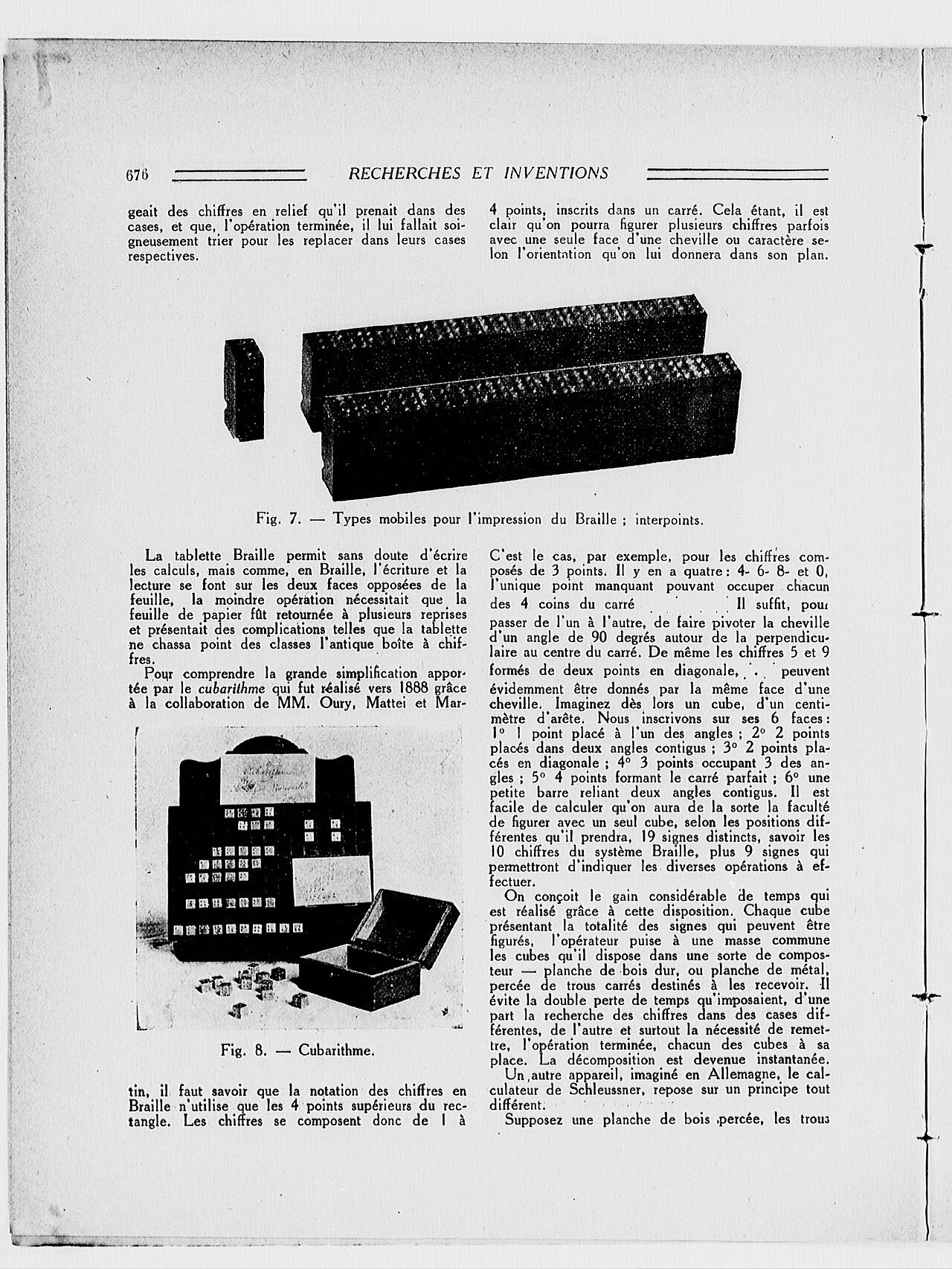
The Nemeth code
The American Abraham Nemeth (1918–2013) was born blind and was advised not to study mathematics: he was told he would have no way of reading formulas. He graduated in psychology, worked at other things and, in his spare time, kept studying mathematics; he eventually earned a doctorate in mathematics at Columbia University and taught at university for decades. To read and write what he studied, he created a Braille code for mathematics, officially adopted in the United States in 1952 and still known as the Nemeth code.
The central idea of the code is to turn position into opening and closing signs. A fraction is written as “begin fraction, numerator, bar, denominator, end fraction”; an exponent as “go up a level, exponent, back to the baseline”. This is what we do today, for other reasons, when typing mathematics on a keyboard:
$$\frac{-b \pm \sqrt{b^2 - 4ac}}{2a}$$becomes, in Knuth’s TeX, the script used throughout this site,
\frac{-b \pm \sqrt{b^2-4ac}}{2a}
with braces in place of position. In both cases linearisation reveals the structure: the writer is forced to say where each part begins and ends.
Reading aloud
Screen readers and teachers who dictate a formula face the same problem. “$x$ plus one over two” can be $\frac{x+1}{2}$ or $x + \frac{1}{2}$. In ordinary speech the difference is made with pauses and intonation, which disappear in a text. Screen readers that read mathematics solve it as Nemeth did: they say “begin fraction, $x$ plus one, over two, end fraction”. It sounds heavy, but it is exactly the information the drawing gives the eye without words.
Exercise: dictate without ambiguity
Write in words, so that a listener cannot go wrong, the expressions $\sqrt{x+1}$, $\sqrt{x} + 1$ and $\frac{\sqrt{x+1}}{2}$.
“Square root of, open, $x$ plus one, close.” “Square root of $x$, end root, plus one.” “Begin fraction: square root of, open, $x$ plus one, close; over two; end fraction.” The words “open”, “close” and “end” play the role of the strokes that ordinary writing draws.
Exercise: from keyboard to paper
Write in ordinary notation \frac{1}{1+\frac{1}{x}} and x^{2^n}, and simplify the first.
The first is $\dfrac{1}{1 + \frac{1}{x}}$, a fraction inside another. Multiplying top and bottom by $x$ gives $\dfrac{x}{x+1}$ (for $x \neq 0$ and $x \neq -1$). The second is $x^{2^n}$: the exponent $2^n$ has an exponent of its own, and the braces say that the $n$ belongs to the $2$, not to the $x$.
Chapter index · ← Writing to think: the notebooks of Gauss and Ramanujan · How to learn to read and write mathematics: a guide and a glossary →