
Euler's Eyes
2022-08-28
Property of Angles in Planes
In the previous post we talked about several important definitions for angles in flat figures. Now, we deepen the concepts through the properties of angles for applications in flat figures.
angle bisector of an angle
Definition: the angle bisector of an angle is a ray, which starts from the vertex of the angle and divides it into two congruent angles ($\cong$).

Ampliar figura para ler os detalhes
From the figure, we notice that
- $\angle \widehat{aob} \cong \angle\widehat{boc}$
- Angle $\widehat{aob}$ is congruent to angle $\widehat{boc}$.
- The ray b is angle bisector of this angle.
Angles opposite the vertex
Definition: two angles are said to be opposite at the vertex if the rays are concurrent.

Ampliar figura para ler os detalhes
From the figure, we notice that
- $\alpha = \beta$
- angles $\alpha$ and $\beta$ are equal.
Are the angles the same?
In fact,
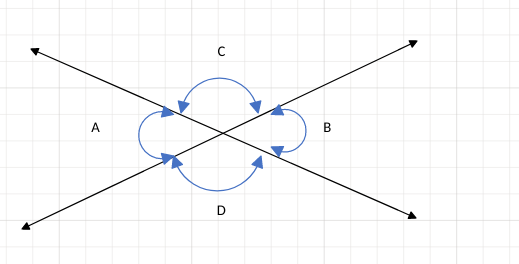
From the post angles in planes we have:
- angles $C$ and $B$ are supplementary $C + B = 180^\circ$
- similarly $C$ and $A$ are supplementary $C + A = 180^\circ$
- With this, we have $C + B = C + A$
- Logo $B=A$
- Therefore, the property of angles opposite the vertex holds.
From the figure we obtain:
$$A=B \qquad \text{e} \qquad C=D$$Two parallel lines cut by a transversal line
From two parallel and distinct lines, cut by another transversal line, we have:
- we obtain eight angles $a,b,c,d,e,f,h,g$;
- from the previous section, we observed from the figure that we have two cases of competing lines and they fall into the previous property;
- these angles are supplementary or congruent;
- with property opposed by the vertex.
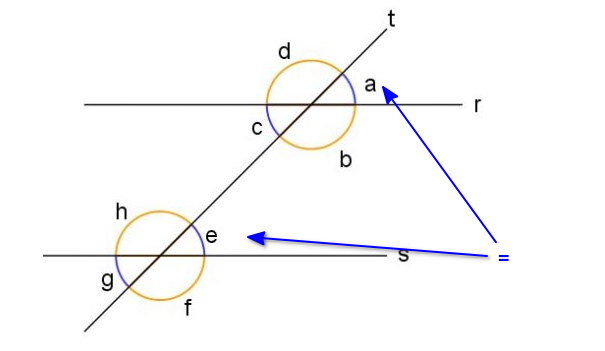
From the property opposites by the vertex, we obtain:
- $a=e$
- $b=f$
- $c=g$
- $d=h$
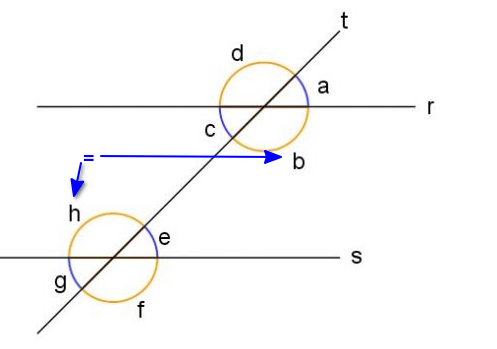
Internal Alternates
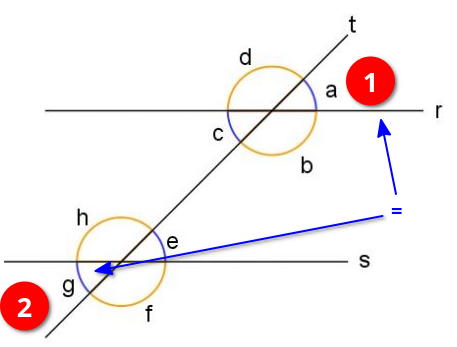
External Alternates
That’s it for now, wait for the next posts.