
Euler's Eyes
2026-10-16
Morphogenesis: the leopard's spots in equations
An embryo starts as a ball of almost identical cells. Even so, it ends up with five fingers on each hand, stripes on a zebra and spots on a leopard. Where does form come from, if at the start everything is uniform? In 1952, in the last major paper he published, “The chemical basis of morphogenesis”, Turing proposed a mathematical answer that biologists took decades to confirm.
Two substances, two speeds
The idea is to imagine two chemical substances, which Turing called morphogens, spreading through a tissue. Today they are usually described like this:
- an activator, which stimulates its own production and also that of the other;
- an inhibitor, which holds the activator back.
The two react with each other and diffuse, that is, spread from regions of higher concentration to regions of lower concentration, like a drop of ink in water. The crucial point is that the inhibitor spreads faster than the activator.
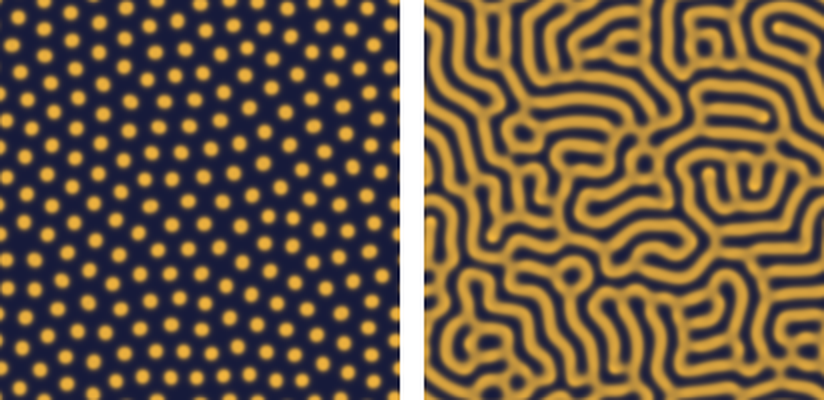
Follow what happens if, at one point, a little extra activator appears by chance. There it produces more activator and more inhibitor. The activator, being slow, stays concentrated in place. The inhibitor, being fast, escapes to the sides and prevents another peak of activator from forming nearby. The result is a peak surrounded by a band with no peaks, then another peak, and another band: spots or stripes with regular spacing, arising out of nothing.
The calculation
Turing wrote the equations, linearised near the uniform state. In a tissue along a straight line, with $u$ and $v$ measuring the deviations of the activator and the inhibitor:
$$\begin{aligned} \frac{\partial u}{\partial t}&=a\,u+b\,v+D_u\frac{\partial^2u}{\partial x^2},\\ \frac{\partial v}{\partial t}&=c\,u+d\,v+D_v\frac{\partial^2v}{\partial x^2}. \end{aligned}$$The terms with $a$, $b$, $c$ and $d$ are the reaction; the terms with $D_u$ and $D_v$ are the diffusion. To see whether a small wave of wavelength $\frac{2\pi}k$ grows or dies out, one tries a solution of the form $e^{\lambda t}\cos kx$. With $q=k^2$, one arrives at a matrix
$$\begin{pmatrix}a-D_uq&b\\c&d-D_vq\end{pmatrix},$$and the wave grows when the determinant of this matrix becomes negative.
Take concrete numbers: $a=1$, $b=-1$, $c=2$, $d=-1.5$. Without diffusion ($q=0$), the determinant is $1\cdot(-1.5)-(-1)\cdot2=0.5>0$ and the trace is $-0.5<0$: the uniform state is stable, and chemistry alone creates no pattern at all.
Now switch on diffusion, with the inhibitor ten times faster, $D_u=1$ and $D_v=10$:
$$\det(q)=(1-q)(-1.5-10q)+2=10q^2-8.5q+0.5.$$The roots are $q\approx0.064$ and $q\approx0.786$. Between them the determinant is negative: waves with those wavelengths grow. The fastest is the one in the middle, $q=0.425$, with wavelength $\frac{2\pi}{\sqrt{0.425}}\approx9.6$. Diffusion, which normally smooths differences away, here creates them. That is why the phenomenon is called diffusion-driven instability.
From the calculation to the animals
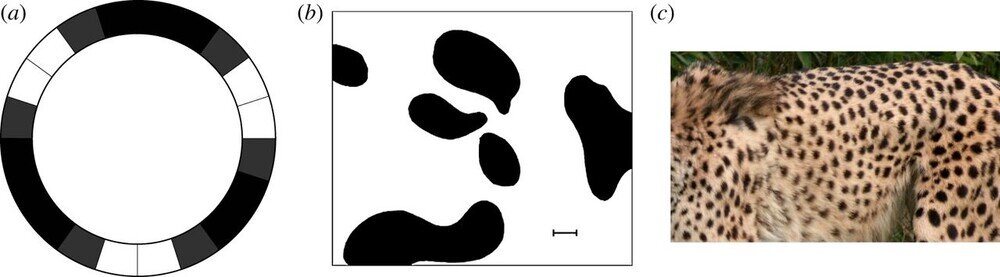
Turing did part of the calculations on the Manchester computer, and one of the patterns he obtained was an irregular dappling, similar to that of some animals. He did not know which substances the morphogens would be, and the biology of the time had no way of checking. The idea lay almost forgotten for decades.
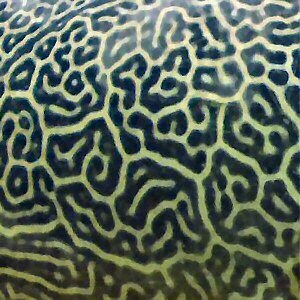
The first confirmation came from chemistry: in 1990 a French group in Bordeaux produced stable Turing patterns in a gel, with a laboratory reaction. In biology, in 1995, the Japanese Shigeru Kondo and Rihito Asai showed that the stripes of an angelfish move and split as the equations predict. Since then, Turing-type mechanisms have been identified in the spacing of fingers, hairs, feathers and the ridges of the roof of the mouth.
Exercise: equal diffusions create no pattern
Redo the calculation with $D_u=D_v=1$. Does the determinant become negative for some $q>0$?
$\det(q)=(1-q)(-1.5-q)+2=q^2+0.5q+0.5$. All the coefficients are positive, so $\det(q)>0$ for every $q\geq0$. No wave grows: without the difference in speeds, diffusion only smooths irregularities away.
Exercise: which wave is fastest?
In $\det(q)=10q^2-8.5q+0.5$, find the value of $q$ at which the determinant is smallest and the corresponding wavelength.
The minimum of a parabola $\alpha q^2+\beta q+\gamma$ is at $q=-\frac{\beta}{2\alpha}=\frac{8.5}{20}=0.425$. Then $k=\sqrt{0.425}\approx0.652$ and the wavelength is $\frac{2\pi}{0.652}\approx9.6$. In a tissue of length 100, about 10 spots fit.
Sources: Alan Turing, “The chemical basis of morphogenesis”, Philosophical Transactions of the Royal Society B, 237 (1952), pp. 37–72 · Shigeru Kondo and Rihito Asai, “A reaction–diffusion wave on the skin of the marine angelfish Pomacanthus”, Nature (1995) · Philip Ball, “Forging patterns and making waves from biology to geology”, Philosophical Transactions B (2015).
All topics on Alan Turing · ← The imitation game: can a machine think? · The legacy of Alan Turing →