
Euler's Eyes
2026-10-22
Trigonometric ratios and solving right triangles
Angle chooses the role of the side
Choose an acute angle $\alpha$ in a right triangle. In relation to it, one side is opposite and the other is adjacent. If we change angles, these roles are reversed; the hypotenuse remains the same.
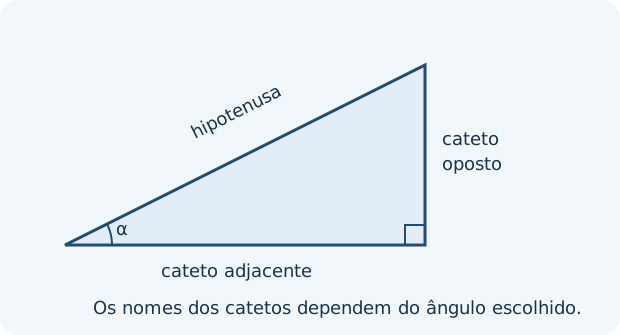
If two triangles have the same acute angle, they are similar. Therefore, the ratios between their corresponding sides are equal:
$$\sin\alpha=\frac{\text{oposto}}{\text{hipotenusa}},\quad \cos\alpha=\frac{\text{adjacente}}{\text{hipotenusa}},\quad \tan\alpha=\frac{\text{oposto}}{\text{adjacente}}.$$When dividing the first quotient by the second, we obtain $\tan\alpha=\sin\alpha/\cos\alpha$. As acute angles are complementary, so is $\sin(90°-\alpha)=\cos\alpha$.
Five types of data
Call the hypotenuse $a$, the opposite side of $\alpha$ $b$, and the adjacent one $c$.
| Known data | How to complete |
|---|---|
| Hypotenuse $a$ and angle $\alpha$ | $b=a\sin\alpha$, $c=a\cos\alpha$ |
| Opposite leg $b$ and angle $\alpha$ | $a=b/\sin\alpha$, $c=b/\tan\alpha$ |
| Adjacent side $c$ and angle $\alpha$ | $a=c/\cos\alpha$, $b=c\tan\alpha$ |
Hypotenuse $a$ and leg $b| $c=\sqrt{a^2-b^2}$, then $\sin\alpha=b/a$ |
|
| Cathetos $b,c$ | $a=\sqrt{b^2+c^2}$, then $\tan\alpha=b/c$ |
In the last two cases, a table or calculator in degrees helps to obtain the angle. The other high pitch is worth $90°-\alpha$. Inverse functions will be studied in high school.
Worked example: a ladder
A 5 m ladder makes $60°$ the ground. Its height on the wall is the opposite side:
$$h=5\sin60°=\frac{5\sqrt3}{2}\text{ m}.$$The distance from the base to the wall is the adjacent leg:
$$d=5\cos60°=\frac52=2{,}5\text{ m}.$$Checking by Pythagoras, $h^2+d^2=75/4+25/4=25=5^2$.
Application at an observed height
If you measure the elevation to a tree from the eyes, the calculation gives the difference between the eyes and the top. Add the height of the eyes to get the total height of the tree. The horizontal distance and angle must refer to the same triangle.
In everyday life
- Height with your cell phone. An application measures the angle to the top of a building, and the tangent transforms the distance into height.
- Ramps. The accessibility standard limits the slope of the ramps, and the trigonometric ratios determine the necessary length.
- Firefighter ladder. The sine of the angle of the ladder tells how high it reaches.
Exercises with resolution
1. A streetlight casts a shadow of 6 m when the Sun’s elevation is $45°$. How tall are you?
Check resolution 1
$h=6\tan45°=6$ m, assuming vertical pole and horizontal terrain.
2. A 13 m ladder reaches 12 m high on a vertical wall. How far from the wall is its base?
Check resolution 2
$d=\sqrt{13^2-12^2}=\sqrt{25}=5$ m.
In the interactive book
The same subjects, with all the demonstrations and the complete list of exercises, are in the interactive Trigonometry book:
- Trigonometric properties — book, chapter IX.
- Resolution of right-angled triangles — book, chapter IX.
This class is a shorter introduction to the topic; In the book, the theory is accompanied by solved and proposed exercises from the chapter.