
Euler's Eyes
2026-11-05
MEXT 2018 – Mathematics (Specialized Training College) solved
Source: MEXT / Study in Japan – Mathematics paper and official answers. Files on the past exams page.
This is the Mathematics exam for scholarship applicants to specialized training colleges (専修学校, senmon gakkō: two- to three-year vocational courses). It lasts 60 minutes and has three fill-in questions. The statements below follow the original English.
Answer key
| Item | Topic | Answer |
|---|---|---|
| 1 (1) | Logarithm and root | $-3$; $4$ |
| 1 (2) | Sines and cosines | $\sqrt3$ |
| 1 (3) | Telescoping sum | $\frac{4}{45}$ |
| 1 (4) | Integers with $-x < x^2 < 6$ | $3$ |
| 1 (5) | Four-digit numbers | $2520$ |
| 1 (6) | Unit vectors | $120^\circ$; $\sqrt3$ |
| 1 (7) | Sequence $3, 4, 6, 10, 18, \dots$ | $130$; $11$ |
| 1 (8) | Parabola $x^2 - 4x + 1$ | $13$; $2 - \sqrt3$, $2 + \sqrt3$; $4\sqrt3$ |
| 1 (9) | Area of a triangle in space | $\sqrt3$ |
| 2 | Cyclic quadrilateral | $1$; $2$; $60^\circ$; $\frac{3\sqrt3}{4}$; $-3$ |
| 3 | Signs from the graph | $<,\ <,\ <,\ <,\ >,\ <,\ >,\ >$ |
Question 1: nine short items
Item (1)
Statement. $\log_5 0.008 = \text{①}$ and $\left(\sqrt[6]{16}\right)^3 = \text{②}$.
Solution. $0.008 = \frac{8}{1000} = \frac{1}{125} = 5^{-3}$, so the logarithm is $-3$. And $\left(16^{\frac16}\right)^3 = 16^{\frac12} = 4$.
Answer: $-3$ and $4$.
Item (2)
Statement. Compute $\sin75^\circ + \sin120^\circ - \cos150^\circ + \cos165^\circ$.
Solution. $\cos165^\circ = -\cos15^\circ = -\sin75^\circ$, so the first and last terms cancel. What is left is $\sin120^\circ - \cos150^\circ = \frac{\sqrt3}{2} + \frac{\sqrt3}{2} = \sqrt3$.
Answer: $\sqrt3$.
Item (3)
Statement. Compute $\dfrac{1}{3\cdot6} + \dfrac{1}{6\cdot9} + \dfrac{1}{9\cdot12} + \dfrac{1}{12\cdot15}$.
Solution. Each term is $\frac{1}{k(k + 3)} = \frac13\left(\frac1k - \frac{1}{k + 3}\right)$, and the sum telescopes:
$$\frac13\left(\frac13 - \frac{1}{15}\right) = \frac13\cdot\frac{4}{15} = \frac{4}{45}.$$Answer: $\frac{4}{45}$.
Item (4)
Statement. How many integers $x$ satisfy $-x < x^2 < 6$?
Solution. $-x < x^2$ is $x(x + 1) > 0$, that is, $x < -1$ or $x > 0$. And $x^2 < 6$ leaves the integers from $-2$ to $2$. What remains is $-2$, $1$ and $2$.
Answer: $3$.
Item (5)
Statement. Among the four-digit numbers with all digits different, how many are greater than or equal to 5000?
Solution. The first digit is 5, 6, 7, 8 or 9 (5 choices). The other three are digits different from each other and from the first: $9\cdot8\cdot7 = 504$. Total $5\cdot504 = 2520$.
Answer: $2520$.
Item (6)
Statement. If $\vec a + \vec b + \vec c = \vec0$ and $|\vec a| = |\vec b| = |\vec c| = 1$, what is the angle between $\vec a$ and $\vec b$, and what is $|\vec a - \vec b|$?
Solution. $\vec a + \vec b = -\vec c$, so $|\vec a + \vec b|^2 = 1$, or $2 + 2\,\vec a\cdot\vec b = 1$: $\vec a\cdot\vec b = -\frac12$ and the angle is $120^\circ$. Then $|\vec a - \vec b|^2 = 2 - 2\left(-\frac12\right) = 3$.
Answer: $120^\circ$ and $\sqrt3$.
Item (7)
Statement. In the sequence $3, 4, 6, 10, 18, \dots$, what is the 8th term, and in which position does 1026 appear?
Solution. The differences are $1, 2, 4, 8, \dots$, powers of 2. So $a_n = 3 + (1 + 2 + \dots + 2^{n-2}) = 3 + 2^{n-1} - 1 = 2^{n-1} + 2$. The 8th term is $2^7 + 2 = 130$, and $2^{n-1} + 2 = 1026$ gives $2^{n-1} = 1024 = 2^{10}$, $n = 11$.
Answer: $130$ and $11$.
Item (8)
Statement. Let $f(x) = x^2 - 4x + 1$. Compute $f(-2)$, the solutions of $f(x) = 0$ and the area bounded by the parabola and the $x$-axis.
Solution.
- $f(-2) = 4 + 8 + 1 = 13$.
- $x = 2 \pm \sqrt{4 - 1} = 2 \pm \sqrt3$.
- The parabola lies below the axis between the roots. For $y = a(x - \alpha)(x - \beta)$, the area between the curve and the axis is $\frac{|a|(\beta - \alpha)^3}{6}$. With $\beta - \alpha = 2\sqrt3$: $\frac{(2\sqrt3)^3}{6} = \frac{24\sqrt3}{6} = 4\sqrt3$.
Answer: $13$; $2 - \sqrt3$ and $2 + \sqrt3$; $4\sqrt3$.
Item (9)
Statement. In space, $A(0, 1, 1)$, $B(-1, -1, 2)$ and $C(2, 3, 1)$. What is the area of triangle $ABC$?
Solution. $\vec{AB} = (-1, -2, 1)$ and $\vec{AC} = (2, 2, 0)$. With $|\vec{AB}|^2 = 6$, $|\vec{AC}|^2 = 8$ and $\vec{AB}\cdot\vec{AC} = -6$:
$$\text{area} = \frac12\sqrt{|\vec{AB}|^2|\vec{AC}|^2 - (\vec{AB}\cdot\vec{AC})^2} = \frac12\sqrt{48 - 36} = \frac12\sqrt{12} = \sqrt3.$$Answer: $\sqrt3$.
Question 2: a cyclic quadrilateral
Statement. The quadrilateral $ABCD$, inscribed in a circle, has $2AB = AC$, $BC = \sqrt3$, $BD = DC$ and $\angle BAC = 60^\circ$. Compute:
- the radius of the circle;
- $AC$;
- $\angle BDC$;
- the area of triangle $BDC$;
- the dot product $\vec{DC}\cdot\vec{CA}$.
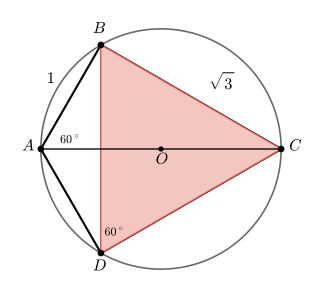
Solution.
1. The radius. By the law of sines in triangle $ABC$: $2R = \frac{BC}{\sin60^\circ} = \frac{\sqrt3}{\sqrt3/2} = 2$, so $R = 1$.
2. $AC$. With $AB = x$ and $AC = 2x$, the law of cosines gives $3 = x^2 + 4x^2 - 2\cdot x\cdot2x\cdot\frac12 = 3x^2$, $x = 1$ and $AC = 2$. Since $AC = 2R$, $AC$ is a diameter (and the angle at $B$ is a right angle).
3. $\angle BDC$. $A$ and $D$ are on the same side of $BC$ and subtend the same arc $BC$: $\angle BDC = \angle BAC = 60^\circ$.
4. The area. Triangle $BDC$ is isosceles ($BD = DC$) with a $60^\circ$ angle between the equal sides: it is equilateral with side $\sqrt3$, and its area is $\frac{\sqrt3}{4}\cdot3 = \frac{3\sqrt3}{4}$.
5. The dot product. With the center at the origin and $AC$ on the $x$-axis: $A(-1, 0)$, $C(1, 0)$, $B\left(-\frac12, \frac{\sqrt3}{2}\right)$ and, on the other side of $AC$, $D\left(-\frac12, -\frac{\sqrt3}{2}\right)$. Then $\vec{DC} = \left(\frac32, \frac{\sqrt3}{2}\right)$, $\vec{CA} = (-2, 0)$ and $\vec{DC}\cdot\vec{CA} = -3$.
(Without coordinates: $DC = \sqrt3$, $CA = 2$, and the angle between the vectors is the supplement of $\angle DCA = 30^\circ$, that is, $150^\circ$: $\sqrt3\cdot2\cdot\cos150^\circ = -3$.)
Answer: $1$; $2$; $60^\circ$; $\frac{3\sqrt3}{4}$; $-3$.
Question 3: the signs of the coefficients from the graph
Statement. The graph of $y = ax^2 + bx + c$ is a parabola opening downward that crosses the $y$-axis below the origin, crosses the $x$-axis once between $1$ and $2$ and again to the right of $2$, and has its vertex to the right of the line $x = 2$. Say whether each expression is greater ($>$) or less ($<$) than zero:
(1) $a$; (2) $4ac - b^2$; (3) $a + b + c$; (4) $4a - 2b + c$; (5) $\frac ca$; (6) $\frac ba$; (7) $b + 4a$; (8) $2a + b$.
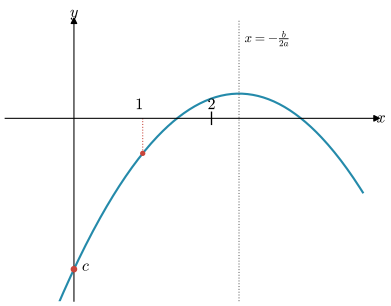
Solution. Each expression is a value of the function or a fact about the vertex.
- Opening downward: $a < 0$.
- Two real roots: $b^2 - 4ac > 0$, so $4ac - b^2 < 0$.
- $a + b + c = f(1)$, and at $x = 1$ the graph is still below the axis: $< 0$.
- $4a - 2b + c = f(-2)$, to the left of the first root: $< 0$.
- $c = f(0) < 0$ and $a < 0$: $\frac ca > 0$.
- The vertex is at $x = -\frac{b}{2a} > 0$, so $\frac ba < 0$.
- The vertex is to the right of 2: $-\frac{b}{2a} > 2$. Multiplying by the positive number $-2a$ keeps the inequality: $b > -4a$, or $b + 4a > 0$.
- In the same way, $-\frac{b}{2a} > 1$ gives $b > -2a$, or $2a + b > 0$.
Answer: (1) $<$, (2) $<$, (3) $<$, (4) $<$, (5) $>$, (6) $<$, (7) $>$, (8) $>$.