
Euler's Eyes
2026-11-01
MEXT 2025 – Mathematics (A) solved
Source: MEXT / Study in Japan – Mathematics (A) exam and official answer key. Files on the past-exam page.
Mathematics (A) is the exam for undergraduate applicants in the humanities and social sciences. It lasts 60 minutes and has three fill-in-the-blank questions: each box $\boxed{\text{1-1}}$, $\boxed{\text{1-2}}$, … takes a number. Fractions are reduced, with a positive denominator. The statements below follow the original English.
Answer key
| Question | Topic | Answers |
|---|---|---|
| 1 | Eight short items | see the table in the question |
| 2 | A line tangent to two parabolas | $-2,\ -1;\ 1,\ -1,\ -2,\ 1;\ \tfrac{1}{12}$ |
| 3 | A quadrilateral inscribed in a semicircle | $0,\ 5;\ \tfrac{25}{4};\ 1;\ 1;\ \tfrac{15}{4};\ \tfrac{21}{4}$ |
Question 1: eight short items
| Item | Boxes | Answer |
|---|---|---|
| (1) | 1-1, 1-2 | $3$, $2$ |
| (2) | 1-3, 1-4 | $0$, $4$ |
| (3) | 1-5 | $126$ |
| (4) | 1-6 to 1-9 | $-3$, $-4$, $5$, $\tfrac{1}{5}$ |
| (5) | 1-10 | $13$ |
| (6) | 1-11 to 1-13 | $2$, $-8$, $11$ |
| (7) | 1-14 to 1-16 | $\tfrac{5}{16}$, $\tfrac{67}{256}$, $\tfrac{267}{896}$ |
| (8) | 1-17, 1-18 | $6$, $-10$ |
Item (1)
Statement. The function $f(x) = |x + 1| + |2x - 4|$ takes the minimum value $\boxed{\text{1-1}}$ at $x = \boxed{\text{1-2}}$.
Solution. The absolute values change sign at $x = -1$ and $x = 2$. On each piece,
$$f(x) = \begin{cases} -3x + 3, & x \le -1 \\ -x + 5, & -1 \le x \le 2 \\ 3x - 3, & x \ge 2 \end{cases}$$The function decreases up to $x = 2$ and increases after it. The minimum is $f(2) = 3$, at $x = 2$.
Answer: $\boxed{\text{1-1}} = 3$ and $\boxed{\text{1-2}} = 2$.
Item (2)
Statement. Let $a$ be a real number. The graphs $y = x^2$ and $y = ax - a$ have two different common points. Then $a < \boxed{\text{1-3}}$ or $\boxed{\text{1-4}} < a$.
Solution. Setting them equal, $x^2 - ax + a = 0$. Two distinct real roots require a positive discriminant:
$$\Delta = a^2 - 4a = a(a - 4) > 0 \iff a < 0 \ \text{or}\ a > 4.$$Answer: $\boxed{\text{1-3}} = 0$ and $\boxed{\text{1-4}} = 4$.
Item (3)
Statement. The sequence $(a_n)$ satisfies
$$a_1 = 1, \qquad a_{n+1} = a_n + 2^n + \cos\left(\frac{n\pi}{6}\right), \quad n = 1, 2, \dots, 6.$$Then $a_7 = \boxed{\text{1-5}}$.
Solution. Adding the six equations, the intermediate terms cancel:
$$a_7 = a_1 + \sum_{n=1}^{6} 2^n + \sum_{n=1}^{6} \cos\frac{n\pi}{6}.$$The first sum is $2 + 4 + \dots + 64 = 126$. The cosines are $\frac{\sqrt3}{2}, \frac12, 0, -\frac12, -\frac{\sqrt3}{2}, -1$, which add up to $-1$. So $a_7 = 1 + 126 - 1 = 126$.
Answer: $\boxed{\text{1-5}} = 126$.
Item (4)
Statement. Consider the circle $C: x^2 + y^2 = 1$ and the line $\ell: 4y = -3x + 6$. If the point $P(x_0, y_0)$ moves on $C$, the distance $L$ between $P$ and $\ell$ is
$$L = \frac{\boxed{\text{1-6}}\,x_0 + \boxed{\text{1-7}}\,y_0 + 6}{\boxed{\text{1-8}}}.$$Furthermore, $L$ takes the minimum $\boxed{\text{1-9}}$.
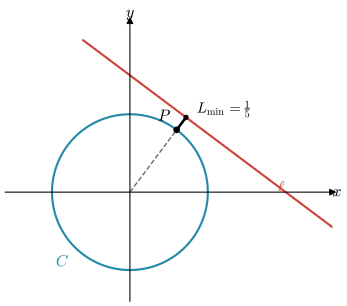
Solution.
1. The distance formula. Writing $\ell$ as $3x + 4y - 6 = 0$,
$$L = \frac{|3x_0 + 4y_0 - 6|}{\sqrt{3^2 + 4^2}} = \frac{|3x_0 + 4y_0 - 6|}{5}.$$2. Removing the absolute value. By the Cauchy–Schwarz inequality, $|3x_0 + 4y_0| \le 5\sqrt{x_0^2 + y_0^2} = 5 < 6$. So $3x_0 + 4y_0 - 6$ is always negative and
$$L = \frac{-3x_0 - 4y_0 + 6}{5}.$$3. The minimum. $L$ is smallest when $3x_0 + 4y_0$ is largest, that is, equal to $5$ (at $P = (\frac35, \frac45)$). Then $L_{\min} = \frac{6 - 5}{5} = \frac15$. Geometrically: the distance from the center to the line is $\frac65$ and the radius is $1$.
Answer: $-3$, $-4$, $5$ and $\frac15$.
Item (5)
Statement. Let $x$ and $y$ be integers that are not less than 0. The number of pairs $(x, y)$ satisfying
$$y \le -\frac12 x^2 + 6, \qquad y \ge -\frac13 x + 2$$is $\boxed{\text{1-10}}$.
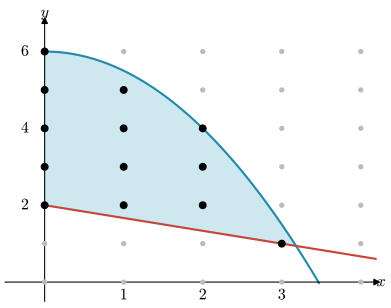
Solution. We count column by column. For $y \le -\frac12x^2 + 6$ to allow some $y \ge 0$ we need $x \le 3$.
| $x$ | smallest $y$ | largest $y$ | pairs |
|---|---|---|---|
| 0 | $2$ | $6$ | 5 |
| 1 | $\lceil 5/3 \rceil = 2$ | $\lfloor 5.5 \rfloor = 5$ | 4 |
| 2 | $\lceil 4/3 \rceil = 2$ | $4$ | 3 |
| 3 | $1$ | $\lfloor 1.5 \rfloor = 1$ | 1 |
There are $5 + 4 + 3 + 1 = 13$ pairs.
Answer: $\boxed{\text{1-10}} = 13$.
Item (6)
Statement. In the $xy$-coordinate system, the graph of the quadratic function $y = ax^2 + bx + c$ passes through the points $(2, 3)$, $(3, 5)$ and $(4, 11)$. Then $a = \boxed{\text{1-11}}$, $b = \boxed{\text{1-12}}$ and $c = \boxed{\text{1-13}}$.
Solution. Substituting the points:
$$4a + 2b + c = 3, \qquad 9a + 3b + c = 5, \qquad 16a + 4b + c = 11.$$Subtracting consecutive equations: $5a + b = 2$ and $7a + b = 6$. Hence $2a = 4$, $a = 2$, $b = -8$ and $c = 3 - 8 + 16 = 11$.
Answer: $a = 2$, $b = -8$, $c = 11$.
Item (7)
Statement. There are coins of type A and type B that cannot be told apart by their appearance. The probabilities of heads are $\frac12$ for type A and $\frac14$ for type B. We toss a coin four times. If heads appears at most once, we estimate that the coin is of type B; otherwise, we estimate that it is of type A. The probability of estimating a type A coin as type B is $\boxed{\text{1-14}}$, and that of estimating a type B coin as type A is $\boxed{\text{1-15}}$. We have five coins of type A and two of type B and pick one of them at random. The probability that the estimate is wrong is $\boxed{\text{1-16}}$.
Solution.
1. A coin of type A taken for type B. With $p = \frac12$, at most one head in four tosses:
$$\left(\tfrac12\right)^4 + 4\cdot\tfrac12\left(\tfrac12\right)^3 = \frac{1 + 4}{16} = \frac{5}{16}.$$2. A coin of type B taken for type A. With $p = \frac14$, at least two heads is the complement of at most one:
$$1 - \left(\tfrac34\right)^4 - 4\cdot\tfrac14\left(\tfrac34\right)^3 = 1 - \frac{81}{256} - \frac{108}{256} = \frac{67}{256}.$$3. A wrong estimate with the coin picked at random. By total probability,
$$\frac57\cdot\frac{5}{16} + \frac27\cdot\frac{67}{256} = \frac{400 + 134}{1792} = \frac{534}{1792} = \frac{267}{896}.$$Answer: $\frac{5}{16}$, $\frac{67}{256}$ and $\frac{267}{896}$.
Item (8)
Statement. Let $x$ be a non-negative integer and $y$ a non-positive integer. The pair satisfying $12x + 7y = 2$ with the smallest $x$ is $x = \boxed{\text{1-17}}$, $y = \boxed{\text{1-18}}$.
Solution. We need $12x \equiv 2 \pmod 7$, that is, $5x \equiv 2 \pmod 7$. Since $5 \cdot 3 = 15 \equiv 1$, multiply by $3$: $x \equiv 6 \pmod 7$. The smallest $x \ge 0$ is $6$, and then $7y = 2 - 72 = -70$, $y = -10 \le 0$.
Answer: $x = 6$ and $y = -10$.
Question 2: a line tangent to two parabolas
Statement
Let $a > 0$ and let $C_1: y = x^2$ and $C_2: y = x^2 - 2ax + a^2 - 2a$. The straight line $\ell$ is tangent to both $C_1$ and $C_2$.
- The equation of $\ell$ is $y = \boxed{\text{2-1}}\,x + \boxed{\text{2-2}}$.
- The point of tangency of $\ell$ and $C_2$ is $\left(\boxed{\text{2-3}}\,a + \boxed{\text{2-4}},\ \boxed{\text{2-5}}\,a + \boxed{\text{2-6}}\right)$.
- The area enclosed by $C_1$, $C_2$ and $\ell$ is $\boxed{\text{2-7}}\,a^3$.
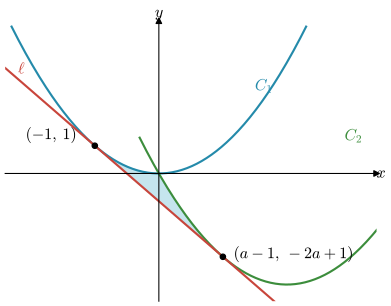
Solution
1. The common tangent. The tangent to $C_1$ at the point with abscissa $t$ is $y = 2tx - t^2$. It is tangent to $C_2$ when the equation
$$x^2 - 2ax + a^2 - 2a = 2tx - t^2 \iff x^2 - 2(a + t)x + (a^2 - 2a + t^2) = 0$$has a double root:
$$\frac{\Delta}{4} = (a + t)^2 - (a^2 - 2a + t^2) = 2at + 2a = 2a(t + 1) = 0.$$Since $a > 0$, $t = -1$ and $\ell: y = -2x - 1$.
2. The point of tangency with $C_2$. The double root is $x = a + t = a - 1$, and $y = -2(a - 1) - 1 = -2a + 1$. The point is $(a - 1,\ -2a + 1)$.
3. The area. $C_2$ is $C_1$ shifted: $y = (x - a)^2 - 2a$. The two parabolas meet where $x^2 = x^2 - 2ax + a^2 - 2a$, that is, at $x = \frac a2 - 1$, exactly halfway between the points of tangency $x = -1$ and $x = a - 1$. The region lies between $\ell$ and the lower of the two parabolas:
- from $x = -1$ to $x = \frac a2 - 1$, between $\ell$ and $C_1$: $x^2 - (-2x - 1) = (x + 1)^2$;
- from $x = \frac a2 - 1$ to $x = a - 1$, between $\ell$ and $C_2$: $(x - a + 1)^2$.
Each part is the integral of a square over an interval of length $\frac a2$:
$$S = \int_{-1}^{\frac a2 - 1} (x + 1)^2\,dx + \int_{\frac a2 - 1}^{a - 1} (x - a + 1)^2\,dx = \frac13\left(\frac a2\right)^3 + \frac13\left(\frac a2\right)^3 = \frac{a^3}{12}.$$Answer
$\boxed{\text{2-1}} = -2$, $\boxed{\text{2-2}} = -1$; $\boxed{\text{2-3}} = 1$, $\boxed{\text{2-4}} = -1$, $\boxed{\text{2-5}} = -2$, $\boxed{\text{2-6}} = 1$; $\boxed{\text{2-7}} = \frac{1}{12}$.
Question 3: a quadrilateral inscribed in a semicircle
Statement
Let the quadrilateral $ACDB$ be inscribed in the circle $O$, where the side $AB$ is a diameter of $O$. Let $E$ be the intersection of the lines $AD$ and $BC$, and $F$ the intersection of the lines $AC$ and $BD$. We write $XY$ for the length of the segment $XY$. Assume that $AC = 5$, $AD = 7$ and $CD = 3\sqrt2$.
- $AB = \boxed{\text{3-1}} + \boxed{\text{3-2}}\sqrt2$.
- $AE = \boxed{\text{3-3}}$.
- $BD = \boxed{\text{3-4}}$.
- $\dfrac{BD}{DF}\cdot\dfrac{AF}{AC}\cdot\dfrac{CE}{BE} = \boxed{\text{3-5}}$.
- $FC = \boxed{\text{3-6}}$.
- $FD = \boxed{\text{3-7}}$.
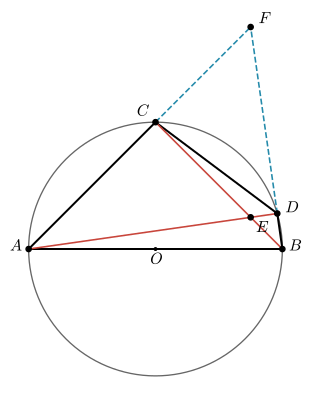
Solution
The vertices appear in the order $A, C, D, B$ on the circle. Since $AB$ is a diameter, the angles $\angle ACB$ and $\angle ADB$ are right angles.
1. The angle $\theta = \angle CAD$. By the law of cosines in triangle $ACD$,
$$18 = 25 + 49 - 2\cdot 5\cdot 7\cos\theta \implies \cos\theta = \frac{56}{70} = \frac45, \qquad \sin\theta = \frac35.$$2. The diameter. By the law of sines in triangle $ACD$, inscribed in the same circle, $CD = AB\sin\theta$:
$$AB = \frac{3\sqrt2}{3/5} = 5\sqrt2 = 0 + 5\sqrt2.$$(Ptolemy’s theorem, $AC\cdot BD + CD\cdot AB = AD\cdot BC$, gives the same result.)
3. The legs. $BC = \sqrt{50 - 25} = 5$ and $BD = \sqrt{50 - 49} = 1$. Triangle $ACB$ is an isosceles right triangle.
4. $AE$. $E$ lies on line $BC$, so triangle $ACE$ has a right angle at $C$ and the angle $\theta$ at $A$:
$$AE = \frac{AC}{\cos\theta} = \frac{5}{4/5} = \frac{25}{4}.$$5. The product of ratios. The line $AED$ meets the sides (or their extensions) of triangle $BCF$ at $D$ (on $BF$), $A$ (on $FC$) and $E$ (on $CB$). Menelaus’ theorem gives
$$\frac{BD}{DF}\cdot\frac{FA}{AC}\cdot\frac{CE}{EB} = 1.$$6. $FC$ and $FD$. The inscribed angles $\angle CBD$ and $\angle CAD$ subtend the same arc $CD$, so $\angle CBF = \theta$. In triangle $BCF$, with a right angle at $C$,
$$FC = BC\tan\theta = 5\cdot\frac34 = \frac{15}{4}, \qquad FB = \frac{BC}{\cos\theta} = \frac{25}{4}.$$Since $D$ lies between $F$ and $B$, $FD = FB - BD = \frac{25}{4} - 1 = \frac{21}{4}$.
Check. The power of the point $F$ gives $FC\cdot FA = FD\cdot FB$: $\frac{15}{4}\cdot\frac{35}{4} = \frac{525}{16} = \frac{21}{4}\cdot\frac{25}{4}$. ✓
Answer
$\boxed{\text{3-1}} = 0$, $\boxed{\text{3-2}} = 5$; $AE = \frac{25}{4}$; $BD = 1$; the product equals $1$; $FC = \frac{15}{4}$; $FD = \frac{21}{4}$.