
Euler's Eyes
2022-08-13
Fees
In cases where a ratio is compared in different units, such as speed, telephone tariff, among others. This ratio (division or quotient), which is a rational number, is called rate. Common rate examples:
Example of Rate with Speed
- a dog travels 2 meters in 2 seconds;
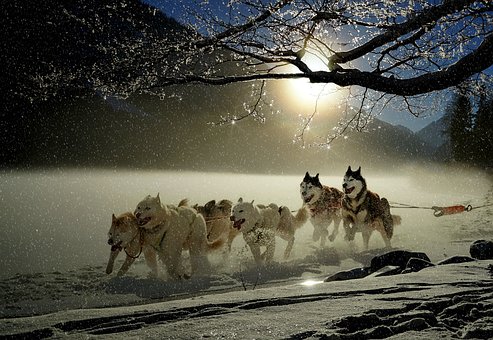
- rate is 1 meter per second
Example of Rate with Telephone Tariff
-
a telephone company charges R$ 1,00 per minute;
- rate is R$ 1,00 per minute

Entrance Examination Exercise
In order to solve the exercise, we will use the concepts of proportions, in which we have directly and inversely proportional ratios, which we will use together.
Problem It is common for the Greenland ice sheet to melt during the summer in the Northern Hemisphere. The high temperatures recorded in 2019 made the phenomenon start earlier. In July alone, Greenland lost around 198 billion tons of ice. This melting is equivalent to how many Olympic swimming pools?
Data:
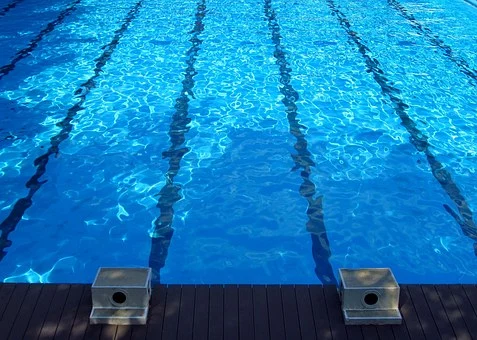
- An Olympic swimming pool has the shape of a rectangular block with dimensions 50 meters long, 25 meters wide and 2m deep.
- Ice density: $0,9 kg/L$.
- $1~ m^3 = 1000L$.
- $1 ~\text{ton} = 1000 kg$.
Solution:
| Olympic Swimming Pool | Volume of the parallelepiped |
|---|---|
|
|
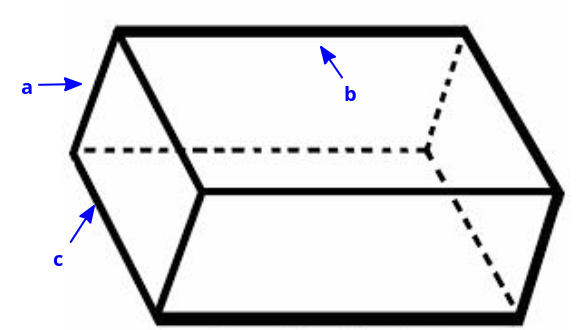
The dimensions of the parallelepiped are given by the sides a, b and c. The volume of the parallelepiped is given by:
$$V_{\text{paralelepípedo} } = a\times b\times c = 50 ~\text{m}\times 25 ~\text{m}\times 2 ~\text{m} = 2500 ~\text{m}^3 $$We define the Olympic pool as PO. With that, let’s solve the exercise:
$$ x[\text{PO}] = \dfrac{1 [\text{PO}]}{2500 ~[ \cancel{\text{m}^3 }]} ~.~ \dfrac{1 [ \cancel{\text{m}^3 }]}{1000 ~[ \cancel{\text{L} }]} ~.~ \dfrac{10 [ \cancel{\text{L} }]}{9 ~[ \cancel{\text{kg} }]} ~.~ \dfrac{1000 [ \cancel{\text{kg} }]}{1 ~[ \cancel{\text{ton} }]} ~.~ 198 \text{bilhões} [ \cancel{\text{ton} }] $$It is worth remembering that the density is $0,9 kg/L$, which we can write as:
$$\dfrac{1 [ \text{L} ]}{0,9 ~[ \text{kg} ]} = \dfrac{10 [ \text{L} ]}{9 ~[ \text{kg} ]}$$Now we return to the exercise, as the entrance exam doesn’t have a calculator, let’s use the shortcuts to calculate in our head:
Therefore, this melting is equivalent to 88 billion Olympic-size swimming pools.