
Euler's Eyes
2022-07-10
The number zero
Look at what’s not there
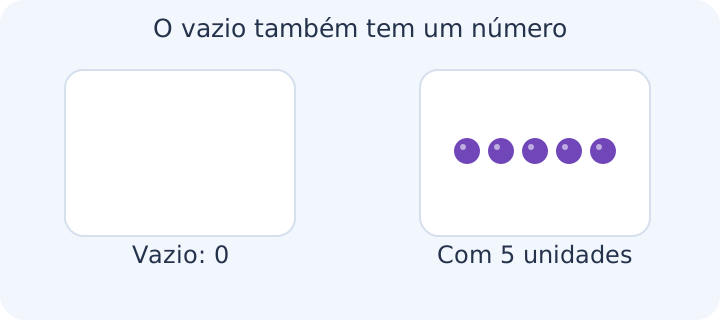

Check out the discovery
In 205 there are 2 hundreds, no tens and 5 ones. In 25 there are 2 tens and 5 units. The position changes the value of the digits.
Introduction
Until now, we have defined natural numbers as 1, 2, 3, 4, … and considered zero a digit of positional systems. Zero was defined only to designate the empty square in representations of numbers.
The next step is to consider it as part of the natural number. The idea is to use this concept to extend the properties of this set. Using or zero as a natural number also facilitates the development of formulas and definitions.
With zero we can define the empty set and it is useful for operations with sets. By For example, given a set, a set with nothing in it is said to be an empty set.
The zero
Definition: Zero is the number of elements in an empty set and we can indicate the number zero with the symbol 0.
Thus, zero is part of the numbers used for counting, or zero is part of the natural numbers.
Sum with zero
Next we observe that:
- If we put a value in an empty set, we have a set with one element.
- 1 is the successor of zero.
Generally, in an empty set, when we place n elements
$$n + 0 = n \quad \text{ou} \quad 0 + n = n$$When we add zero to an empty set we have:
$$0 + 0 = 0$$Subtraction as zero
In a set of n elements, when we subtract the same n elements from a set of n elements:
$$n - n = 0 \quad \text{para todo número natural n.}$$It also applies to zero:
$$0 - 0 = 0$$Multiplication with zero
In the post about basic operations, we saw that:
- 1 x n means we get n once
- 2 x n means we get n twice (or double n)
- So on.
With this, 0 x n means that we obtain n never or
$$0\times n = 0 = n\times 0 \quad \text{para qulquer número natural n.}$$In particular,
$$0\times 0 =0 $$Formalization from scratch
Definition: the set of natural numbers including zero is given by:
$$\mathbb{N} = \{0, 1 , 2 , 3, 4, \dots\}$$
The symbol for zero was indicated to represent something empty in positional representations.
The first report of the use of zero was in India from the 7th century onwards by mathematicians like Brahmagupta, Mahavira and Bhaskara.
Mahavira described zero in a book as follows:
“…a number multiplied by zero is zero, and a number remains the same when zero is subtracted from it”
In university-level mathematics, zero is treated with great care, as we cannot divide a number by zero and there are some indeterminacies that can be obtained with zeros.
Why is zero so important?
The use of zero was taboo for ancient mathematicians, because when used inappropriately, we could make serious mistakes. What mathematics takes the most care about is the hypotheses used. This involves whether a result is determined or indeterminate. The classic joke that people make with indeterminacy is:
We have reached an absurdity, but why?
This result is due to an indeterminacy of the type:
$$\frac{0}{0}$$
More specifically:
$$\frac{1-1}{1-1}=\frac{0}{0}$$Therefore, be very careful with zero, as you can get absurd results.