
Euler's Eyes
2024-05-04
Right Triangles
A triangle is a three-sided polygon, in which we use straight segments for the sides. It is a particular case of quadrilaterals, as it is a quadrilateral divided by 2.

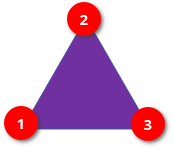
- Vertices: can be defined as meeting points between the sides of a triangle. Generally speaking, vertices are meeting points between sides of any polygon.
In particular, a triangle is formed by 3 vertices.
- Diagonal: is the straight line segment that connects two non-consecutive vertices of any flat and spatial polygon.
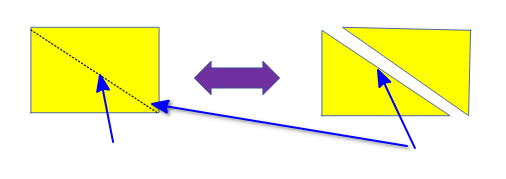
One of the important properties of triangles is that they have diagonals. An important observation is that there is no triangle that has two non-consecutive vertices. The diagonal of a quadrilateral, for example, is one of the sides of a triangle.
The right-angled triangle, as derived from the name, has one of the right angles (90 degrees), that is, two sides of the triangle are perpendicular1, as in two sides of a square. Below, according to history, we present the names forcefully imposed by textbooks.

What we know as Catetos represents what is perpendicular ⊥, whereas what we know as Hipotenusa is what is below
two perpendicular lines (stretched).

Next, let’s define some terms:
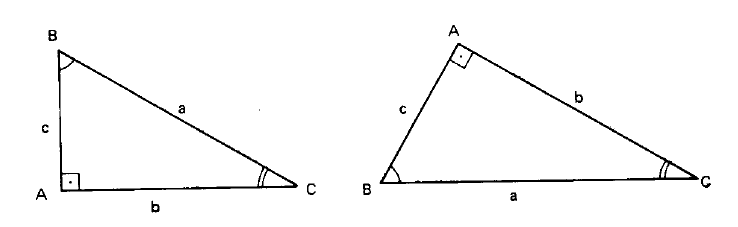
- sides: AB, BC, AC
- interior angles: $B\hat{A} C$, $A\hat{B} C$, $A\hat{C} B$
- side measurements:
- a = measure of BC
- b = AC measurement
- c = measure of AB
- angle measurements:
- $\hat{A}$= measurement of $B\hat{A} C$
- $\hat{B}$ = measurement of $A\hat{B} C$
- $\hat{C}$= measurement of $A\hat{C} B$
equilateral triangle
equilateral triangle can be derived from the words equi (iguais) lateralo (lados) and can be obtained from a right-angled triangle. The right triangle is half (½) of a equilateral triangle.
From the right triangle we notice that the hypotenuse in the following example has distance a, one of the legs has distance h and the other leg a/2. As shown in the following figure:
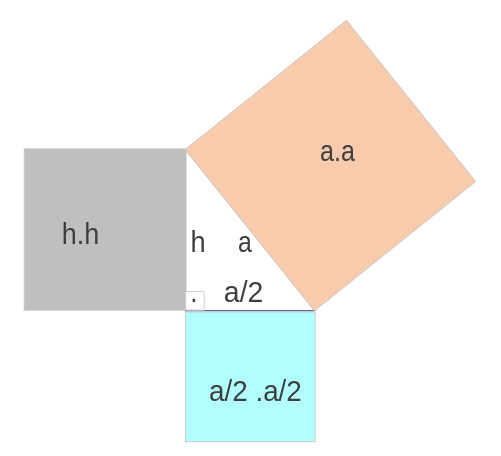
When we unfold the right triangle, we obtain the following equilateral triangle (3 equal sides).

Example 1:
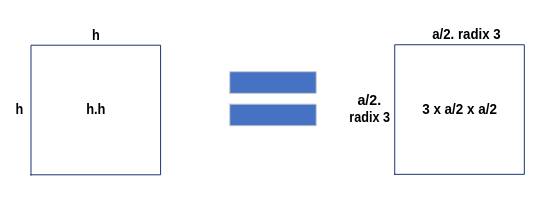
With this, we obtain:
$$h= \frac{a}{2}~.~\text{radix}~ 3$$
Example 2:
Example 3:
Therefore:
radix quadratum 9 aequalis 3
$$\sqrt{9} = 3$$
Metric relations of a right triangle
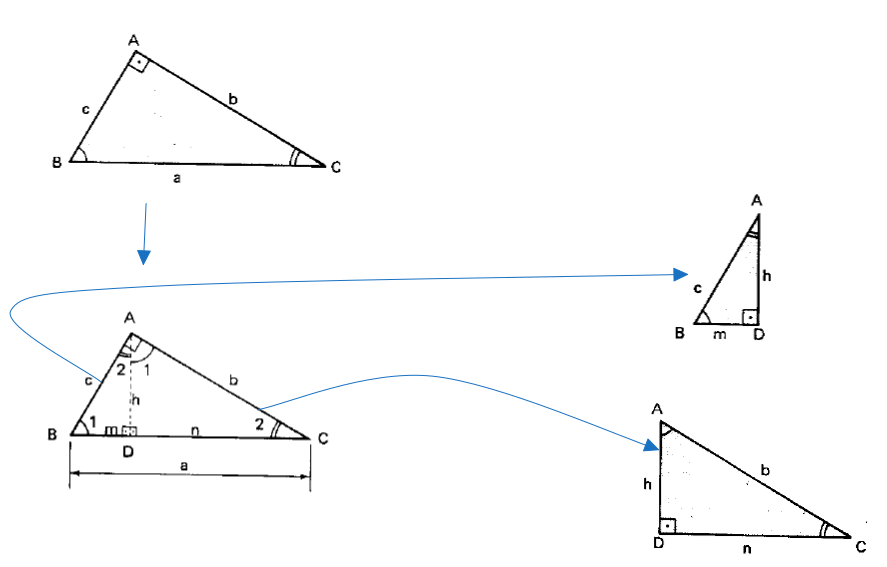
If we take a right triangle ABC and conduct AD perpendicular to BC, with D in BC, we obtain:
- AD = height relative to the hypoten uses (measurement: h)
- BD = projection of side AB onto the hypotenuse (measurement: m)
- CD = projection of AC on the hypotenuse (measurement: n)
- $\hat{B}\equiv \hat{1}$ and $\hat{C}\equiv \hat{2}$ because $AB \perp AC$ and $BC \perp AD$
Property 1
$\Delta ABC \sim \Delta DBA$ implies $\dfrac{a}{c} = \dfrac{c}{m}.$ Therefore
$$c² = a. m$$
$\Delta ABC \sim \Delta DAC$ implies $\dfrac{a}{b} = \dfrac{b}{n}.$ Therefore
$$b² = a. n$$
Property 2
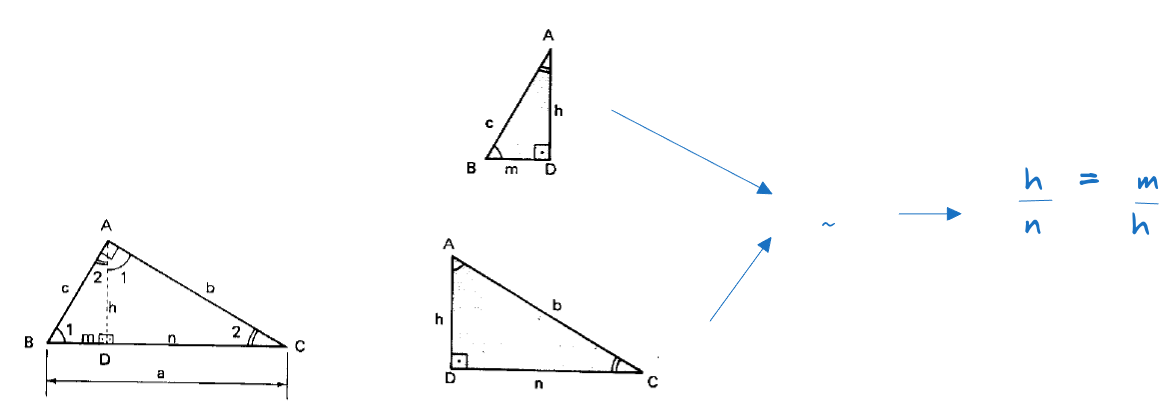
$\Delta DBA \sim \Delta DAC$ implies $\dfrac{h}{n} = \dfrac{m}{h}.$ Therefore
$$h² = m. n$$
Property 3 (Pythagorean theorem)
From the property 1 we have $c^2 = a.m$ and $b^2 = a.n$. When we add these two equations:
$$b^2 + c^2 = a.n + a.m = a(n+m) = a.a = a^2$$With this, we have the Pythagorean theorem:
$$b^2 + c^2 = a^2$$
Property 4 (right triangle inscribed in a circle)
Another notable property of right-angled triangles can be seen if we take the midpoints of the sides (M, N, O) and connect them as shown in the figure.
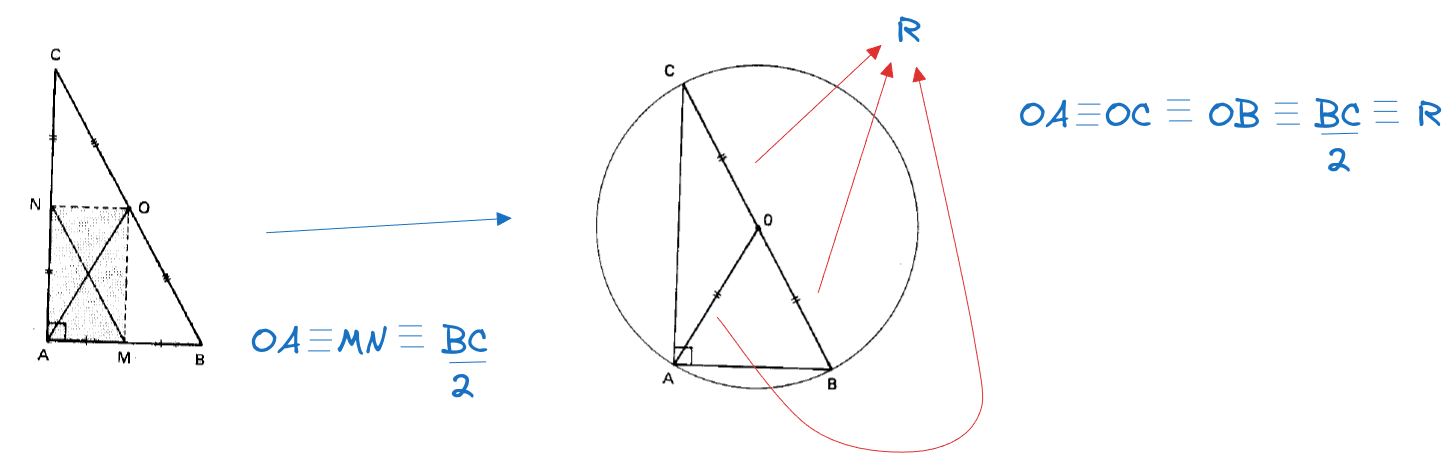
The AMON polygon is a rectangle, therefore:
$$OA \equiv MN \equiv \dfrac{BC}{2}$$
that is, the median relative to the hypotenuse is equal to half of it.
As a consequence we have to:
$$OA \equiv OB \equiv OC \equiv \dfrac{BC}{2} \equiv r$$
where $r$ is the radius of the circle.
Solved exercises
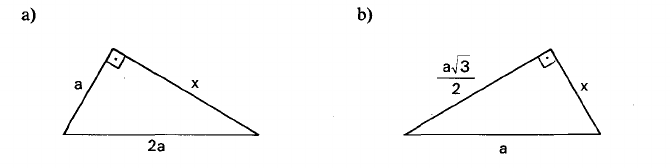
Exercise 1: Determine x as a function of a
Resolution:
a) As the base of the right triangle is half the hypotenuse, when we fold this rectangle, we have equilateral triangle. In this case, $x$ is given by the height of a equilateral triangle:
$$\text{altura} = h = \frac{\text{lado} \sqrt{3} }{2}$$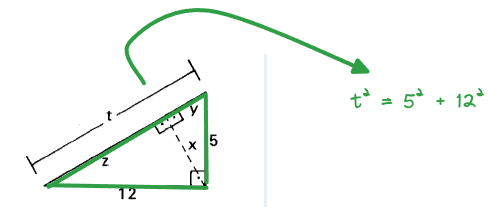
Therefore, we have to:
$$x = \frac{2a \sqrt{3} }{2} = a\sqrt{3}$$b) Analogous to item a, we have, that we have a equilateral triangle. This way, $x$ is half the side of equilateral triangle.
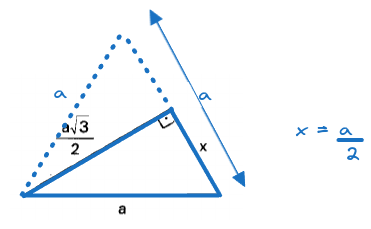 $$x = \frac{\text{lado} }{2} = \frac{a}{2}$$
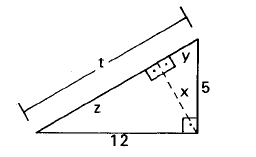
Exercise 2: Determine x, y, z and t:
Resolution:
For $t$ we just need to use the Pythagorean theorem, as $t$ is the hypotenuse.
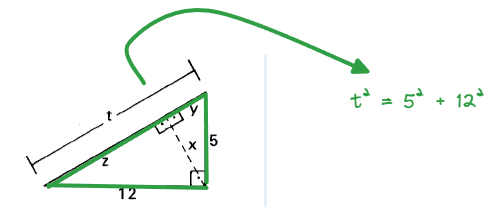 $$t^2 = 5^2 + 12^2 $$
$$t^2 = 252 + 144 $$
$$t^2 = 169 $$
$$t = \sqrt{169} $$
$$t = 13 $$
From the property 1, we have:
$$c^2 = y~. ~t$$$$5^2 = y~. ~13$$
$$ y= \frac{25}{13}$$
e
$$b^2 = z~. ~t$$$$144 = z~. ~13$$
$$ z= \frac{144}{13}$$
From the property 2, we have:
$$x^2 = y ~.~ z$$$$x^2 = \frac{25}{13} ~.~ \frac{144}{13}$$
$$x^2 = \frac{25 ~.~ 144}{13 ~.~ 13} $$
$$x = \sqrt{\frac{5^2 ~.~ 12^2}{13^2} }$$
$$x = \frac{60}{13} $$
Exercise 3: Determine x in the trapezoid:
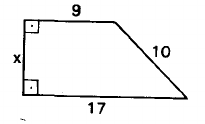
Resolution:
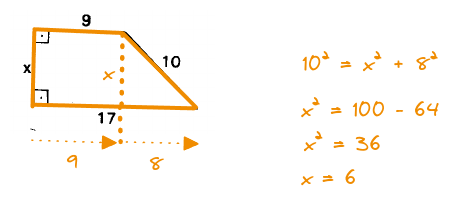
Pythagoras:
$$a^2 = b^2 + c^2$$$$10^2 = x^2 + 8^2$$
$$x^2 = 100 - 64$$
$$x^2 = 36$$
$$x^2 = 6^2$$
$$x = 6$$
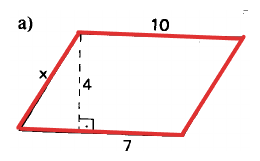
Exercise 4: Determine x in the parallelogram:
Resolution:
Let us make the relations in the figure:
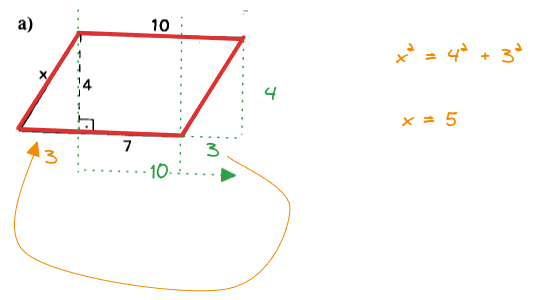
This is a classic right triangle, the famous $3-4-5$.
Therefore, the value of $x=5$.
These are the concepts of right triangles. Wait for the next posts.
-
Perpendicular lines are when two straight lines intersect, forming a right angle between them, that is, an angle of 90º. ↩︎