
Euler's Eyes
2022-07-05
Quadrilateral
Detectives from all four sides


In the previous post, we talked a little about the book Elements of Euclid, which is made up of 13 books.
Before we talk about quadrilaterals, let’s define what a polygon is.
Polygons are closed figures, formed only by straight segments that are not crossed.
In this way, we can define quadrilateral.
Quadrilaterals are polygons that have four sides.
Notable quadrilaterals
Next, you can show some notable quadrilaterals.
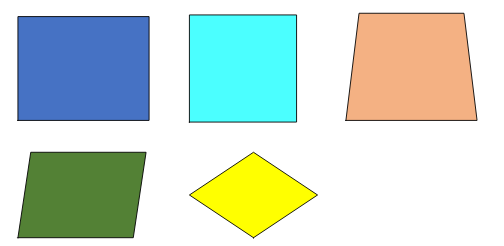
The quadrilaterals in the figure are respectively:
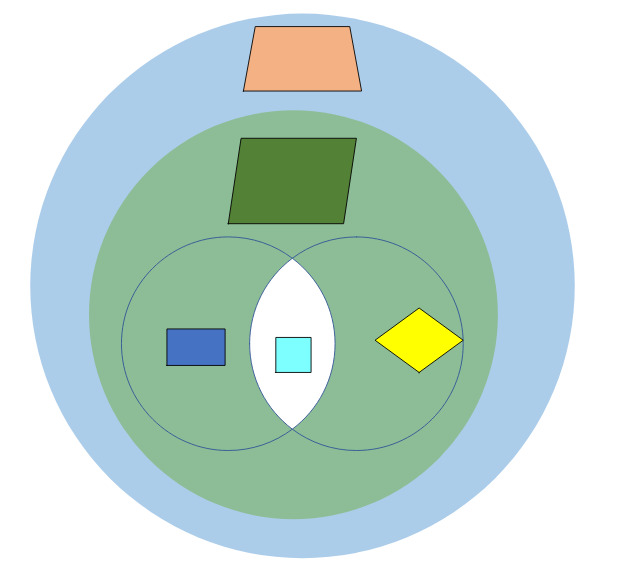
- Square of all quadrilaterals is the one that has properties in common with all the others.
- Rectangle, also called Oblong by Euclid.
- Trapezium was not present in Euclid’s definition, but it is any case within quadrilaterals.
- Parallelogram, also known as Rhomboid by Euclid.
- Losango, also known as Rombo by Euclid.
Help us build the math website. Donate as much as you can.

Square
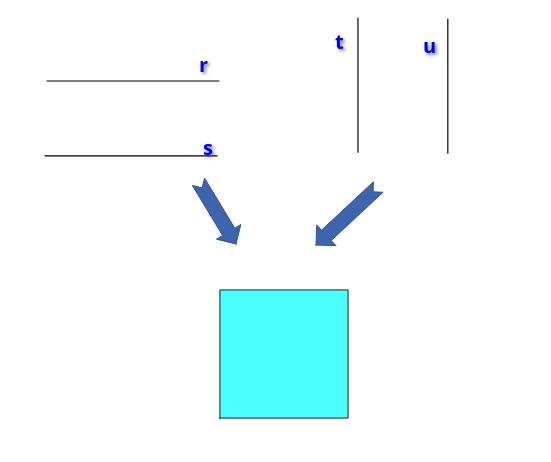
The square can be defined as two pairs of parallel lines, with a horizontal pair and a vertical pair. It is worth remembering that these pairs are equal and perpendicular.
Area of the square
The area of the square is basically the multiplication table of natural numbers, where the two parallel sides are equal. See the following example:
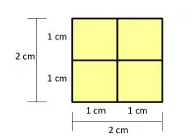
This way:
$$\text{Área do quadrado} = \text{lado} ~\times ~ \text{lado}= 2\times 2 = 4$$More general:
$$A_{\square} = \ell \times \ell \qquad \text{para qualquer }\ell \text{ natural.}$$Rectangle
The rectangle can be defined as two pairs of parallel lines, with a horizontal pair and a vertical pair. It is worth remembering that these pairs are not always equal, but they are perpendicular.
Area of the rectangle
The area of the rectangle is basically the multiplication table of natural numbers, where the two parallel sides are different. The square is a particular case of the rectangle.
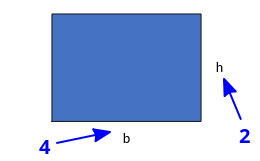
This way:
$$\text{Área do retângulo} = \text{base} ~\times ~ \text{altura}= 4\times 2 = 8$$More general:
$$A_{\text{retângulo} } = b \times h \qquad \text{para qualquer }b,~ h \text{ natural.}$$Diamond
The rhombus is a polygon that has four congruent sides. This means that all sides are the same measurement. Rhombuses are geometric figures formed by straight segments that meet only at their extremes.
Rhombus area
The area of the rhombus is basically the table of natural numbers, in which the two diagonals can be the same or different.
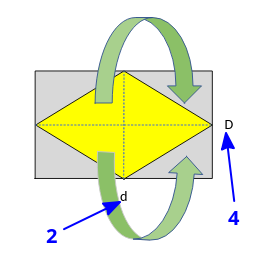
This way:
$$\text{Área do losango} = \frac{\text{diagonal maior} ~\times ~ \text{diagonal menor} }{2}= \frac{4\times 2}{2} = 4$$More general:
$$A_{\text{losango} } = \frac{D \times d}{2} \qquad \text{para qualquer }D, ~d \text{ natural.}$$Parallelogram
Every parallelogram has the rectangle, rhombus and square as subsets.
Parallelogram Area
The area of a Parallelogram is basically the same as calculating the area of a rectangle.
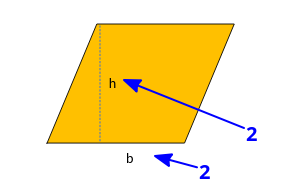
This way:
$$\text{Área do paralelogramo} = \text{base} ~\times ~ \text{altura} = 2\times 2 = 4$$More general:
$$A_{\text{paralelogramo} } = b \times h \qquad \text{para qualquer }D, ~d \text{ natural.}$$
Trapezium
A trapezoid is a flat geometric figure formed by four sides. Two of them are parallel and are called bases. The other two sides are not parallel and are called legs.
Trapezium Area
The area of the Trapezium is basically the same as calculating the area of the rectangle.
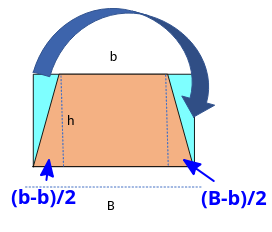
Instead of memorizing the formula, let’s deduce:
$$\text{Área do Trapézio} = \frac{(\text{Base maior} + \text{base menor})}{2}~\times ~ \text{altura} $$To do this, let’s follow some steps:
- Step 1: area of the largest rectangle
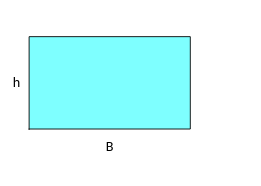 $$A_{\text{Retângulo maior} } = B\times h$$
- Step 2: area of the smaller rectangle
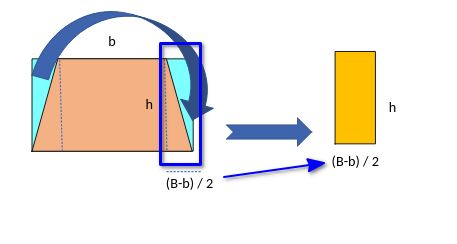
- Step 4: Trapezium area
Therefore
$$A_{\text{Trapézio} } = \frac{(B+b)\times h}{2}$$