
Euler's Eyes
2026-10-11
Definitions — right angle
Walls, squares, sheets of paper: the built world is full of right angles.
Who discovered
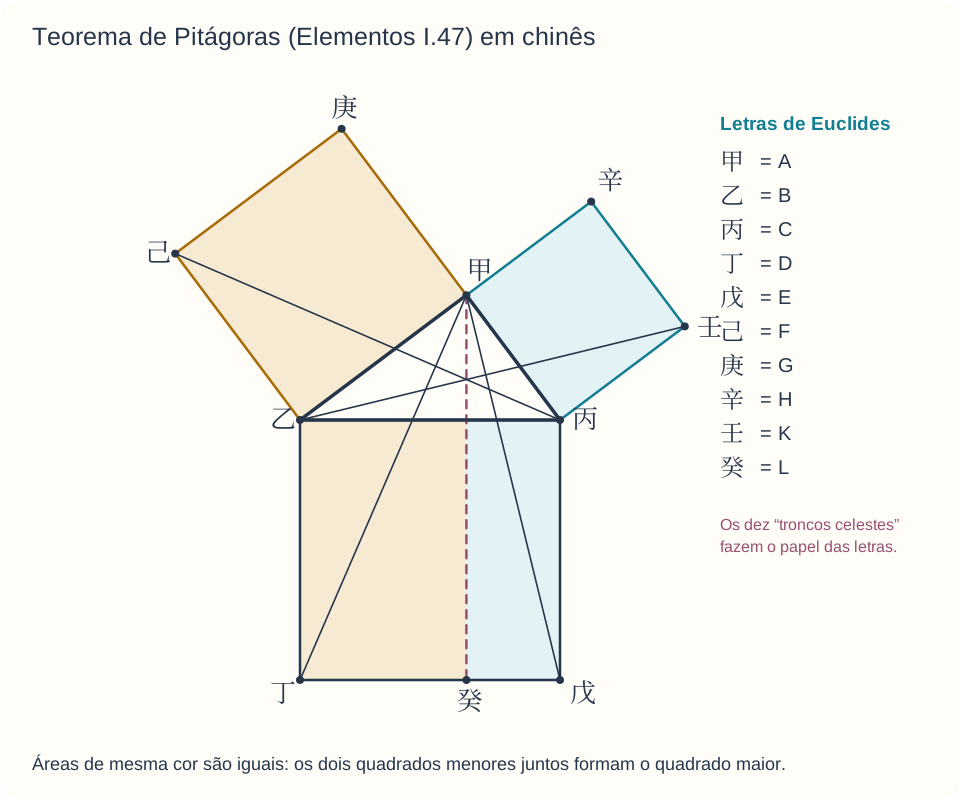
The right angle was used in practice by Egyptians, Babylonians, Indians and Chinese long before it was defined. The Babylonian tablet Plimpton 322 (c. 1800 B.C.) lists sets of numbers that form right triangles, such as 45, 60, and 75 — the triangle 3-4-5 magnified 15 times —, and the Chinese text Zhoubi Suanjing brings a famous figure about the triangle 3-4-5. The rigorous definition is from Euclid (definition I.10): when a straight line meets another forming equal adjacent angles, each of them is straight, and the straight line is perpendicular to the other.

The story
It is often said that Egyptian “rope stretchers” made right angles with a rope of 12 knots, forming the triangle 3-4-5. It’s a beautiful story, but there is no Egyptian document that confirms it: it emerged as a hypothesis from 19th century historians. What is reliably known is that Egyptian builders produced right angles with enormous precision.
Euclid made the right angle the standard for comparing all angles and stated, in the fourth postulate, that all right angles are equal. The word perpendicular comes from the Latin perpendiculum, the plumb line.
In everyday life
- Bricklayers’ rule 3-4-5. To check the squareness of a wall, mark 3 m on one side, 4 m on the other and check whether the diagonal measures 5 m.
- Plumb and level. The plumb line gives the vertical, the level gives the horizontal, and the two are perpendicular.
- Paper and canvas. A4 sheets, photos and canvases have straight corners; This allows for stacking, fitting and alignment.
- Intersections. Streets that intersect at right angles give drivers more visibility.
Sources: Elements, definition I.10 · Babylonian Mathematics: Plimpton 322 (MacTutor) · Chinese Mathematics (MacTutor).
Theory and constructions
DefiniçãoPerpendicular lines
Two lines are perpendicular (symbol $\perp$) if, and only if, they are concurrent and form congruent supplementary adjacent angles:
$$a \perp b \iff a \cap b = \lbrace P \rbrace \ \text{ e } \ a_1\hat{P}b_1 \equiv a_1\hat{P}b_2,$$where $a_1$ is one of the rays of $a$ with origin $P$, and $b_1$, $b_2$ are the opposite rays of $b$ with origin $P$.
Two rays (or two segments) are perpendicular if they are contained in perpendicular lines and have a common point. An angle $a_1\hat{P}b_1$ is right if $a_1 \perp b_1$.
DefiniçãoOblique straights
Two concurrent lines that are not perpendicular are oblique.
TeoremaExistence of the right angle
There is a right angle.
View the demo
Take a straight line $r$, a point $O$ from it and a ray $r_1$ from $r$ with origin $O$. In opposite half-planes with respect to $r$, take $P$ and $Q$ with $r_1\hat{O}P \equiv r_1\hat{O}Q$ (1) and $\overline{OP} \equiv \overline{OQ}$ (2). The segment $\overline{PQ}$ cuts $r$ at a point $X$.
- If $X = O$, the angles $P\hat{X}r_1$ and $Q\hat{X}r_1$ are adjacent, supplementary and congruent: they are straight.
- If $X \neq O$, by LAL ((2), (1) and $\overline{OX}$ common), $\triangle POX \equiv \triangle QOX$, then $P\hat{X}O \equiv Q\hat{X}O$: again two congruent supplementary adjacent angles, that is, right angles.