
Euler's Eyes
2026-10-11
Segment angle (semi-inscribed)
The angle between a chord and the tangent also measures half the arc. Hence the capable bow, used by navigators to escape rocks.
Who discovered
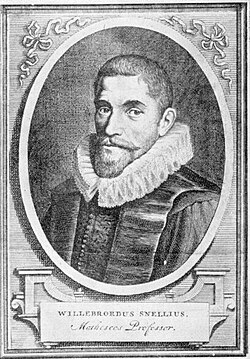
The measure of the segment angle is the proposition III.32 of the The Elements of Euclid, and the construction of the capable arc — the location of the points from which a segment is seen at a given angle — is the III.33. The best-known practical use has two names: the Dutch Willebrord Snellius (1617) and the French Laurent Pothenot (1692) solved the problem of discovering one’s own position from the angles under which three known points are seen, crossing two capable arcs.

The story
The Snellius-Pothenot problem was the basis of triangulation cartography. Snellius used it to measure the distance between Dutch cities and estimate the size of the Earth; surveyors and sailors applied it for more than three centuries, until the arrival of GPS.
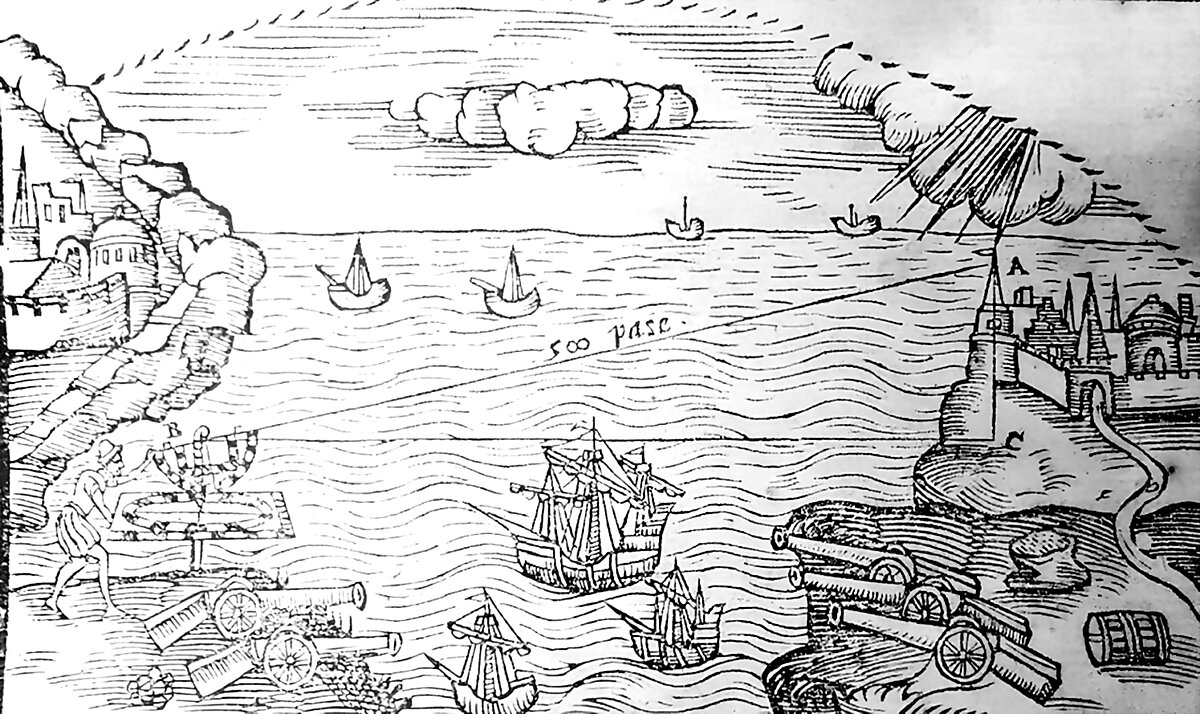
Navigators created a technique called danger angle: an arc is drawn on the chart that passes through two lighthouses and goes around the rocks. By measuring the angle between the headlights with the sextant, the commander knows whether he is inside or outside the arc — and, therefore, far or close to the danger.
In everyday life
- Coastal navigation. Danger angle is still taught in navigation courses as an alternative to GPS.
- Topography. The Pothenot problem locates a point in the field from three known landmarks.
- Stage and audience. Capable arc shows all places from which a stage is viewed from the same angle.
- Sports. In a shot on goal, the capable arc indicates the points with the same opening as the goal.
Sources: Elements, proposition III.32 · Elements, proposition III.33 · Snellius (MacTutor).
Theory and constructions
DefiniçãoSegment angle
Segment angle (or semi-inscribed) is an angle with the vertex on the circle, one side secant and the other tangent to it. The name comes from the circular segment it determines.
TeoremaSegment angle measurement
A segment angle measures half of the corresponding central angle, that is, half of the corresponding arc: $\alpha = \dfrac{\overset{\frown}{AB}}{2}$.
Demonstration (acute angle). In isosceles triangle $OAB$, $\hat{A} = 90^{\circ} - \dfrac{\beta}{2}$ (1). As $t$ is tangent, $\alpha + \hat{A} = 90^{\circ}$, that is, $\hat{A} = 90^{\circ} - \alpha$ (2). From (1) and (2), $\alpha = \dfrac{\beta}{2}$. If the angle is right, $\overline{AB}$ is diameter and the arc measures $180^{\circ}$; if it is obtuse, the adjacent supplementary is used.
DefiniçãoArc capable
Given a segment $\overline{AB}$ and an angle $\alpha$, the vertices of all inscribed (and segment) angles that measure $\alpha$ and have sides passing through $A$ and $B$ lie on an arc $\overset{\frown}{APB}$: the capable arc of $\alpha$ over $\overline{AB}$. It is the arc of a circle whose central angle about $\overline{AB}$ measures $2\alpha$.