
Euler's Eyes
2022-07-18
Least Common Multiple
Check out the discovery
In 12: multiples start with 4, 8, 12 and with 6, 12. Therefore, MMC(4, 6) = 12. This game is a current activity, inspired by the study of numbers.
In the previous post, we talked a lot about the set of divisors. In this post we will present the set of multiples. Next, we have the book The Elements by Euclid, which contains the definition of the sets of multiples (chapters VII and IX). Basically it talks about number theory.
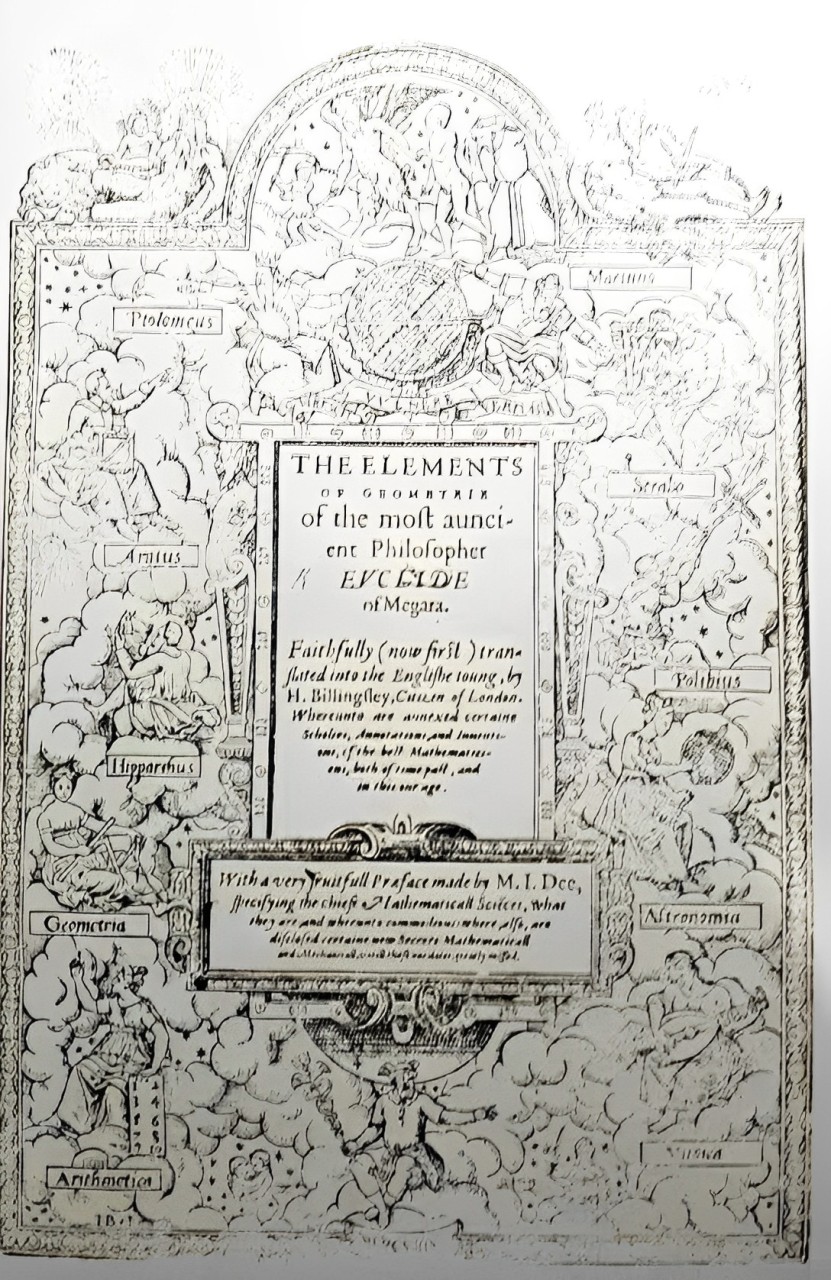
In particular, it deals with sets of multiples.
Set of multiples

Let the set of naturals be given by:
$$\mathbb{N} = \\{0,1,2,3,\dots\\}$$We take a value $a$ natural number. The set of multiples is given by:
$$\mathcal{M}(a) = \\{0~.~a, 1~.~a,2~.~a,3~.~a,\dots\\}$$For example, the set of multiples of 3 is given by:
$$\mathcal{M}(3) = \\{3, 6, 9, 12, \dots\\}$$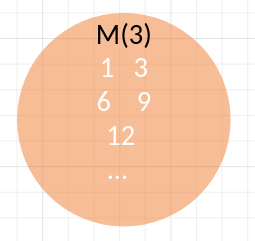
Definition of Least Common Multiple (LCM)

Once we see the set of multiples, we can define a least common multiple.
Definition: Given two nonzero numbers $a$ and $b$, the least common multiple between them is the smallest natural number that is a multiple of $a$ and $b$. It can also be defined as the meeting between the sets of multiples of $a$ and multiples of $b$.
$$\min \\{\mathcal{M}(a)\cap \mathcal{M}(b)\\}$$
For example, what is the minimum multiple between 6 and 9?
- The set of multiples of 6 is: $$\mathcal{M}(6) = \\{ 6, 12, {\color{red}{18} } , 24, \dots \\}$$
- The set of multiples of 9 is: $$\mathcal{M}(9) = \\{9, {\color{red}{18} }, 27, 36, \dots\\}$$
Therefore, the least common multiple between 6 and 9 is 18.
$$\min \\{\mathcal{M}(6)\cap \mathcal{M}(9)\\} = 18$$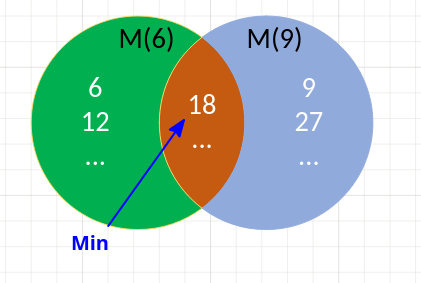
Geometric example of least common multiple
To show the least common multiple method, we use the geometric method. Let $a$ and $b$ be non-zero natural numbers. Suppose $a=6$ and $b=4$.
Let be a rectangle with sides $a$ and $b$. A ray of light always crosses the diagonal of one square of the unit side of the rectangle. When a ray hits one side, it is reflected to the opposite side. The reflection ends when it reaches one of its vertices, as in the following figure:
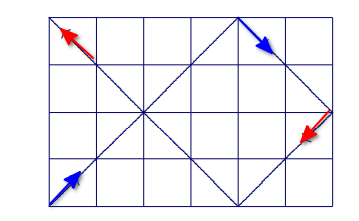
The ray of light in the figure passed through 12 unit squares, which is the same as calculating the least common multiple between 6 and 4.
- The set of multiples of 6 is: $$\mathcal{M}(6) = \\{ 6, {\color{red}{12} }, 18 , 24, \dots \\}$$
- The set of multiples of 4 is: $$\mathcal{M}(4) = \\{4, 8 , {\color{red}{12} }, 16, 20, \dots\\}$$
Therefore, the least common multiple between 6 and 4 is 12.
$$\min \\{\mathcal{M}(6)\cap \mathcal{M}(4)\\} = 12$$IMPA and the MDC
- Impa Portal: Least Common Multiple
- Impa Portal: Properties of the Greatest Common Divisor
Here we finish the concept of least common multiple and with it much of the theory of natural numbers. Wait for new posts.