
Euler's Eyes
2026-09-26
ENEM 2025 – Solved mathematics: questions 151 to 165
Source: INEP – proof and template of the 2nd day, Notebook 5 – Yellow.
The ENEM Mathematics and Technologies test 2025 was administered on the 2nd day and will from question 136 to 180. This post addresses questions 151 to 165. The numbering used here is that of the Notebook 5 – Yellow; us In other notebooks the same questions appear in a different order.
Template
| Question | Subject | Template |
|---|---|---|
| 151 | Polyhedra: number of vertices | B |
| 152 | Proportionality: production | D |
| 153 | Numeric code (rules reading) | D |
| 154 | Probability: permutations | D |
| 155 | Reading charts: bars and sectors | B |
| 156 | Trigonometry: law of cosines and directions | A |
| 157 | Statistics: mean and standard deviation | D |
| 158 | Average (running pace) | E |
| 159 | Tangent function: period and displacement | E |
| 160 | Mesh localization (orientation) | A |
| 161 | Percentage and inequality of the 1st degree | B |
| 162 | Combinatorial analysis: multiplicative principle | B |
| 163 | Scale | E |
| 164 | Reason | C |
| 165 | Percentage: cost and profit | C |
Question 151: Vertices of the gyroelongated pentagonal dome
Statement
The gyroelongated pentagonal dome is a Johnson polyhedron, whose faces are regular polygons, but it is not a polyhedron of Plato, Archimedes, prism or antiprism.
The figures present this polyhedron in two positions and one of its plans.

How many vertices does this polyhedron have?
- A) 21
- B) 25
- C) 55
- D) 80
- E) 110
Resolution
1. Counting the faces by flattening. There is 1 decagon (red), 1 pentagon (green), 5 squares (yellow) and 25 triangles (blue): 20 na strip that surrounds the decagon and 5 in the “dome”, between the squares. Total faces:
$$F = 25 + 5 + 1 + 1 = 32$$2. Counting edges. Each edge is shared by two faces. Adding the sides of all faces and dividing by 2:
$$A = \frac{25 \cdot 3 + 5 \cdot 4 + 1 \cdot 5 + 1 \cdot 10}{2} = \frac{75 + 20 + 5 + 10}{2} = \frac{110}{2} = 55$$3. Euler relation. For convex polyhedra, $V - A + F = 2$:
$$V = 2 + A - F = 2 + 55 - 32 = 25$$4. Direct conference. The polyhedron has three “floors” of vertices: the 10 of base decagon, the 10 of the middle decagon (where the strip of triangles meets the dome) and the 5 of the top pentagon: $10 + 10 + 5 = 25$.
Answer: alternative B (25).
Be careful with the catch: 55 (alternative C) is the number of edges, and 110 (alternative E) is the sum of the sides of all faces, before dividing by 2.
Question 152: Production of ecological bricks (proportionality)
Statement
An eco-brick factory with 3 employees, each working 6 hours per day, produces 720 units per day. To meet the growth of demand for this type of brick, this factory now has 5 employees, each working 9 hours a day, thus increasing their capacity to production. All employees produce an equal number of bricks each hour, regardless of whether they work 6 or 9 hours per day.
The number of bricks manufactured daily after increasing the production capacity production is
- A) 800.
- B) 1 080.
- C) 1 200.
- D) 1 800.
- E) 2 520.
Resolution
1. Production per employee per hour. Before: $3 \cdot 6 = 18$ hours work per day, producing 720 bricks:
$$\frac{720}{18} = 40 \text{ tijolos por funcionário por hora}$$2. New production. Now there are $5 \cdot 9 = 45$ working hours per day:
$$45 \cdot 40 = 1800 \text{ tijolos}$$Answer: alternative D (1 800).
Be careful with the catch: only consider the increase in employees ($720 \cdot \frac{5}{3} = 1200$, alternative C) or just hours ($720 \cdot \frac{9}{6} = 1080$, alternative B). Production is proportional to two quantities at the same time.
To review, see Rule of 3.
Question 153: Visitor identification code
Statement
To monitor the flow of visitors to its building, a company established a identification code for the visit. According to the established rule, each visitor will be identified with a numerical sequential code with 7 digits, determined, from left to right, as follows:
- the first digit indicates the floor the visitor is going to, which is a number from 1 to 4;
- the next two digits correspond to the number of the company sector to which the visitor is intended. This number ranges from 01 to 20;
- the next three digits correspond to the number of the company employee with whom the visitor will meet. This number ranges from 001 to 135;
- the last digit indicates whether the visitor arrived at the company in the morning, digit 0, or in the afternoon, digit 1.
A visitor arrived at the company at 10 hours in the morning to meet with the employee identified by number 109, who works in sector 08 of the company, located on the 2nd floor.
This visitor’s identification code is
- A) 0109082.
- B) 0281090.
- C) 1010982.
- D) 2081090.
- E) 2810910.
Resolution
Assembling the code in the requested order:
| Part | Information | Digits |
|---|---|---|
| To walk | 2nd floor | 2 |
| Sector | sector 08 | 08 |
| Employee | nº 109 | 109 |
| Period | morning (10 h) | 0 |
Adding: 2 08 109 0 = 2081090.
Answer: alternative D (2081090).
Be careful with the catch: alternative B (0281090) starts with the digit of period; a E (2810910) forgets the zero to the left of the sector 08. The code has Fixed order and number of digits.
Question 154: Cell phones returned at random (probability)
Statement
Four candidates presented themselves to take the test in a competition. Before start the test, the cell phones of the four candidates were collected by the applicator, who kept them, each one, inside a black envelope. At the end of test, the administrator returned the four envelopes with the cell phones to the four candidates, randomly, as they had not identified the envelopes.
The probability that all candidates received their envelopes back with their respective cell phones is
- A) $\dfrac{1}{2}$
- B) $\dfrac{1}{10}$
- C) $\dfrac{1}{16}$
- D) $\dfrac{1}{24}$
- E) $\dfrac{1}{256}$
Resolution
1. Possible cases. Distribute 4 different envelopes among 4 candidates, one for each, is a permutation of 4 elements:
$$4! = 4 \cdot 3 \cdot 2 \cdot 1 = 24$$2. Favorable cases. Only one distribution gives everyone their own cell phone.
3. Probability.
$$P = \frac{1}{24}$$Answer: alternative D ($\frac{1}{24}$).
Beware of the catch: alternative E ($\frac{1}{256} = \frac{1}{4^4}$) treats each delivery as independent, as if the same envelope could be delivered to more than one person. But each envelope delivered leaves the applicator’s hand.
To review, see Equiprobable Events.
Question 155: Students by sport (graphics)
Statement
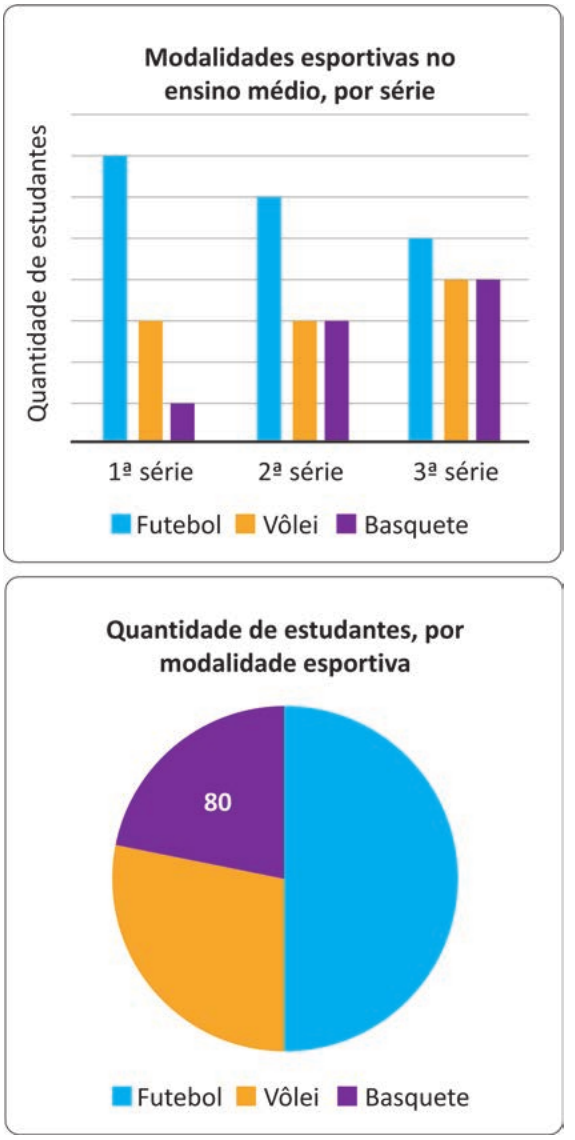
In a school, all high school students practice one of three sports offered as physical activity, and each of them practices only one of these activities. The graphs provide some data relating to the number of students who practice these sports in this school, although some quantities were not reported.
How many students are in high school at this school?
- A) 720
- B) 360
- C) 320
- D) 288
- E) 240
Resolution
The bar chart has no numbers on the axis, but has gridlines equally spaced. Let’s call $u$ the number of students that corresponds to a space between two lines.
1. Reading bars in units $u$:
| Series | Soccer | Volleyball | Basketball |
|---|---|---|---|
| 1ª | 7 | 3 | 1 |
| 2ª | 6 | 3 | 3 |
| 3ª | 5 | 4 | 4 |
| Total | 18 | 10 | 8 |
2. Discovering $u$. The pie chart tells you that 80 students play basketball. Through the bars, basketball adds $8u$:
$$8u = 80 \quad\Rightarrow\quad u = 10$$3. Total students.
$$(18 + 10 + 8) \cdot u = 36 \cdot 10 = 360$$(Checking the pie chart: football has $180$, half of 360, like the blue sector of half circle indicates.)
Answer: alternative B (360).
Be careful with the catch: the value 80 in the pie chart is the amount of basketball, not a percentage. And you need to count the bars of the three series.
Question 156: Correcting the vessel’s route (law of cosines)
Statement
The owner of a vessel must depart from point $P$ and reach point $R$ through of two linear displacements and sailing at a constant speed. This trip will be made during the night, and as he only has a compass and a clock, planned his route as follows:
1st – start from point $P$ in direction 110 and navigate for 4 hours, reaching point $Q$;
2nd – start from point $Q$ in direction 90 and navigate for 2 hours, reaching the destination point $R$.
However, when directing the boat for the first displacement, it did so in the direction 340 instead of 110. As a result, he made the following trips:
1st – departed from point $P$ in direction 340 and sailed for 4 hours, reaching point $S$;
2nd – departed from point $S$ in direction 90 and sailed for 2 hours, reaching point $T$.
The figure shows the compass, the planned route and the executed route.
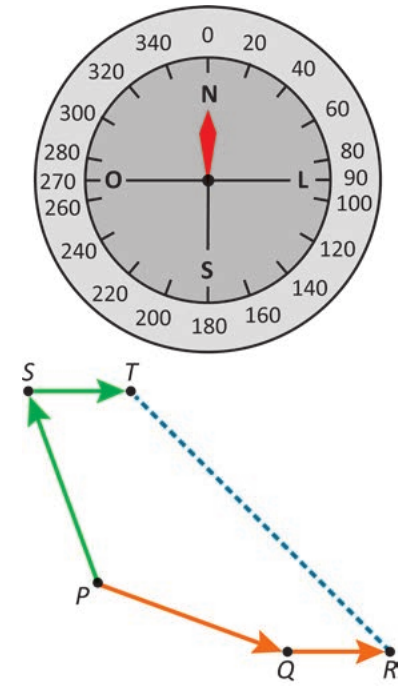
The owner of the vessel only realized the mistake when arriving at point $T$. With this, now he needs to define the direction and navigation time that allows him, starting from point $T$, reach the destination point $R$ via a route rectilinear.
Consider 0,64 as an approximation for cos 50°.
The direction and approximate sailing time that the vessel owner must to use are, respectively,
- A) 135 and 7 hours and 15 minutes.
- B) 45 and 7 hours and 15 minutes.
- C) 135 and 12 hours.
- D) 135 and 6 hours.
- E) 45 and 6 hours.
Resolution
As speed is constant, we will measure distances in “hours of sailing”. On the compass, directions are measured in degrees, clockwise, from the North (0 = N, 90 = L, 180 = S, 270 = W).
1. TR is equal to SQ. The second offsets ($Q \to R$ and $S \to T$) are equal: direction 90, 2 hours. So $STRQ$ is a parallelogram, and the path $T \to R$ has the same length and direction as $S \to Q$.
2. The triangle PSQ. $PS = PQ = 4$ (hours). The angle in $P$ is the difference between the directions 340 and 110, on the smaller side:
$$\widehat{SPQ} = 360° - 340° + 110° = 130°$$3. Law of cosines. As $\cos 130° = -\cos 50° = -0{,}64$:
$$SQ^2 = 4^2 + 4^2 - 2 \cdot 4 \cdot 4 \cdot \cos 130° = 32 + 32 \cdot 0{,}64 = 32 \cdot 1{,}64 = 52{,}48$$$$SQ = \sqrt{52{,}48} \approx 7{,}24 \text{ horas}$$And $0{,}24 \text{ h} = 0{,}24 \cdot 60 \approx 15$ minutes. Then, about 7 hours and 15 minutes.
4. Direction. The triangle $PSQ$ is isosceles, so the base angles are valid $\frac{180° - 130°}{2} = 25°$. Leaving $S$, the direction pointing to $P$ is $340 - 180 = 160$. The direction from $S$ to $Q$ is $25°$ further east (as the figure shows, $Q$ is to the right of $P$ seen from $S$):
$$160 - 25 = 135$$The direction 135 points southeast, which matches the dashed line of $T$ to $R$ in the figure.
Answer: alternative A (135 and 7 hours and 15 minutes).
Be careful with the catch: the direction 45 (alternatives B and E) points to the northeast, but $R$ is southeast of $T$. And time is not simply the sum or the difference in sailing hours: you need to solve the triangle $PSQ$.
Question 157: Group aged between 20 and 30 years (mean and standard deviation)
Statement
In a clinical study, 55 women were randomly distributed into 5 groups of 11 people. To test a new medication, a group will be chosen in which the Most women are between 20 and 30 years old. The other groups will take placebo or medications already on the market. The frame, partially When completed, it provides some data regarding the ages of the women in these groups.
| Groups | Minor age | Older age | Average | Median | Fashion | Standard deviation |
|---|---|---|---|---|---|---|
| 1 | 25 | 10 | ||||
| 2 | 25 | 9 | ||||
| 3 | 25 | |||||
| 4 | 25 | 1 | ||||
| 5 | 20 | 35 |
Even with the incomplete picture, it was possible to select one of these groups because, With just the data presented in the table, a group was identified that, certainly met the selection criteria.
The group chosen was
- A) 1.
- B) 2.
- C) 3.
- D) 4.
- E) 5.
Resolution
We need a group in which the data guarantees that the majority (at least 6 of 11) is between 20 and 30 years old.
1. Group 4: mean 25 and standard deviation 1. The small standard deviation tells you that the ages are very close to the average. More precisely, the variance is the mean of the squares of the deviations:
$$\sigma^2 = \frac{(x_1 - 25)^2 + \dots + (x_{11} - 25)^2}{11} = 1^2 = 1$$Therefore, the sum of the squares of the deviations is 11. If any woman had less than 20 or more than 30 years, its deviation would be greater than 5, and only its square would would exceed 25, which is more than 11. Impossible. So all 11 women have between 20 and 30 years.
2. Why others don’t serve.
- Group 1: mean 25, but standard deviation 10, that is, ages well spread out; he can there will be many outside 20 to 30.
- Group 2: median 25 only guarantees that half have up to 25 and half have at least 25, not that they are between 20 and 30.
- Group 3: mode 25 only says that 25 is the most frequent age; could be, for example, two women with 25 and the rest scattered.
- Group 5: younger 20 and older 35; several may be larger than 30.
Answer: alternative D (group 4).
Be careful with the catch: mean, median or mode equal to 25 alone does not They say nothing about the spread of data. The one who measures the spread is the standard deviation, and it needs to be small.
To review, see Dispersion Measures.
Question 158: Repeating the best pace (average)
Statement
Pace is a term used by a runner to describe his average pace in a race. Represents the average time, in seconds, that this runner takes to travel 1 km.
The diagram shows the time, in seconds, that a runner took to cross the marks that define the first four stretches of 1 km, in a race of 5 km, and the time taken to travel each section of 1 km.
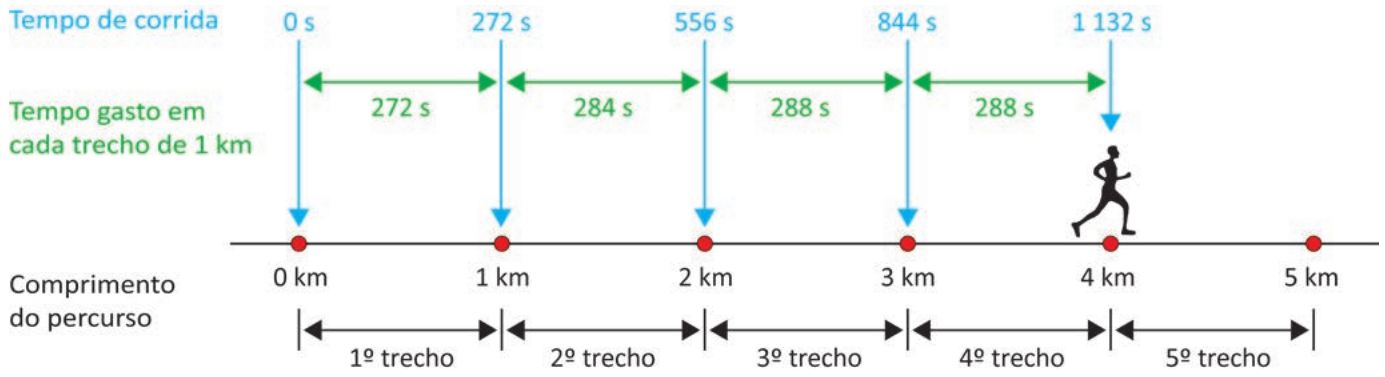
The best pace this runner achieved in 5 km races was 281 s/km.
So that you can repeat your best pace in races of 5 km in this race, his time, in the 5th section, must be how many seconds less than what he spent to travel the 4th section?
- A) 1
- B) 2
- C) 8
- D) 9
- E) 15
Resolution
1. Total time for a pace of 281 s/km in 5 km.
$$5 \cdot 281 = 1405 \text{ s}$$2. Time available for the 5th section. Up to km 4 he has already spent 1 132 s:
$$1405 - 1132 = 273 \text{ s}$$3. Comparison with the 4th snippet, which took 288 s:
$$288 - 273 = 15 \text{ s}$$Answer: alternative E (15).
Be careful with the catch: it is not enough to do the 5th section in 281 s. The pace is the average of the 5 sections; how the first 4 together took 1 132 s (8 s to more than $4 \cdot 281 = 1124$s), the latter needs to compensate for these 8s. What matters is the total time.
To review, see Position Measurements.
Question 159: Filling a container (tangent function)
Statement
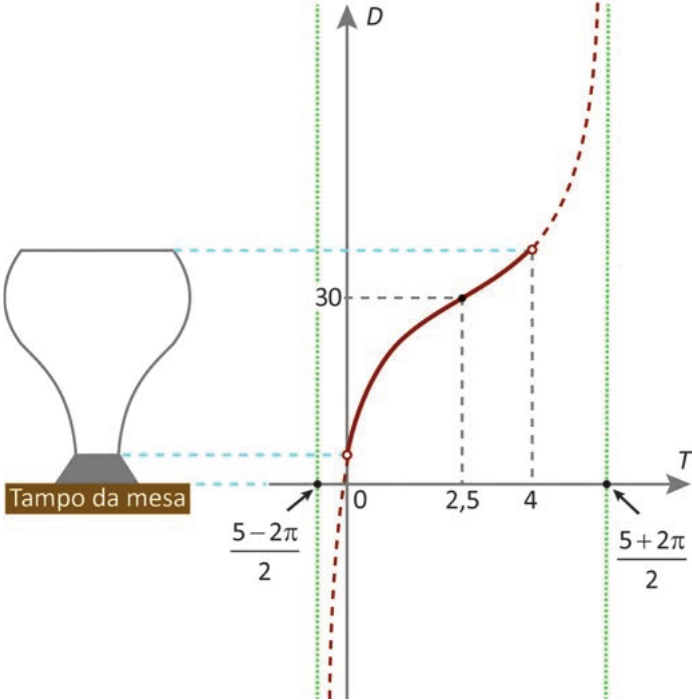
A container has a shape that means that, when filled with water at a constant flow, the distance $D$ from the water layer to the table top, in centimeter, increase in relation to time $T$, in minutes, according to a function of the type
$$D = k + \text{tg}[p(T + m)],$$the parameters $k$, $p$ and $m$ being real numbers, for $T$ varying between 0 and 4 minutes, as illustrated in the figure, in which asymptotes are presented vertical lines of the tangent function used in the definition of $D$.
The algebraic expression that represents the relationship between $D$ and $T$ is
- A) $D = 2{,}5 + \text{tg}\left[30\left(T - \dfrac{5 - 2\pi}{2}\right)\right]$
- B) $D = 4 + \text{tg}\left[30\left(T + \dfrac{5}{2}\right)\right]$
- C) $D = 4 + \text{tg}\left[2{,}5\left(T + \dfrac{5 + 2\pi}{2}\right)\right]$
- D) $D = 30 + \text{tg}\left[\dfrac{1}{2}(T - 5)\right]$
- E) $D = 30 + \text{tg}\left[\dfrac{1}{2}\left(T - \dfrac{5}{2}\right)\right]$
Resolution
The function $y = \text{tg}\,x$ has asymptotes at $x = -\frac{\pi}{2}$ and $x = \frac{\pi}{2}$, passes through $(0, 0)$ right in the middle of them and has period $\pi$. Each parameter of $D = k + \text{tg}[p(T + m)]$ changes one of these characteristics.
1. Period → $p$. The distance between two consecutive asymptotes is the period:
$$\frac{5 + 2\pi}{2} - \frac{5 - 2\pi}{2} = \frac{4\pi}{2} = 2\pi$$The period of $\text{tg}(pT)$ is $\frac{\pi}{p}$, then $\frac{\pi}{p} = 2\pi$, i.e. $p = \frac{1}{2}$.
2. Center point → $m$. The “center” of the curve (the inflection point, where the tangent value 0) is in the middle of the asymptotes:
$$T = \frac{1}{2}\left(\frac{5 - 2\pi}{2} + \frac{5 + 2\pi}{2}\right) = \frac{5}{2} = 2{,}5$$At that point, $T + m = 0$, then $m = -\frac{5}{2}$.
3. Value at center → $k$. At center point, $\text{tg}(0) = 0$ and $D = k$. The graph shows $D = 30$ to $T = 2{,}5$, then $k = 30$.
4. Putting it together.
$$D = 30 + \text{tg}\left[\frac{1}{2}\left(T - \frac{5}{2}\right)\right]$$Answer: alternative E.
Be careful with the catch: alternative D uses $(T - 5)$, placing the center in $T = 5$ instead of $T = 2{,}5$. It’s also easy to swap the roles of $k$ (vertical offset, 30) and $p$ (which controls the period), as in alternatives A and B.
Question 160: João’s house (orientation in a grid of blocks)
Statement
The gray squares in the figure represent the blocks of a part of the neighborhood where João and his friend live. The small square (A), painted in black and located in the upper left corner of a larger square, indicates the house of the friend of João. João also lives in a corner house, but at the end northeast of one block. To get to your friend’s house, when leaving home, João should walk around the block where he lives in the west direction, turn right, walk three blocks north and turn left. The house of your friend is on the second block west.
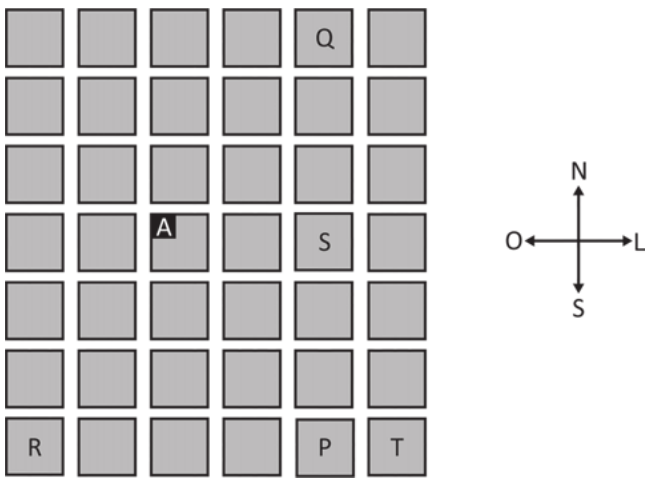
The block where João’s house is located is represented by the square with the letter
- A) P.
- B) Q.
- C) R.
- D) S.
- E) T.
Resolution
We will number the block columns from 1 to 6 (from west to east) and the lines from 1 to 7 (from north to south). The friend’s block (A) is on line 4, column 3, and the house is in its northwest corner.
Testing block P (row 7, column 5):
1. John leaves the northeast corner of P and walks west along the side of above P, reaching the northwest corner of P, on the street between columns 4 and 5.
2. Turn right (north) and walk three blocks: pass through lines 6, 5 and 4, reaching the street above the line 4.
3. Turn left (west): the 1st block it passes is in column 4 and the 2nd is in column 3, in line 4. At the end of this 2nd block is the corner northwest of block A: friend’s house. It worked out.
Checking the other options: leaving T (column 6), the same route ends a column further east (at the corner of column 4); leaving R (column 1), it would off the map when turning west; Q and S are north of or on the same line of A and, walking three blocks north, they do not reach the A line.
Answer: alternative A (P).
Be careful with the trick: the route is described from João’s house, but the known data is the friend’s house. It is safer to test each alternative following the instructions in order, counting the blocks carefully.
Question 161: Production with recycled plastic (percentage)
Statement
A company produced, in a given month, 110 tons of plastic from from petroleum derivatives and 80 tons from recycled plastics. The cost to recycle a ton of plastic is R$ 500,00, which is equivalent to 5% of cost to produce the same amount of plastic from animal by-products oil. For the following month, this company’s goal is to produce the same amount of plastic that was produced that month, but with a reduction of at least 50% in production cost.
In order for the company to reach its target in the following month, the minimum amount of tons of plastic that must be produced from recycling must be
- A) 135.
- B) 140.
- C) 155.
- D) 160.
- E) 175.
Resolution
1. Cost per ton from oil. R$ 500,00 is 5% of this cost:
$$0{,}05 \cdot c = 500 \quad\Rightarrow\quad c = 10\thinspace 000 \text{ reais por tonelada}$$2. This month’s cost.
$$110 \cdot 10\thinspace 000 + 80 \cdot 500 = 1\thinspace 100\thinspace 000 + 40\thinspace 000 = 1\thinspace 140\thinspace 000 \text{ reais}$$3. Goal. Produce the same $110 + 80 = 190$ tons costing at most half: R$ 570 000,00. If $r$ tons are recycled, the other $190 - r$ come from oil:
$$500r + 10\thinspace 000(190 - r) \le 570\thinspace 000$$$$1\thinspace 900\thinspace 000 - 9\thinspace 500r \le 570\thinspace 000$$$$9\thinspace 500r \ge 1\thinspace 330\thinspace 000 \quad\Rightarrow\quad r \ge 140$$Answer: alternative B (140).
Beware of the catch: “50% reduction in cost” is not “reducing 50% to production of petroleum plastic”. It is necessary to calculate the costs in reais.
To review, see Percentage Basics.
Question 162: Board with a maximum of one person per couple
Statement
Ten couples founded a dance group and decided to form a board of directors with three positions: president, secretary and treasurer. For greater representation, It was decided that a maximum of one person per couple could occupy a position in this board.
How many different boards can be formed by these 10 couples?
- A) $10 \times 9 \times 8$
- B) $20 \times 18 \times 16$
- C) $20 \times 19 \times 18$
- D) $10 \times 9 \times 8 \times 2$
- E) $20 \times 18 \times 16 \times 2$
Resolution
We chose the positions in order (the positions are different, so the order matters).
1. President: any of 20 people → 20 options.
2. Secretary: cannot be the president or his spouse → $20 - 2 = 18$ options.
3. Treasurer: it cannot be anyone from the two couples already used → $20 - 4 = 16$ options.
By the multiplicative principle:
$$20 \times 18 \times 16$$Answer: alternative B ($20 \times 18 \times 16$).
Be careful with the catch: alternative C ($20 \times 19 \times 18$) only prevents the same person from holding two positions, but allows a couple to hold two positions. Another way to get the right answer: choose the couples in order ($10 \times 9 \times 8$) and, in each one, which of the two assumes ($2^3 = 8$), which gives $10 \times 9 \times 8 \times 8 = 20 \times 18 \times 16$. Alternative D multiplies by 2 instead of $2^3$.
Question 163: Scale of the drawing in the sand
Statement
An artist, who usually makes drawings with sand on the beach, asked a bather to make a small drawing, which would serve as a sketch for a large work of art. art to be made in the sand. This design is represented in the figure.
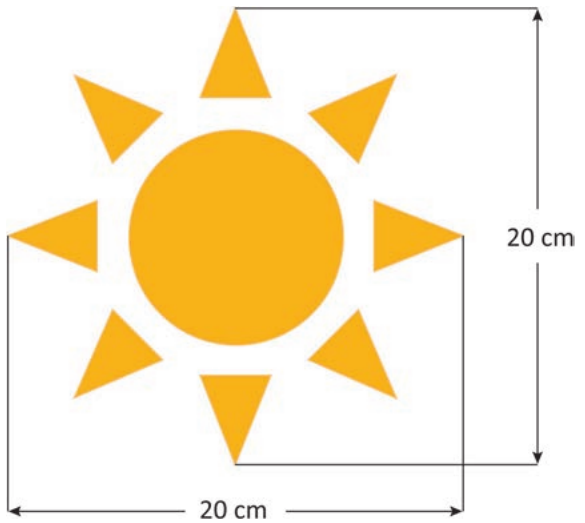
Upon completion, the work of art obtained maintained the same proportions as the drawing made by the bather, and the measurements indicated in the figure were expanded to 30 m.
At what scale does this drawing represent the work of art?
- A) 1 : 1,5
- B) 1 : 2,25
- C) 1 : 10
- D) 1 : 100
- E) 1 : 150
Resolution
The scale is (measured in the drawing): (actual measurement), in the same unit.
1. Same unit. $30 \text{ m} = 3000 \text{ cm}$.
2. Reason.
$$\frac{20 \text{ cm}}{3000 \text{ cm}} = \frac{1}{150}$$Answer: alternative E (1 : 150).
Be careful with the catch: alternative A (1 : 1,5) comes from dividing 30 by 20 without converting meters to centimeters. And B (1 : 2,25) is the square of that, confusing with area ratio.
To review, see Proportions and Geometry.
Question 164: Cortisol on working and non-working days (reason)
Statement
Cortisol is a hormone produced by the adrenal glands and can be considered an important marker of physiological stress. In a study developed with nurses, it was found that the concentration of cortisol saliva in a working day, denoted by $T$, was, on average, 1,59 times the salivary cortisol concentration on a day off, denoted by $F$.
ROCHA, M. C. P. et al. Stress in nurses: the use of salivary cortisol on working and non-working days. Rev. Nursing Esc. USP, n. 5, 2013 (adapted).
In this study, the relationship obtained between $T$ and $F$ was
- A) $T = 1{,}59 + F$
- B) $F = 1{,}59 + T$
- C) $\dfrac{T}{F} = 1{,}59$
- D) $\dfrac{F}{T} = 1{,}59$
- E) $F \cdot T = 1{,}59$
Resolution
“$T$ was 1,59 times $F$” is written as a multiplication:
$$T = 1{,}59 \cdot F$$Dividing both sides by $F$:
$$\frac{T}{F} = 1{,}59$$Answer: alternative C ($\frac{T}{F} = 1{,}59$).
Be careful with the catch: “times” indicates multiplication, not sum (alternative A). And the order matters: $\frac{F}{T} = 1{,}59$ (alternative D) I would say that time off is where there is more cortisol.
To review, see Proportions.
Question 165: Monthly parking fee
Statement
A parking lot has 120 spaces for vehicles, and all of these spaces are busy. Each customer pays a monthly fee to use a space, which is calculated based on monthly parking expenses and intended profit. The monthly parking expenses are: R$ 14 240,00 with maintenance plus R$ 36,00 of insurance per vehicle. Parking profit is determined by difference in the amount collected from monthly fees for the expenses incurred. A Starting from the following month, the amount of insurance per vehicle will increase by 20%, and the maintenance expenses will remain unchanged. As a result, the owner of the parking will readjust the monthly fees to obtain a monthly profit of R$ 10 000,00. Despite this adjustment, all vacancies will remain occupied.
The value, in reais, of the adjusted monthly fee will be
- A) 185,60.
- B) 226,09.
- C) 245,20.
- D) 268,93.
- E) 285,60.
Resolution
1. New insurance per vehicle. 20% increase:
$$36 \cdot 1{,}20 = 43{,}20 \text{ reais}$$2. New monthly expenses.
$$14\thinspace 240 + 120 \cdot 43{,}20 = 14\thinspace 240 + 5\thinspace 184 = 19\thinspace 424 \text{ reais}$$3. Necessary collection. Profit = collection − expenses, so:
$$\text{arrecadação} = 19\thinspace 424 + 10\thinspace 000 = 29\thinspace 424 \text{ reais}$$4. Monthly fee. Divided between 120 vacancies:
$$\frac{29\thinspace 424}{120} = 245{,}20 \text{ reais}$$Answer: alternative C (R$ 245,20).
Be careful with the catch: apply the 20% increase to the entire expense, and not just insurance, or forgetting to multiply the insurance by 120 vehicles, leads to different values. Maintenance is a fixed fee for the entire parking lot.
To review, see Increases and Discounts.