
Euler's Eyes
2026-10-13
From words to letters: algebra learns to write
In Baghdad, around the year 820, Muhammad ibn Musa al-Khwarizmi worked at the House of Wisdom, the great library of the caliph al-Ma’mun. There he wrote a book with a long title, The Compendious Book on Calculation by Restoration and Balancing. “Restoration”, in Arabic, is al-jabr. From that word came algebra.
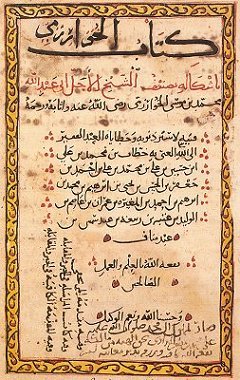
The whole book contains not a single symbol. No $x$, no $+$, no $=$. Even the numbers are written out in words. One of the most famous problems is this:
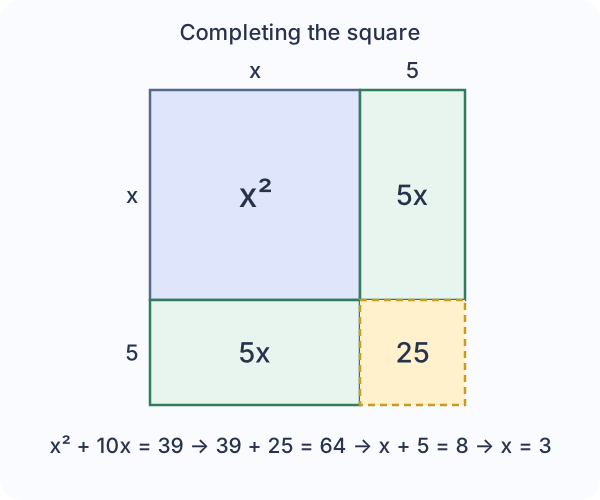
A square and ten roots of the same equal thirty-nine dirhams. Take half the roots, which is five; multiply it by itself, which gives twenty-five; add it to thirty-nine, which gives sixty-four. Take the root of that, which is eight, and subtract half the roots, which is five. Three remains: it is the root of the square you were looking for.
— al-Khwarizmi, c. 820 (paraphrase)
Today we would write the problem as $x^2+10x=39$ and the answer as $x=3$. Al-Khwarizmi’s recipe is exactly what we call completing the square, and he justified it with a figure: a square of side $x$, two $5\times x$ rectangles placed against it, and a small $5\times5$ square missing to close up a larger square of side $x+5$ and area $39+25=64$.
This way of writing is called rhetorical algebra: everything in sentences. It works, but it has a price. Each problem is told as a little story with specific numbers, and the reader has to notice alone that the same recipe works for other numbers. The general rule is hidden inside the example.
Abbreviating: syncopated algebra
Much earlier, in Alexandria, in the third century, Diophantus had taken a step in another direction. In his Arithmetica he used a letter resembling $\varsigma$ for the unknown number, $\Delta^{\Upsilon}$ (from dýnamis, power) for its square and $K^{\Upsilon}$ (from kýbos, cube) for its cube. To subtract he used a sign that looks like an upside-down arrowhead. An expression such as $x^3-2x^2+10x-1$ looked roughly like this:
$$K^{\Upsilon}\,\overline{\alpha}\;\varsigma\,\overline{\iota}\;\pitchfork\;\Delta^{\Upsilon}\,\overline{\beta}\;M\,\overline{\alpha}$$(Greek numbers were written as letters with a bar on top: $\overline{\alpha}=1$, $\overline{\beta}=2$, $\overline{\iota}=10$; and $M$ marked the units). This halfway writing, with abbreviations but without a full grammar of symbols, is called syncopated algebra. Diophantus had only one name for an unknown, so every problem with two unknowns needed a trick to turn it into a problem with one.
Viète: letters for what is unknown and for what is known
The great turn came in France in 1591. François Viète, a lawyer and royal counsellor who in his spare time deciphered the coded letters of the Spanish, published the Introduction to the Analytic Art. His idea looks small: use vowels ($A$, $E$, …) for unknown quantities and consonants ($B$, $C$, $D$, …) for quantities that are known, but arbitrary.
The second half is the revolutionary one. Al-Khwarizmi solved “a square and ten roots equal thirty-nine”. Viète could write something like “$A$ squared plus $B$ times $A$ equals $Z$ plane” and solve all equations of that kind at once. The letter $B$ is not an unknown number waiting to be found: it is any number, and the answer is written in terms of it. For the first time the recipe itself became an object that could be written down, looked at and transformed. Viète called this logistica speciosa, calculation with species (forms), as opposed to logistica numerosa, calculation with numbers.
Descartes: today’s alphabet
In 1637 René Descartes published La Géométrie as an appendix to the Discourse on Method. There we find the conventions we still use: the last letters of the alphabet ($x$, $y$, $z$) for unknowns and the first ones ($a$, $b$, $c$) for known quantities, plus numerical exponents for powers: $x^3$, $x^4$. Curiously, he still preferred to write $xx$ rather than $x^2$, which took up no more space, and for equality he used a sign of his own, similar to $\propto$, not $=$.
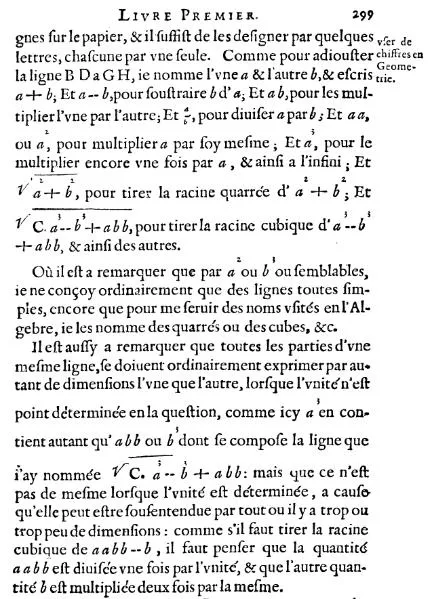
With this, the expression $ax^2+bx+c=0$ is no longer a sentence about particular numbers and comes to represent a whole family of equations. You can factorise, complete the square and arrive at the formula that solves them all at once:
$$x=\frac{-b\pm\sqrt{b^2-4ac}}{2a}.$$Compare this line with al-Khwarizmi’s page. The content is the same procedure; the writing is different, and with it came questions that could not even be asked before, such as “what happens when $b^2-4ac$ is negative?”.
Four scripts, one equation
| Period | Writing | Kind |
|---|---|---|
| al-Khwarizmi, c. 820 | “a square and ten roots equal thirty-nine” | rhetorical |
| Diophantus, 3rd c. | $\Delta^{\Upsilon}\,\overline{\alpha}\;\varsigma\,\overline{\iota}$ … $M\,\overline{\lambda\theta}$ | syncopated |
| Viète, 1591 | $A$ squared $+$ $B$ in $A$ equals $Z$ plane | symbolic, with words |
| Descartes, 1637 | $xx+10x\;\propto\;39$ (Descartes’s equals was a different sign) | symbolic |
The passage was not a triumphal march in a straight line. The forms lived side by side for centuries, and many good people solved hard problems in words. But each step in this table made visible something that had stayed in the head of whoever was calculating: first the unknown, then the general data, then the whole structure of the equation.
Exercise: solve it like al-Khwarizmi
“A square and six roots equal sixteen.” Half the roots: $3$. Times itself: $9$. Add to sixteen: $25$. Root: $5$. Minus half the roots: $5-3=2$. The root you want is $2$.
In symbols: $x^2+6x=16 \iff x^2+6x+9=25 \iff (x+3)^2=25$. Since $x+3$ is a length, $x+3=5$ and $x=2$. Symbolic algebra reveals a second solution, $x+3=-5$, that is, $x=-8$, which al-Khwarizmi did not consider, because for him a root was a side.
Exercise: from sentence to equation
“A quantity, added to its half, gives five.” Calling the quantity $x$:
$$x+\frac{x}{2}=5 \iff \frac{3x}{2}=5 \iff x=\frac{10}{3}.$$Check: $\frac{10}{3}+\frac{5}{3}=\frac{15}{3}=5$. We will come back to this equation in chapter 2 and read it sign by sign.
Chapter index · ← Sine, leg and hypotenuse: trigonometry and its lost names · +, −, × and =: a short history of the signs →