Euler's Eyes
2026-10-27
The legacy of William Rowan Hamilton
The Hamiltonian principle has become the cornerstone of modern physics, the thing with which a physicist expects every physical phenomenon to be in conformity.
— Erwin Schrödinger (1943)
Hamilton believed quaternions would be his great work, the language of the physics of the future. He was wrong in the detail and right in the essentials. Physics adopted Gibbs’s and Heaviside’s vectors, but Hamilton’s mechanics, which he thought less important, became the basis of almost everything that came after.
In physics
- Quantum mechanics. In the Schrödinger equation, the energy of a system is an operator, the Hamiltonian $\hat H$. Computing the energy levels of an atom means finding the eigenvalues of its Hamiltonian.
- Statistical mechanics and chaos. Hamilton’s phase space, where each state is a point, is the stage for statistical thermodynamics and chaos theory. Liouville’s theorem, that volume in phase space is conserved, is a direct consequence of Hamilton’s equations.
- Optics. The characteristic function is still used in designing optical systems, and conical refraction has been studied again in the twenty-first century, with lasers.
In mathematics and computing
- Algebra. By giving up commutativity, Hamilton opened the door to abstract algebras: matrices, octonions, Lie algebras, Clifford algebras. The idea that one may invent an algebra with whatever rules a problem demands is, in good part, his.
- Graphics and navigation. Quaternions turn video-game characters, film cameras, robot arms, space telescopes and the phone in your pocket.
- Graphs. The Hamiltonian cycle is one of the central problems of complexity theory.
In Dublin
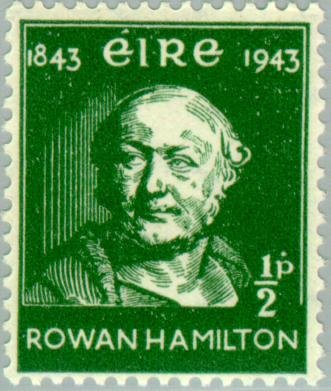
In 1943, for the centenary of the bridge, Ireland issued two stamps with Hamilton’s face, and the head of government, Éamon de Valera, who had been a mathematics teacher, promoted the celebrations. Schrödinger, then living in Dublin at the Institute for Advanced Studies founded by De Valera, gave lectures on Hamilton’s work. In 1958 the plaque that replaces the lost carving was placed on Broom Bridge. And since 1990, every 16 October, mathematicians make the Hamilton Walk, from Dunsink Observatory to the bridge, retracing the route of 1843. Nobel-winning physicists such as Murray Gell-Mann and Steven Weinberg, and the mathematician Andrew Wiles, have walked it.
What to say of him
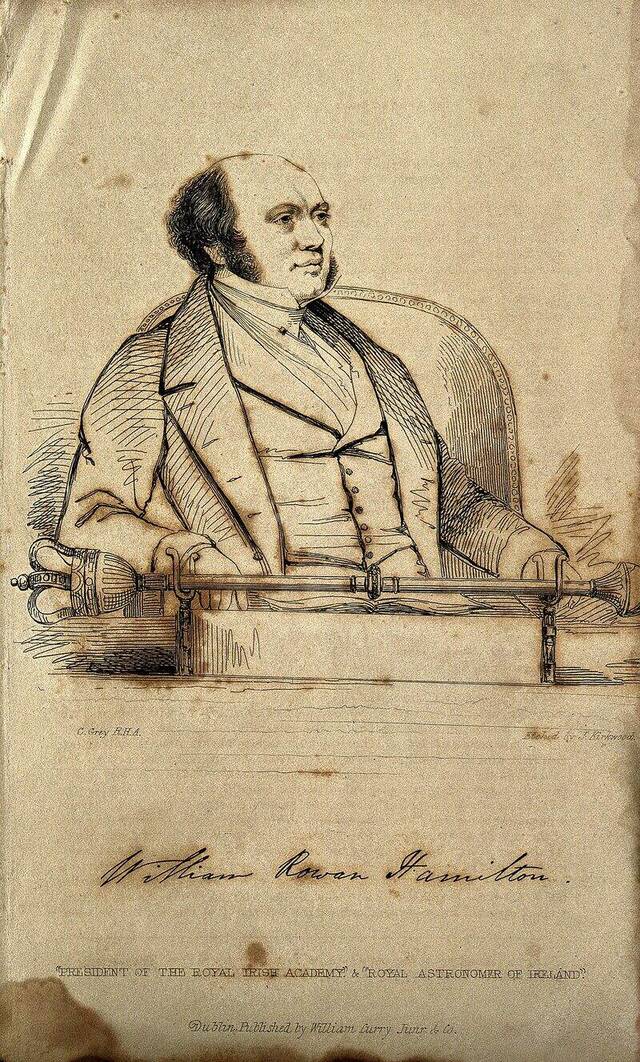
Hamilton was a prodigy who did not burn out: at 21 he already had an original theory, and at 38 he found his greatest discovery on a walk. He was also a man with a difficult personal life, who drank too much and worked amid disorder. But the lesson he left is one of freedom: the rules of arithmetic are not sacred. When a problem calls for a new algebra, one may invent it, as long as it is consistent. It was with that freedom that twentieth-century mathematics built its structures.
Exercise: quaternion or matrix?
A rotation can be stored as a $3 \times 3$ matrix or as a unit quaternion. How many multiplications of numbers are needed to compose two rotations in each case?
In the product of two $3 \times 3$ matrices, each of the 9 entries is a sum of 3 products: $27$ multiplications. In the product of two quaternions, each of the 4 parts is a sum of 4 products: $16$ multiplications. Besides, the quaternion stores 4 numbers instead of 9, and rounding errors are easy to correct: just divide it by its size.
Exercise: the law of the moduli at work
Multiply $p = 1 + i + j$ by $q = 1 + 2i$ and check that $\lvert pq \rvert^2 = \lvert p \rvert^2 \lvert q \rvert^2$.
$pq = 1 + 2i + i + 2i^2 + j + 2ji = 1 + 3i - 2 + j - 2k = -1 + 3i + j - 2k$. So $\lvert pq \rvert^2 = 1 + 9 + 1 + 4 = 15$, and $\lvert p \rvert^2 \lvert q \rvert^2 = 3 \times 5 = 15$. The $15$, which is not a sum of three squares, appears here as a sum of four: that is why Hamilton needed the fourth dimension.
Sources: Thomas L. Hankins, Sir William Rowan Hamilton (1980) · Erwin Schrödinger, “The Hamilton Postage Stamp: An Announcement” (1943), in A Collection of Papers in Memory of Sir William Rowan Hamilton (1945) · the Hamilton Walk, Maynooth University · Hamilton’s biography, MacTutor.
All topics on William Rowan Hamilton · ← The Icosian game and Hamiltonian cycles · Image credits →